| Elbaite |
|
|
Fluorescent light (daylight)
|
|
|
|
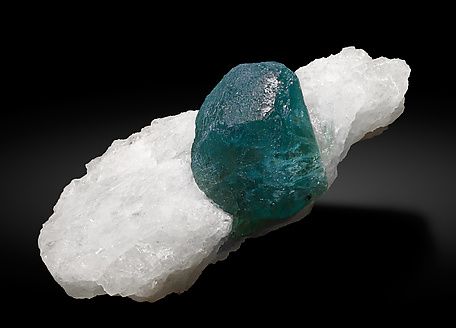
TH86AN2: Elbaite crystal with very sharp crystal forms and excellent upper terminations. Transparent, very lustrous, and very uniform green with bluish tones.
Rubaya, Bahunde, Masisi Territory, North Kivu Province (Kivu) Democratic Republic of the Congo (Zaire) (2020)
Specimen size: 6.2 × 1.2 × 1 cm = 2.44” × 0.47” × 0.39”
Weight: 12.2 grams
|
|
|
|
Elbaite |
|---|
Fluorescent light (daylight)
|
|
|
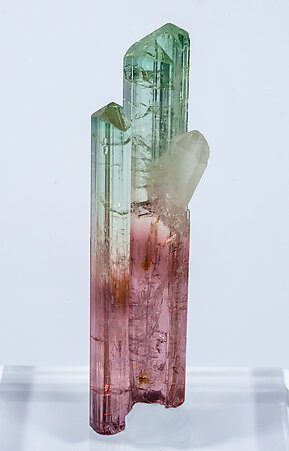
TVA96AN2: Parallel growth of two Elbaite crystals with very sharp crystal forms, good upper terminations and a related Quartz crystal. The crystal faces are very sharp, transparent and lustrous and with the base of the prism of an intense red wine color with gradations in the color tones, and with the termination exhibiting an uniform green color.
Rubaya, Bahunde, Masisi Territory, North Kivu Province (Kivu) Democratic Republic of the Congo (Zaire) (2020)
Specimen size: 6.3 × 1.8 × 1.1 cm = 2.48” × 0.71” × 0.43”
Main crystal size: 5.9 × 1 cm = 2.32” × 0.39”
Weight: 17.5 grams
|
| 
Front | 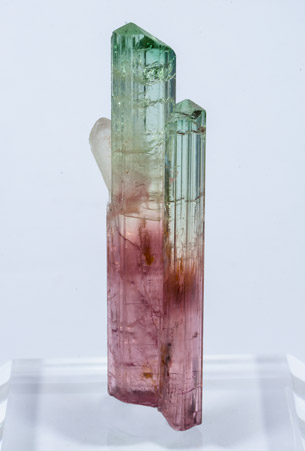
Rear |
| |
|
|
| Chrysocolla with Quartz and Malachite |
|
|
Fluorescent light (daylight)
|
|
|
|
EAB92AN4: Elongated botryoidal growths of Chrysocolla, with an intense and uniform bluish color, totally covered by a surface of Quartz microcrystals. They are on a matrix with Quartz crystals that cover Malachite microcrystals with a very deep and uniform green-bluish color. A particularly elegant specimen.
Tenke deposit, Tenke-Fungurume area, Kolwezi District, Lualaba, Katanga Copper Crescent, Katanga (Shaba) Democratic Republic of the Congo (Zaire) (2021)
Specimen size: 7.2 × 6.8 × 4.2 cm = 2.83” × 2.68” × 1.65”
|
|
|
|
Baryte |
|---|
|
|
ND92AK9: Tabular Baryte floater crystal with parallel growths, transparent, with very marked geometric growths, very lustrous and with an intense toasted honey color.
An excellent specimen that comes from the Carlos Prieto Paramio collection, whose label we will send to the buyer.
Mashamba West Mine, Kolwezi District, Lualaba, Katanga Copper Crescent, Katanga (Shaba) Democratic Republic of the Congo (Zaire) (±1990)
Specimen size: 6.5 × 5.8 × 1 cm = 2.56” × 2.28” × 0.39”
Former collection of Carlos Prieto Paramio
|
| |
|
| Cuprite with Calcite and Chrysocolla |
|
 |
|
|
|
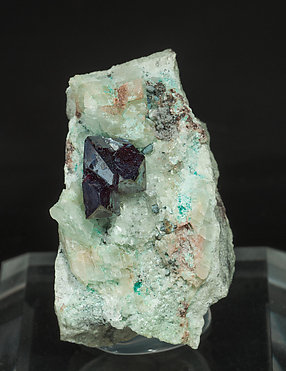
EB56Y6: Group, of very sharp octahedral Cuprite crystals that are extraordinarily bright and have a deep red color. On matrix with Calcite and Chrysocolla.
Mashamba West Mine, Kolwezi District, Lualaba, Katanga Copper Crescent, Katanga (Shaba) Democratic Republic of the Congo (Zaire)
Specimen size: 3.2 × 2.2 × 2.4 cm = 1.26” × 0.87” × 0.94”
Main crystal size: 0.7 × 0.7 cm = 0.28” × 0.28”
|
|
|
|
Cuprite with Chrysocolla |
|---|
|
|
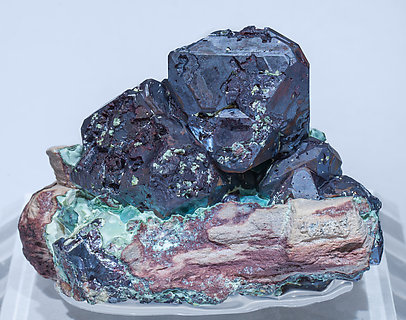
TC90AJ8: Group of crystals formed by the octahedron and the dodecahedron, partially flattened and deformed, translucent with a very deep red color, and on matrix with Malachite.
The sample is from the Edward L. Loye collection whose label we will send to the buyer.
Mashamba West Mine, Kolwezi District, Lualaba, Katanga Copper Crescent, Katanga (Shaba) Democratic Republic of the Congo (Zaire)
Specimen size: 5.5 × 4.1 × 3.3 cm = 2.17” × 1.61” × 1.30”
Main crystal size: 2.2 × 2.2 cm = 0.87” × 0.87”
Former collection of Edward R Loye
|
| 
Front | 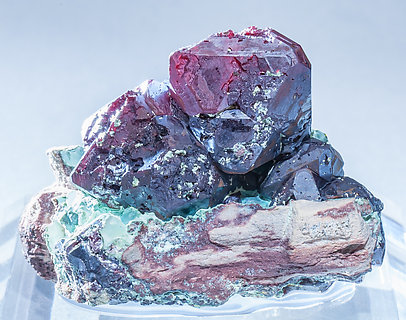
Light behind |
| |
|
|
| Cuprite with Calcite |
|
|
|
|
|
TB17E6: These crystals of Cuprite have a very metallic luster, but are not that red. That said, the definition and form are, in my opinion, good, so overall it is a neat specimen.
Mashamba West Mine, Kolwezi District, Lualaba, Katanga Copper Crescent, Katanga (Shaba) Democratic Republic of the Congo (Zaire)
Specimen size: 5.5 × 4.6 × 3.3 cm = 2.17” × 1.81” × 1.30”
Main crystal size: 1 × 0.6 cm = 0.39” × 0.24”
Calcite extremely fluorescent long & short UV
|
|
|
|
Dolomite (variety cobaltoan) with Heterogenite |
|---|
|
|
ET87AL7: Druse of rhombohedral Dolomite crystals with the so-called “saddle” habit and different shades of mauve, intense and lively and with Heterogenite coatings.
Mashamba West Mine, Kolwezi District, Lualaba, Katanga Copper Crescent, Katanga (Shaba) Democratic Republic of the Congo (Zaire)
Specimen size: 10.6 × 6.2 × 2.2 cm = 4.17” × 2.44” × 0.87”
Main crystal size: 1.1 × 0.5 cm = 0.43” × 0.20”
|
| |
|
| Cobaltoan Calcite |
|
|
|
|
|
EP16K3: Group of lenticular crystals with an especially intense color and luster. The base of the specimen is sawn but it doesn’t diminish the esthetic value of the specimen.
Mashamba West Mine, Kolwezi District, Lualaba, Katanga Copper Crescent, Katanga (Shaba) Democratic Republic of the Congo (Zaire)
Specimen size: 6.7 × 5.2 × 2.6 cm = 2.64” × 2.05” × 1.02”
Main crystal size: 0.4 × 0.3 cm = 0.16” × 0.12”
|
|
|
|
Malachite |
|---|
|
|
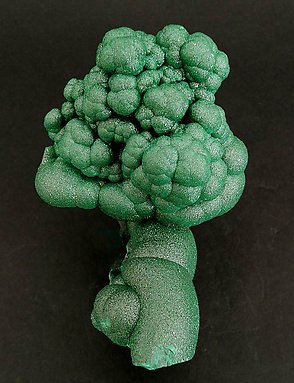
JJ86F4: A kidney-like, very esthetic, intensely colored form that has a brilliant but satiny surface.
This one was shown in number 336 (January-February 2005) on the magazine ‘Minéraux et Fossiles’. We will send the purchaser a copy of the magazine.
Kolwezi District, Lualaba, Katanga Copper Crescent, Katanga (Shaba) Democratic Republic of the Congo (Zaire)
Specimen size: 7 × 5.6 × 9.3 cm = 2.76” × 2.20” × 3.66”
|
| 
Front | 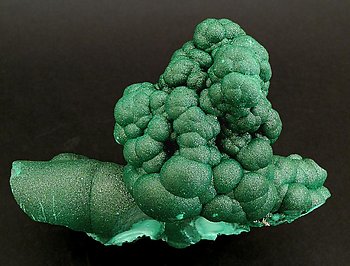
Side | |
|
|
| Malachite |
|
|
|
|
|
TP57AE5: Stalactitic Malachite growths, on matrix, elongated and with spheroidal thickenings on the terminations. They are bright with an excellent color, very deep and uniform.
Kolwezi District, Lualaba, Katanga Copper Crescent, Katanga (Shaba) Democratic Republic of the Congo (Zaire)
Specimen size: 7.3 × 7.3 × 5.6 cm = 2.87” × 2.87” × 2.20”
|
|
|
|
Malachite with Heterogenite |
|---|
|
|
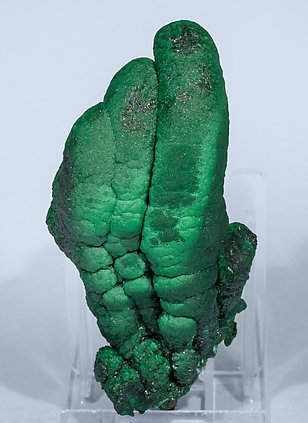
MF77AH7: Very aerial and fine triple stalactitic-botryoidal Malachite growth with small Heterogenite crystallizations near the base, bright and with a black color. We analyzed the Heterogenite and will send a copy of the analysis to the buyer.
Katanga (Shaba) Democratic Republic of the Congo (Zaire)
Specimen size: 7.4 × 4.3 × 2.4 cm = 2.91” × 1.69” × 0.94”
Former collection of Carles Manresa
|
| 
Front | 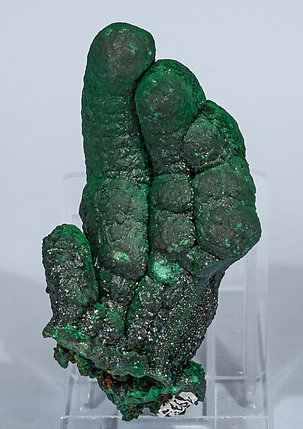
Rear |
| |
|
|
| Malachite with Chrysocolla |
|
|
|
|
|
TB48AN1: Aggregates of small, extraordinarily lustrous acicular Malachite crystals with an intense and deep green color, which have grown in cavities bordered by parallel growths of Chrysocolla.
L'Etoile du Congo Mine (Star of the Congo Mine), Lubumbashi (Elizabethville), Katanga Copper Crescent, Haut-Katanga (Shaba) Democratic Republic of the Congo (Zaire)
Specimen size: 8.8 × 6.2 × 5.8 cm = 3.46” × 2.44” × 2.28”
|
|
|
|
Plancheite |
|---|
|
|
EF87Z9: Botryoidal growths with surfaces that have a felted aspect. They are on matrix and have very fine hair-like crystals with an intense sky-blue color. The sample has an excellent quality for the species.
Tantara Mine, Shinkolobwe, Katanga Copper Crescent, Katanga (Shaba) Democratic Republic of the Congo (Zaire)
Specimen size: 6 × 5.2 × 2.2 cm = 2.36” × 2.05” × 0.87”
Main crystal size: 0.4 × 0.1 cm = 0.16” × 0.04”
|
| |
|
| Plancheite |
|
|
|
|
|
TA86AK4: Aggregates centered on matrix, of fine acicular crystals of Plancheite, with a satiny luster and uniform light blue color. A Musonoi classic.
Musonoi Mine, Kolwezi, Kolwezi District, Lualaba, Katanga Copper Crescent, Katanga (Shaba) Democratic Republic of the Congo (Zaire) (06-08/2010)
Specimen size: 6.4 × 4.4 × 4.6 cm = 2.52” × 1.73” × 1.81”
|
|
|
|
Calcite (variety cobaltoan Calcite) |
|---|
|
|
MA6AG7: Aggregate, on matrix, of crystals that are very rich in faces with a predominant rhombohedron, between transparent and translucent, very bright and with an extraordinary color due to its liveliness and depth.
Kakanda, Kambove District, Katanga Copper Crescent, Katanga (Shaba) Democratic Republic of the Congo (Zaire)
Specimen size: 7.2 × 6.5 × 4.7 cm = 2.83” × 2.56” × 1.85”
Main crystal size: 0.3 × 0.3 cm = 0.12” × 0.12”
|
| |
|
| Chrysocolla |
|
|
|
|
|
TC48AK9: Botryoidal Chrysocolla on matrix, with very aerial shapes and a sharper profile than usual and with a very clear and uniform greenish blue color. A Congo classic.
Kambove District, Katanga Copper Crescent, Katanga (Shaba) Democratic Republic of the Congo (Zaire)
Specimen size: 5.4 × 3.2 × 3.4 cm = 2.13” × 1.26” × 1.34”
|
|
|
|
Baryte with Malachite |
|---|
|
|
TR99AI0: Cluster of parallel groups of doubly terminated Baryte crystals with a greenish color due to Malachite inclusions. On limonite matrix. The sample is among the best found at the locality, famous because it offers the best well-known Baryte with Malachite inclusions.
Shangulowé Mine, Kambove District, Katanga Copper Crescent, Katanga (Shaba) Democratic Republic of the Congo (Zaire)
Specimen size: 6.9 × 6.2 × 3.7 cm = 2.72” × 2.44” × 1.46”
Main crystal size: 5 × 1.3 cm = 1.97” × 0.51”
|
| |
|
| Baryte with Malachite and inclusions of Malachite |
|
Front | 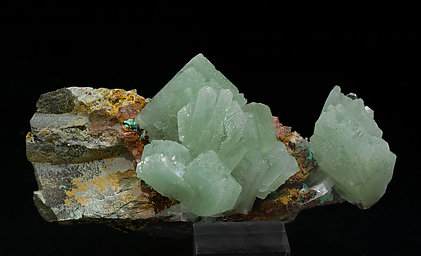
Side |
| |
|
|
|
|
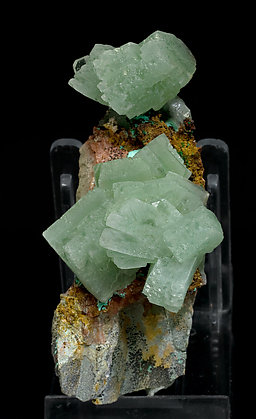
EF10W7: Very aerial groups of thick tabular crystals of Baryte. They are translucent, bright and have a clear green color due to Malachite inclusions. They are on matrix, with small coatings of globular clear green Malachite. Due to its esthetics and perfection it is one of the best examples of this Baryte with Malachite we have seen.
Shangulowé Mine, Kambove District, Katanga Copper Crescent, Katanga (Shaba) Democratic Republic of the Congo (Zaire) (11/1997)
Specimen size: 8.4 × 3.7 × 5.6 cm = 3.31” × 1.46” × 2.20”
Main crystal size: 2.1 × 1.5 cm = 0.83” × 0.59”
Fluorescent short UV
|
|
|
|
Malachite after Baryte |
|---|
|
|
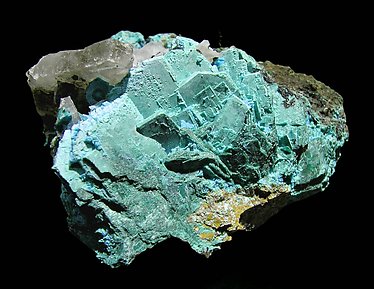
E59AH5: Growth of two generations of Baryte crystals. The first in laminar crystals has been completely replaced by Malachite. The second one formed gray tabular crystals. Very original.
Shangulowé Mine, Kambove District, Katanga Copper Crescent, Katanga (Shaba) Democratic Republic of the Congo (Zaire) (11/1997)
Specimen size: 5 × 3.5 × 4.2 cm = 1.97” × 1.38” × 1.65”
|
| 
Front | 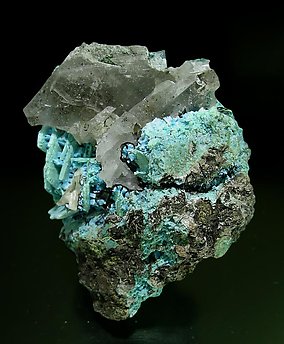
Top |
| |
|
|
| Malachite |
|
 |
|
|
|
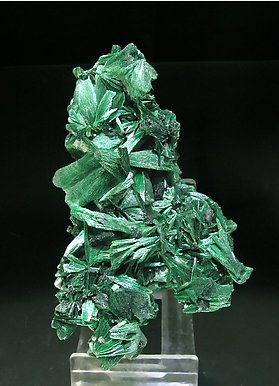
TN66L1: Nice specimen with unusual fan-shaped growths formed by acicular Malachite crystals, with velvet aspect brilliance. From a Shaba locality not yet well known by mineral collectors.
Mindingi Mine (Mindigi Mine), Swambo, Kambove District, Katanga Copper Crescent, Katanga (Shaba) Democratic Republic of the Congo (Zaire) (2007)
Specimen size: 9.5 × 5.9 × 4.7 cm = 3.74” × 2.32” × 1.85”
Main crystal size: 1.8 × 0.1 cm = 0.71” × 0.04”
|
|
|
|
Cornetite |
|---|
|
|
EA14Y6: Flattened radial aggregates of fine prismatic crystals showing a very deep blue color and a very good luster. They are on a rocky matrix with green surficial staining of an unidentified secondary mineral of copper. A classic of the mineralogy from the type locality for the species.
L'Etoile du Congo Mine (Star of the Congo Mine), Lubumbashi (Elizabethville), Katanga Copper Crescent, Haut-Katanga (Shaba) Democratic Republic of the Congo (Zaire)
Specimen size: 5.1 × 3.1 × 0.9 cm = 2.01” × 1.22” × 0.35”
Type locality
|
| |
|
| Cornetite with Malachite |
|
|
|
|
|
E16EDH5: Crystals are very bright and appear in radial groups. Some of these groups are deep uniform marine blue, some others have a clearer blue in zones near the center and are deeper on the edges. We call attention on the contrast with the deep green color of the Malachite base.
L'Etoile du Congo Mine (Star of the Congo Mine), Lubumbashi (Elizabethville), Katanga Copper Crescent, Haut-Katanga (Shaba) Democratic Republic of the Congo (Zaire)
Specimen size: 8.9 × 6.3 × 3 cm = 3.50” × 2.48” × 1.18”
Main crystal size: 0.6 × 0.5 cm = 0.24” × 0.20”
|
|
|
|
Dioptase |
|---|
|
|
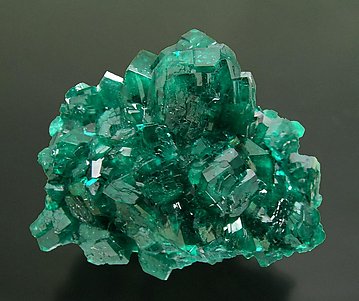
MC67I0: Color and luster are magnificent. The group is formed by a lot of crystals with very well defined faces and edges and absolutely free of damage. The specimen, really esthetic, is from a recent find at a classic mine.
Tantara Mine, 20 m.↓, Shinkolobwe, Katanga (Shaba) Morocco (2006)
Specimen size: 3.8 × 3.1 × 2.2 cm = 1.50” × 1.22” × 0.87”
Main crystal size: 1.2 × 1 cm = 0.47” × 0.39”
|
|  |
|
| Dioptase |
|
|
|
|
|
TX16H7: The main crystal, rising on a surface of smaller crystals, can be considered as a giant. Its faces and edges are perfectly defined, bright and partially pseudomorphed by another (undetermined) copper mineral. The matrix is a very rich blue mineral described as Chrysocolla on the label but it must be Plancheite. Please note that although the original labels state that the locality is "near Gouloukoutou River", we have labeled it as Tantara because we believe that this is the right locality.
The sample is with two old labels, of Burminco (George Burnham) and from D.E. Boydston collection.
Tantara Mine, Shinkolobwe, Katanga Copper Crescent, Katanga (Shaba) Democratic Republic of the Congo (Zaire)
Specimen size: 4.9 × 4 × 3.2 cm = 1.93” × 1.57” × 1.26”
Main crystal size: 2.8 × 1.7 cm = 1.10” × 0.67”
|
|
|
|
Dioptase with Shattuckite |
|---|
|
|
NR56P8: Botryoidal and spherical growths of small acicular crystals of Shattuckite with a single Dioptase crystal that has an excellent color and luster and very well defined faces and edges.
Tantara Mine, Shinkolobwe, Katanga Copper Crescent, Katanga (Shaba) Democratic Republic of the Congo (Zaire)
Specimen size: 6 × 4.9 × 3.2 cm = 2.36” × 1.93” × 1.26”
Main crystal size: 0.7 × 0.5 cm = 0.28” × 0.20”
|
| |
|
| Dioptase with Shattuckite |
|
|
|
|
|
ME89AK9: Druze of rhombohedral Dioptase crystals, translucent, very bright and intense in color. With bluish coatings of Shattuckite and an aggregate of flat Malachite crystals.
Tantara Mine, Shinkolobwe, Katanga Copper Crescent, Katanga (Shaba) Democratic Republic of the Congo (Zaire) (2006)
Specimen size: 7.8 × 4.9 × 2.6 cm = 3.07” × 1.93” × 1.02”
Main crystal size: 0.7 × 0.7 cm = 0.28” × 0.28”
|
|
|
|
Dioptase with Bayldonite |
|---|
|
|
TP91Y3: Dioptase crystals of a considerable size, on matrix, with very well defined faces and edges and partially coated by small botryoidal growths of yellowish-green Bayldonite.
Tantara Mine, Shinkolobwe, Katanga Copper Crescent, Katanga (Shaba) Democratic Republic of the Congo (Zaire)
Specimen size: 9.5 × 7.7 × 5.7 cm = 3.74” × 3.03” × 2.24”
Main crystal size: 2.1 × 1.2 cm = 0.83” × 0.47”
|
| |
|
| Malachite after Dioptase after Calcite |
|
|
|
|
|
EG48AE5: An unusual Malachite aggregate on the scalenohedral shape of former Calcite crystals that had first been pseudomorph by Dioptase, which is residually retained on some areas on the sample.
Tantara Mine area, Shinkolobwe, Katanga Copper Crescent, Katanga (Shaba) Democratic Republic of the Congo (Zaire)
Specimen size: 4.7 × 3.5 × 2.5 cm = 1.85” × 1.38” × 0.98”
Main crystal size: 2 × 1.1 cm = 0.79” × 0.43”
|
|
|
|
Azurite with Malachite |
|---|
|
|
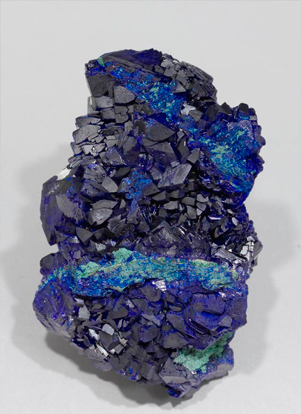
MZ14W9: A novelty at Munich 2012. Group of Azurite crystals with very well defined faces and edges. They have a very deep color with vivid clearer reflections and are partially coated by Malachite. The sample is an indication of what this mine can, perhaps, offer in the future.
This specimen has been photographed and published as a reference for the Azurite species in the magazine ‘Lapis‘ number 12/2022, page 15
Kimbwe Pit (Kinsevere Mine), Lubumbashi (Elizabethville), Katanga Copper Crescent, Haut-Katanga (Shaba) Democratic Republic of the Congo (Zaire) (09/2012)
Specimen size: 5 × 3.2 × 2 cm = 1.97”
Main crystal size: 1 × 0.6 cm = 0.39”
|
| 
Front | 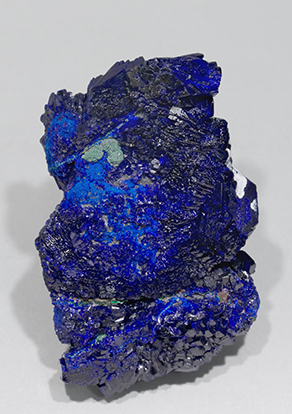
Rear |
| |
|
|
| Azurite with Malachite |
|
|
|
|
|
ME47W9: A novelty at Munich 2012. Parallel and rosette growths, on a matrix with Malachite coatings, of very well defined crystals of Azurite whose luster and color are very much more vivid than usual. The sample is an indication of what this mine can, perhaps, offer in the future.
Kimbwe Pit (Kinsevere Mine), Lubumbashi (Elizabethville), Katanga Copper Crescent, Haut-Katanga (Shaba) Democratic Republic of the Congo (Zaire) (09/2012)
Specimen size: 6.2 × 4.9 × 4.4 cm = 2.44” × 1.93” × 1.73”
Main crystal size: 0.4 × 0.3 cm = 0.16” × 0.12”
|
|
|
|
Spherocobaltite |
|---|
|
|
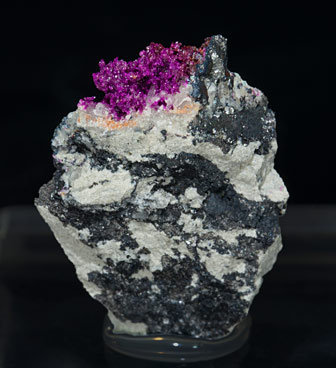
AE11AA2: Aggregate of small scalenohedral crystal of this very rare species. They are on matrix, are translucent, very bright and have a very deep color. The sample has been analyzed and we will send a copy f the analysis to the buyer.
Katanga Copper Crescent, Katanga (Shaba) Democratic Republic of the Congo (Zaire)
Specimen size: 2.4 × 1.7 × 0.7 cm = 0.94” × 0.67” × 0.28”
|
|  |
|
Between 2001 and 2003 Congo has given us fabulous Carrollites, which were much better than the older ones. We got hold of many nice specimens that sold well on our web pages. We still run into them when buying from our normal sources and we still see some good specimens which we can offer on our website. Thus we can continue to offer this excellent mineralogical species.
| Carrollite |
|
 |
|
|
|
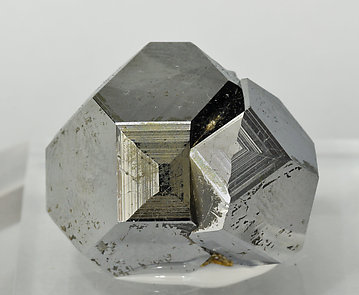
EP56Y6: Group of sharp crystals with very well defined faces and edges showing the forms of the dodecahedron, the cube and a finely striated tetrahexaedron. They have thin Chalcopyrite coatings, are very bright and their morphology is most unusual for Carrollite from Kambove.
Kamoya South II Mine, Kamoya, Kambove District, Katanga Copper Crescent, Katanga (Shaba) Democratic Republic of the Congo (Zaire) (2002)
Specimen size: 2.5 × 2 × 1.4 cm = 0.98” × 0.79” × 0.55”
Main crystal size: 2 × 1.7 cm = 0.79” × 0.67”
|
|
|
|
Carrollite on Calcite |
|---|
|
|
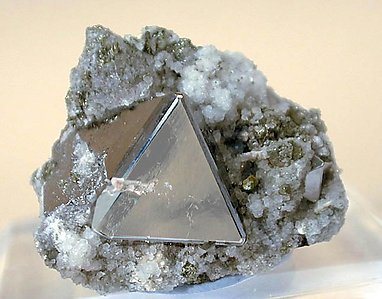
TU2B6: It is not common to find an octahedral form in a very sharp and brilliant undamaged crystal (Calcite covers its natural crack) Minor Chalcopyrite as well.
Kamoya South II Mine, Kamoya, Kambove District, Katanga Copper Crescent, Katanga (Shaba) Democratic Republic of the Congo (Zaire) (08-09 / 2001)
Specimen size: 2.5 × 2.4 cm = 0.98” × 0.94”
Main crystal size: 1.6 × 1.3 cm = 0.63” × 0.51”
|
|  |
|
| Carrollite with Mica |
|
 |
|
|
|
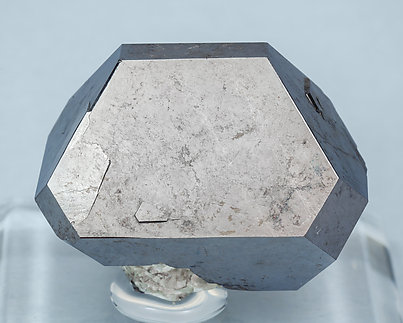
TM27AH0: A novelty at Tucson 2018. Single, very aerial and very sharp cubo-octahedral crystal, slightly elongated, complete and on a tiny bit of Mica matrix. The sample is from a recent find of samples of great quality.
The specimen has been photographed and published in the magazine ‘Paragénesis’, number 02/2018, page 88
Kamoya South II Mine, Kamoya, Kambove District, Katanga Copper Crescent, Katanga (Shaba) Democratic Republic of the Congo (Zaire) (2016-2017)
Specimen size: 3.6 × 3 × 2.6 cm = 1.42” × 1.18” × 1.02”
Main crystal size: 3.6 × 2.4 cm = 1.42” × 0.94”
|
|
|
|
Carrollite on Calcite |
|---|
|
|
TD51G0: The crystal is near perfection. Dominated by the cube and the octahedron, it is especially interesting for its brightness and its esthetic position on the Calcite matrix.
Kamoya South II Mine, Kamoya, Kambove District, Katanga Copper Crescent, Katanga (Shaba) Democratic Republic of the Congo (Zaire) (2001)
Specimen size: 4 × 4 × 3 cm = 1.57” × 1.57” × 1.18”
Main crystal size: 1.6 × 1.4 cm = 0.63” × 0.55”
|
| |
|
| Carrollite with Calcite |
|
|
|
|
|
EX17I2: Crystal on Calcite matrix. It is very well developed, with predominating forms of the octahedron but with the four faces of the tetrahexahedron in every visible corner.
Kamoya South II Mine, Kamoya, Kambove District, Katanga Copper Crescent, Katanga (Shaba) Democratic Republic of the Congo (Zaire) (2002)
Specimen size: 5 × 4.9 × 3.5 cm = 1.97” × 1.93” × 1.38”
Main crystal size: 1.2 × 1.1 cm = 0.47” × 0.43”
|
|
|
|
Opal |
|---|
|
|
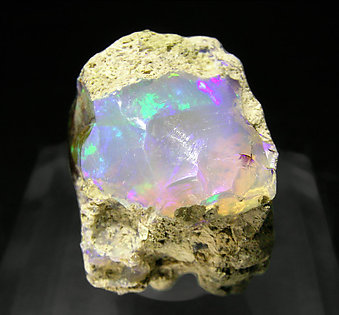
TB62Q0: A novelty at Tucson 2010. Opal on a matrix of dominant bluish shades with “harlequin” effect and green reflections. Although the Ethiopian Opal was previously known we note the detailed locality, so we can consider it a novelty.
Tsehay Mewcha, Wegeltena, Delanta, Wello Ethiopia (10/2009)
Specimen size: 2.1 × 1.7 × 2 cm = 0.83” × 0.67” × 0.79”
|
|  |
|
| Opal |
|
 |
|
|
|
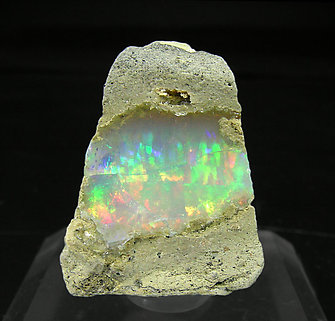
TX63Q0: A novelty at Tucson 2010. Opal on a matrix of dominant bluish shades with “harlequin” effect and reddish, orange and green reflections. Although the Ethiopian Opal was previously known we note the detailed locality, so we can consider it a novelty.
Tsehay Mewcha, Wegeltena, Delanta, Wello Ethiopia (10/2009)
Specimen size: 2.7 × 1.9 × 2.1 cm = 1.06” × 0.75” × 0.83”
|
|
|
|
Microcline (amazonite) with smoky Quartz |
|---|
|
|
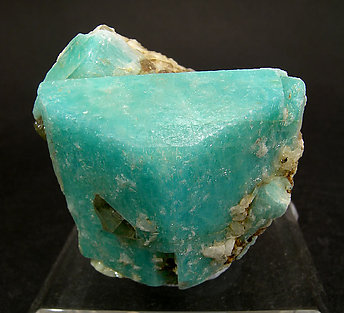
MG12F6: The crystal has a sharp well-defined form, and it stands out from the matrix because of its great green color. It comes from a recently discovered locality (for mineral collectors that is)
Kenticha, Negele area, Sidamo Ethiopia (2002)
Specimen size: 4.2 × 4 × 4.4 cm = 1.65” × 1.57” × 1.73”
Main crystal size: 3.7 × 3 cm = 1.46” × 1.18”
Fluorescent short UV
|
|  |
|
| Microcline (amazonite) |
|
 |
|
|
|
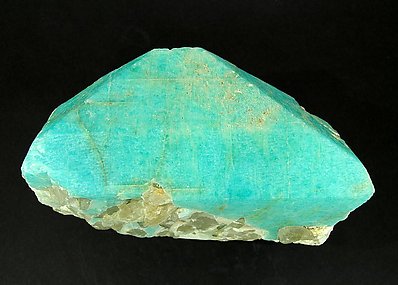
MF63F5: A really very interesting specimen. One can see how the Quartz and Microcline have grown together and then have continued until they end in the geometric faces of a crystal of amazonite, which is also large, well defined, and has good color.
Kenticha, Negele area, Sidamo Ethiopia (2002)
Specimen size: 8.5 × 5.7 × 4.2 cm = 3.35” × 2.24” × 1.65”
Minor fluorescence long & short UV
|
|
|
|
Rhodochrosite |
|---|
|
|
TC28W4: Aggregate of very acute scalenohedral crystals. They are translucent, with a color between red and mauve, very intense, deep and uniform, and are on a matrix of manganese oxides. The locality is not well known for good collection samples.
Moanda Mine, Moanda, Léboumbi-Leyou, Haut-Ogooué Gabon (1958)
Specimen size: 5,8 × 4 × 2.7 cm = 1.97” × 1.57” × 1.06”
Main crystal size: 0.4 × 0.1 cm = 0.16” × 0.04”
|
| |
|
| Rhodochrosite |
|
|
|
|
|
EV78X6: Druse of crystals that have an uncommon shape for Rhodochrosite, with very elongated prism faces and very flattened rhombohedral terminations. They have a very deep and intense color and are on a matrix of manganese oxides. A lost locality from which it is currently very difficult to obtain good samples.
The specimen has been reviewed, photographed and published in the magazine ‘Rivista Mineralogica Italiana’ on page 214 in number 2013/3
Moanda Mine, Moanda, Léboumbi-Leyou, Haut-Ogooué Gabon (±1980)
Specimen size: 7.3 × 6.7 × 3.8 cm = 2.87” × 2.64” × 1.50”
Main crystal size: 0.6 × 0.1 cm = 0.24” × 0.04”
|
|
|
|
Corundum |
|---|
|
|
TC64L1: This tabular crystal shows a deep red color, translucent under a light source. With triangular growth striations on the pinacoid.
Ampanihy area, Toliara Madagascar
Specimen size: 3.2 × 3.1 × 0.6 cm = 1.26” × 1.22” × 0.24”
Fluorescent long UV & minor fluorescence short UV
|
|  |
|
| Corundum (variety ruby) with Pyrope (variety rhodolite) and Muscovite |
|
|
|
|
|
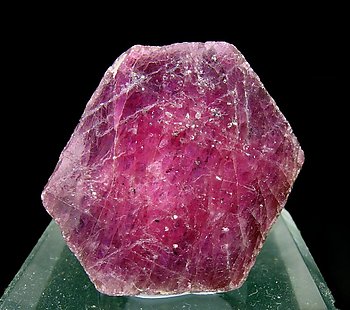
MH29L7: Well defined Corundum crystal, translucent and with a color that varies between red (under sunlight) and mauve with bluish tones (under artificial light). Crystal is partially included in a rich Muscovite and Pyrope (variety rhodolite) matrix.
Zazafotsy Quarry, Ambahatraso, Ihosy, Fianarantsoa Madagascar (10/2007)
Specimen size: 5.6 × 4.2 × 3.4 cm = 2.20” × 1.65” × 1.34”
Main crystal size: 1.8 × 1 cm = 0.71” × 0.39”
Minor fluorescence long & short UV
|
|
|
|
Corundum with Biotite |
|---|
|
|
TP37J3: Doubly terminated prismatic crystal, very rich of faces, combining prism, pyramid and pinacoid. Partly transparent, very bright and with a deep color between red and mauve. On Biotite matrix.
Zazafotsy Quarry, Ambahatraso, Ihosy, Fianarantsoa Madagascar (2006)
Specimen size: 5.8 × 3.4 × 4.3 cm = 2.28” × 1.34” × 1.69”
Main crystal size: 2.2 × 0.9 cm = 0.87” × 0.35”
Minor fluorescence long & short UV
|
| |
|
| Corundum (variety ruby) with Pyrope (variety rhodolite) and Muscovite |
|
Front | 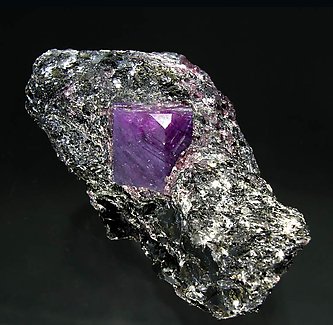
Side | |
|
|
|
|
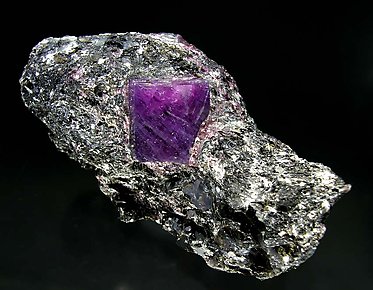
MN69K8: A novelty from Munich 2007. Corundum crystal of sharp faces and edges, excellent terminations and good color. It shows different color shades depending of the type of light they receive, and has a marked zonation between red and blue-mauve. On the front crystal face you can see some curious concentric growth figures around a little triangular rhombohedron face. The matrix, very rich in Muscovite, also has abundant red growths of Pyrope (variety rhodolite).
Zazafotsy Quarry, Ambahatraso, Ihosy, Fianarantsoa Madagascar (10/2007)
Specimen size: 7.7 × 3.9 × 4.5 cm = 3.03” × 1.54” × 1.77”
Main crystal size: 1.6 × 1.5 cm = 0.63” × 0.59”
Minor fluorescence long & short UV
|
|
|
|
Corundum with Muscovite |
|---|
|
|
MA74I1: Crystals are prismatic, very well developed. The main one is doubly terminated, with triangular growth pits on terminations. In addition to its quality and esthetics, we note its variable color mainly blue but with reddish zones. A new find at Munich 2006 because there were not specimens of such high quality from the locality.
Zazafotsy Quarry, Ambahatraso, Ihosy, Fianarantsoa Madagascar (2006)
Specimen size: 9.5 × 8.1 × 5 cm = 3.74” × 3.19” × 1.97”
Main crystal size: 5.3 × 4.4 cm = 2.09” × 1.73”
|
| |
|
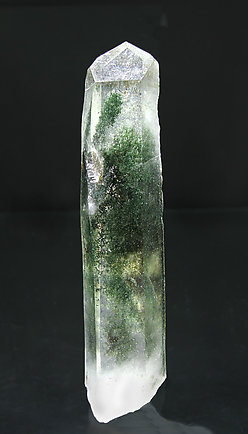
| Quartz with inclusions |
|
 |
|
|
|
TT9K9: Extremely elongated crystal with many dark green inclusions, probably Clinochlore.
Ambatomanoina, Ambatolampikely, Antananarivo Madagascar (2006)
Specimen size: 6.8 × 1.5 × 1.2 cm = 2.68” × 0.59” × 0.47”
|
|
|
|
Hematite with Rutile |
|---|
Fluorescent light (daylight)
|
|
|
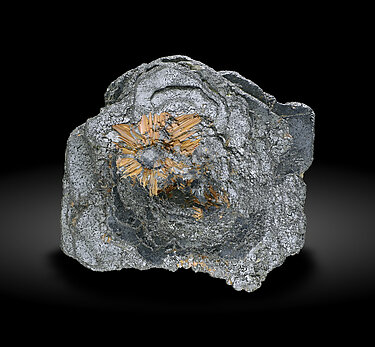
MLA56AO2: Floater rosette aggregate of lamellar Hematite crystals, with epimorphic growths of Rutile crystals between acicular and prismatic, with bright luster and a reddish orange color. The specimen comes from an old French collection.
Ambositra District, Amoron'i Mania Region Madagascar
Specimen size: 3.5 × 3.2 × 1 cm = 1.38” × 1.26” × 0.39”
|
| 
Front / Photo: Joaquim Callén | 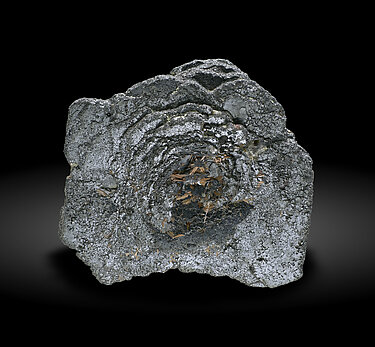
Rear / Photo: Joaquim Callén |
| |
|
|
| Hematite with Rutile |
|
Front / Photo: Joaquim Callén | 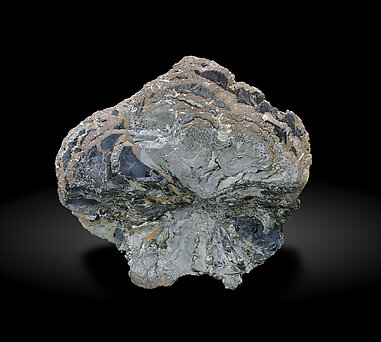
Rear / Photo: Joaquim Callén |
| |
|
Fluorescent light (daylight)
|
|
|
|
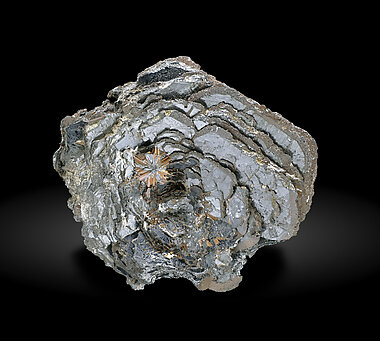
MFM56AO2: Floater rosette aggregate of lamellar Hematite crystals, with epimorphic growths of Rutile crystals between acicular and prismatic, with bright luster and a reddish orange color. The specimen comes from an old French collection.
Ambositra District, Amoron'i Mania Region Madagascar
Specimen size: 4 × 3.5 × 1.4 cm = 1.57” × 1.38” × 0.55”
|
|
|
|
Hematite with Rutile |
|---|
Fluorescent light (daylight)
|
|
|
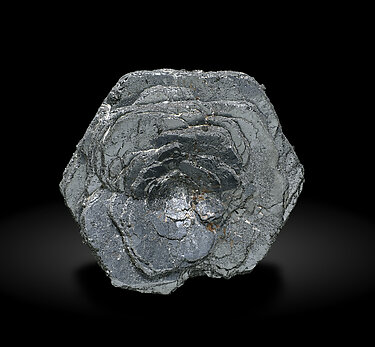
MPL66AO2: Floater rosette aggregate of lamellar Hematite crystals, with epimorphic growths of Rutile crystals between acicular and prismatic, with bright luster and a reddish orange color. The specimen comes from an old French collection.
Ambositra District, Amoron'i Mania Region Madagascar
Specimen size: 4.3 × 4.1 × 1.3 cm = 1.69” × 1.61” × 0.51”
|
| 
Front / Photo: Joaquim Callén | 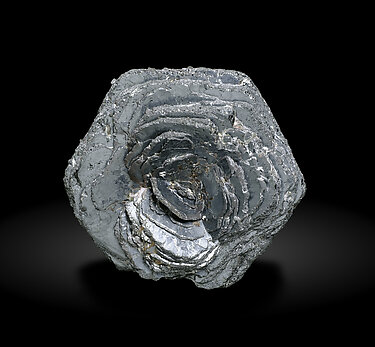
Rear / Photo: Joaquim Callén |
| |
|
|
| Hematite with Rutile |
|
Front / Photo: Joaquim Callén | 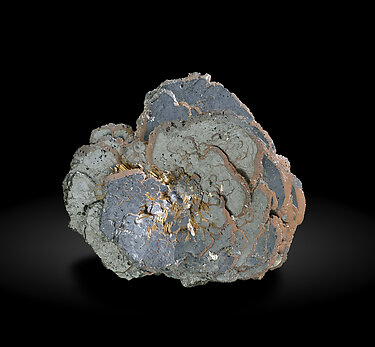
Rear / Photo: Joaquim Callén |
| |
|
Fluorescent light (daylight)
|
|
|
|
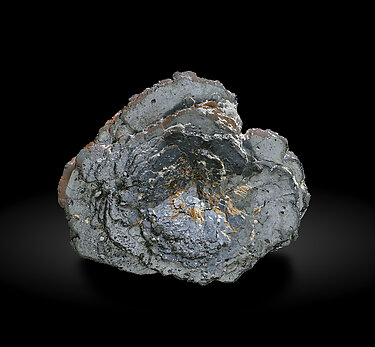
MZY86AO2: Floater rosette aggregate of lamellar Hematite crystals, with epimorphic growths of Rutile crystals between acicular and prismatic, with bright luster and a reddish orange color. The specimen comes from an old French collection.
Ambositra District, Amoron'i Mania Region Madagascar
Specimen size: 4.6 × 4.1 × 1.2 cm = 1.81” × 1.61” × 0.47”
|
|
|
|
Quartz with Muscovite (variety fuchsite) inclusions |
|---|
|
|
TT16AH1: Group of very clear Quartz crystals, on a rocky matrix very transparent and bright and with very well defined phantom growths that show their inner pyramidal faces coated by clear green microcrystalline Muscovite (variety fuchsite) growths. Great esthetic appearance.
Anovitra, Itremo, Ambatofinandrahana District, Amoron'i Mania Region, Fianarantsoa Province Madagascar (07/2017)
Specimen size: 11.3 × 8 × 8 cm = 4.45” × 3.15” × 3.15”
Main crystal size: 4.3 × 1.2 cm = 1.69” × 0.47”
|
| |
|
| Quartz with Hematite |
|
Front | 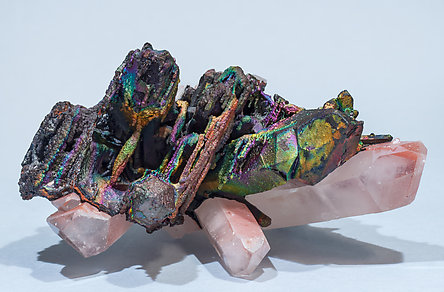
Top |
| |
|
|
|
|
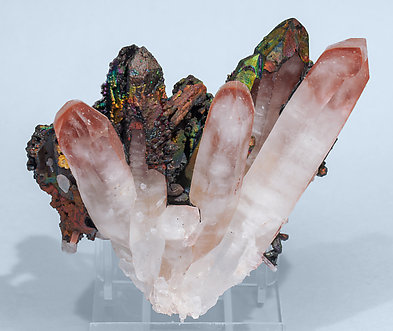
NT26AJ9: Group of Quartz crystals with very visible phantom growths due the red Hematite inclusions. They are partially coated by an iridescent and scoriaceous Goethite patina with metallic green, blue and red dominant shades.
The sample is from the Ignacio Hernández collection whose label we will send to the buyer.
Itremo Massif, Itremo, Ambatofinandrahana District, Amoron'i Mania Region, Fianarantsoa Province Madagascar
Specimen size: 6.7 × 6.3 × 3.7 cm = 2.64” × 2.48” × 1.46”
Main crystal size: 6.7 × 1.3 cm = 2.64” × 0.51”
Former collection of Ignacio Hernández
|
|
|
|
Albite with Muscovite |
|---|
|
|
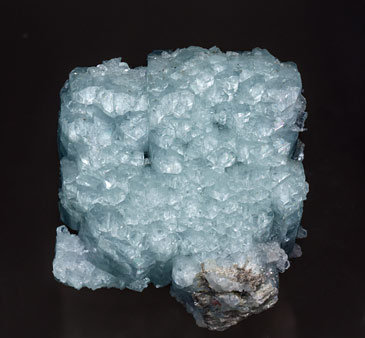
TQ87AB2: A novelty at Tucson 2015. Parallel aggregates and polycrystalline growths of bright and translucent Albite crystals that have an unusual and beautiful clear sky blue color and are with small aggregates of laminar Muscovite. The sample has been analyzed and we will send a copy of the analysis to the buyer.
Manakana, Vohambohitra pegmatite, Tsaratanàna District, Betsiboka Region, Mahajanga (Majunga) Province Madagascar (2014)
Specimen size: 5 × 4.4 × 3.5 cm = 1.97” × 1.73” × 1.38”
Minor fluorescence short UV
|
| 
Front | 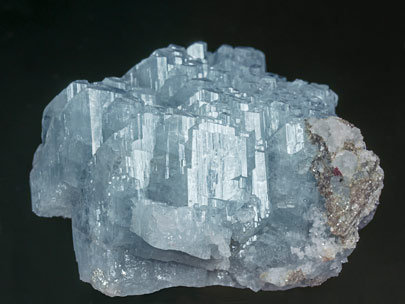
Side |
| |
|
|
| Celestine |
|
|
|
|
|
EH89AI8: Druse of Celestine crystals very rich in faces that are very well defined with sharp edges, extraordinarily transparent and bright and with an intense sky blue color. Of a great quality for Madagascar.
The sample is from the Raúl Sanabria collection whose label we will send to the buyer.
Sakoany deposit, Katsepy Commune, Mitsinjo District, Boeny Region, Mahajanga (Majunga) Province Madagascar
Specimen size: 12.5 × 8.1 × 6.8 cm = 4.92” × 3.19” × 2.68”
Main crystal size: 2.5 × 0.7 cm = 0.98” × 0.28”
Former collection of Raúl Sanabria
|
|
|
|
Twinned Calcite |
|---|
|
|
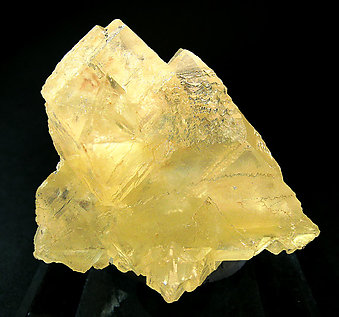
TA56G1: Fine specimen of the discovery in August 2004, in Madagascar, with the typical complex twin and excellent color, bright and clarity.
Sambava, Antsiranana Madagascar (08/2004)
Specimen size: 4.3 × 4 × 3.5 cm = 1.69” × 1.57” × 1.38”
Extremely fluorescent long & short UV
|
|  |
|
| Twinned Calcite |
|
 |
|
|
|
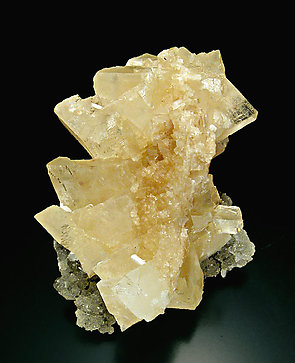
TB27G9: A group of slightly flattened crystals that have a very uncommon type of twinning. They are on a matrix of little Quartz crystals. With the Calcite, some white prismatic crystals of Laumontite have also grown.
Sambava, Antsiranana Madagascar (08/2004)
Specimen size: 6.5 × 4.5 × 4 cm = 2.56” × 1.77” × 1.57”
Main crystal size: 1.5 × 1.3 cm = 0.59” × 0.51”
Intense fluorescence long & short UV
|
|
|
|
Twinned Chrysoberyl |
|---|
|
|
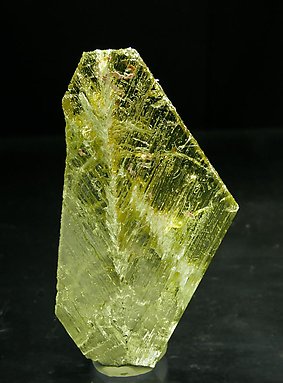
MB70L1: This floating twinned Chrysoberyl, which has well-defined contours, intense yellow color and brilliance, shows an assymmetric growth due probably to formation conditions. The two parts of the twin are well marked by the central joint and fine divergent growth striations. Good size and very original.
Lac Alaotra, Ambatondrazaka, Tamatave Madagascar (2005)
Specimen size: 3.8 × 2.3 × 0.3 cm = 1.50” × 0.91” × 0.12”
|
| 
Front | 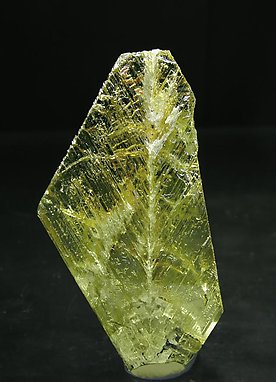
Rear |
| |
|
|
| Twinned Chrysoberyl on smoky Quartz |
|
Front | 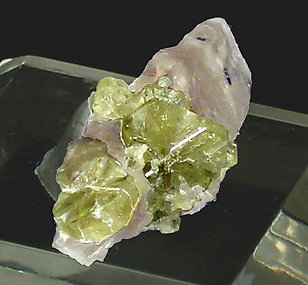
Side | |
|
|
|
|
|
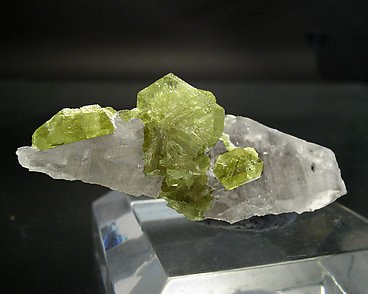
MC48H1: The specimen has some cyclic tabular twins of good color, luster and transparency and, which is very uncommon, they are on Quartz matrix.
Ampanorana Est, Ambatondrazaka, Tamatave Madagascar (07/2005)
Specimen size: 4.4 × 1.5 × 1.4 cm = 1.73” × 0.59” × 0.55”
Main crystal size: 0.9 × 0.9 cm = 0.35” × 0.35”
|
|
|
|
Chrysoberyl |
|---|
|
|
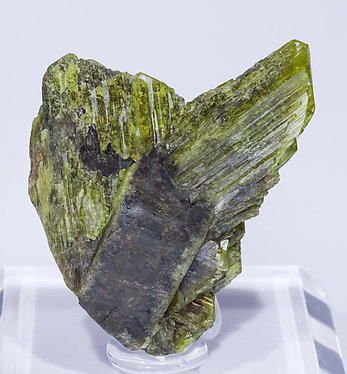
MG67AJ1: Floater twinned Chrysoberyl crystals with very well defined parallel polycrystalline growths. It is translucent, bright and has an intense yellowish green color.
Ambatondrazaka District, Toamasina Province (Tamatave), Alaotra-Mangoro Region Madagascar
Specimen size: 4.6 × 3 × 1.5 cm = 1.81” × 1.18” × 0.59”
|
| 
Front | 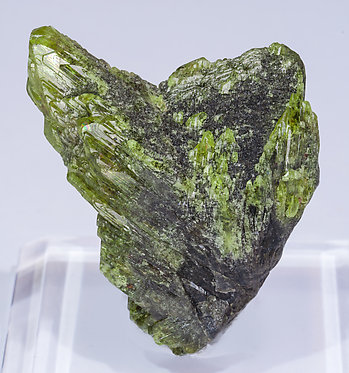
Rear |
| |
|
|
| Chrysoberyl with K-Feldspar |
|
Recorded under neon light
|
Recorded under neon light
|
| |
|
|
|
|
MBY69CD3: On a potassium feldspar matrix, a Chrysoberyl crystal of an intense bright lemon-yellow color, doubly terminated and with very distinct striations along the main growth axis.
The specimen comes from the pegmatite field east of Lake Alaotra, in Madagascar, and its appearance is very different from that of the classic chrysoberyls previously found in that country.
Lac Alaotra (Lake Alaotra) pegmatite field, Ambatondrazaka District, Toamasina Province (Tamatave), Alaotra-Mangoro Region Madagascar
Specimen size: 6.4 × 3.2 × 1.9 cm = 2.52” × 1.26” × 0.75”
Main crystal size: 3.6 × 1.6 cm = 1.42” × 0.63”
|
|
|
|
Beryl with Muscovite |
|---|
|
|
TA62F3: A crystallographic rarity. The crystal is almost exclusively formed by the faces of at least three pyramids, while the prism is almost inexistent. One side is covered with Muscovite, which contrasts well with the deep blue-green of the Beryl. This all makes for a strongly esthetic specimen whose base is formed by the surfaces of its contact with the pocket.
Brieville, Vohambohitra, Tamatave Madagascar (2003)
Specimen size: 7.7 × 6.3 × 6.9 cm = 3.03” × 2.48” × 2.72”
|
| |
|
| Tourmaline (Group) with smoky Quartz |
|
|
|
|
|
TB99S3: A single crystal with very well marked parallel growths and very well defined terminal faces. It is transparent with a slightly orange color and pinkish and mauve shades and color zoning perpendicular to the main direction of the crystal. The matrix is a smoky Quartz crystal.
Tsarafara, Sahatany, Vakinankaratra, Antananarivo Madagascar (07/2000)
Specimen size: 4.8 × 3.3 × 3 cm = 1.89” × 1.30” × 1.18”
Main crystal size: 2.4 × 1 cm = 0.94” × 0.39”
|
|
|
|
Tourmaline (Group) |
|---|
|
|
TA67Q8: Sharp prismatic crystal with very well defined faces and edges terminated by the three typical faces of a very flattened rhombohedron. It has deep mauve color with orange reflections and has a very well defined phantom.
Camp Robin area, Fianarantsoa Madagascar (2005)
Specimen size: 4.5 × 1.6 × 1.9 cm = 1.77” × 0.63” × 0.75”
Minor fluorescence short UV
|
| |
|
| Tourmaline (Group) |
|
|
|
|
|
MT49G5: A floater crystal whose base is recrystallized. It has beautiful color zones, with a clear contrast between the inner red zone and the skin which varies from green to yellow. The lower termination is especially complex.
Anjanabonoina, Betafo, Antsirabé Madagascar (04/2005)
Specimen size: 3.7 × 1.2 × 0.9 cm = 1.46” × 0.47” × 0.35”
|
|
|
|
Tourmaline (Group) |
|---|
|
|
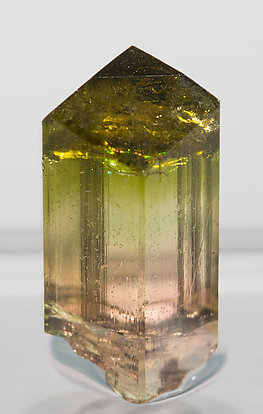
TF8S7: The crystal is completely transparent, very bright and it has a wide variety of color shades that form soft gradations. The group of terminal faces is exceptionally sharp and neat, showing the three faces of rhombohedron perfectly equilibrated with the pinacoid.
Ampatsikahitra, Sahatany Valley Madagascar (08/2010)
Specimen size: 2.1 × 1 × 0.9 cm = 0.83” × 0.39” × 0.35”
|
| 
Front | 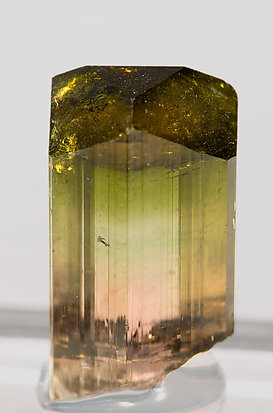
Rear |
| |
|
|
| Fluor-liddicoatite with Quartz |
|
Front | 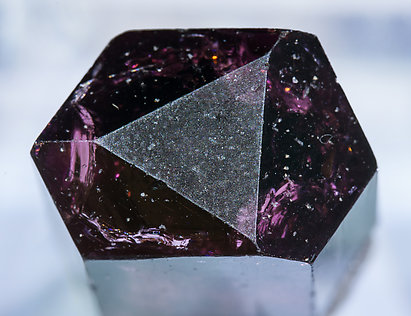
Top |
| |
|
|
|
|
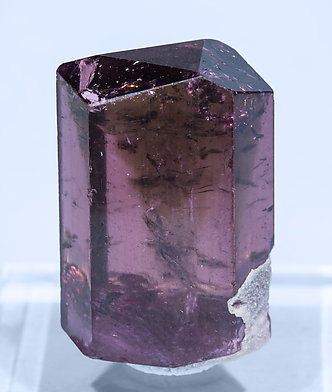
EA64AK0: Fluor-liddicoatite crystal with very well defined and perfect prism faces as well as both terminal faces, the pinacoid and the rhombohedron. Very transparent and bright with micro inclusions and a mauve color that is very intense and uniform, different from the usual color of the Fluor-liddicoatites of Madagascar. Also with a small Quartz coating.
Sahatany Valley (Mt. Ibity), Vakinankaratra Region, Antananarivo Province Madagascar (03/2019)
Specimen size: 2.5 × 1.7 × 1.3 cm = 0.98” × 0.67” × 0.51”
|
|
|
|
Fluor-liddicoatite with Feldspar |
|---|
Fluorescent light (daylight)
|
|
|
EG87AK9: Group of Fluor-liddicoatite crystals, one of them clearly dominant, doubly terminated, translucent, with high luster and intense, uniform and deep purple red color, in Feldspar matrix. A great classic from Madagascar, of unusual size and quality for a matrix specimen.
The specimen has been photographed and published in the magazine ‘Paragénesis’, number 01/2020, page 64
Sahatany Valley (Mt. Ibity), Vakinankaratra Region, Antananarivo Province Madagascar
Specimen size: 7.5 × 5.5 × 4.5 cm = 2.95” × 2.17” × 1.77”
Main crystal size: 6.5 × 4.5 cm = 2.56” × 1.77”
|
| |
|
| Twinned Hambergite |
|
Front | 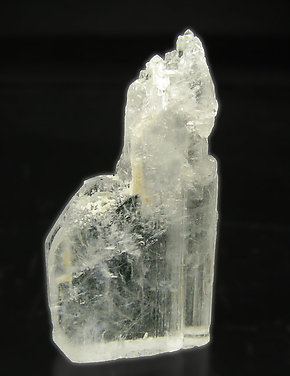
Rear |
| |
|
|
|
|
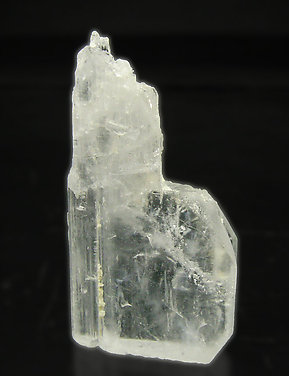
TA64Q0: A novelty at Tucson 2010. A floater crystal with very well defined faces and edges, a very unusual shape for the species, with a very obvious twin, a very good luster and an excellent degree of transparency.
Tampo'ny llapa, Sahatany Valley, Ibitiny, Antsirabe Madagascar (20/12/2009)
Specimen size: 3.3 × 1.8 × 0.7 cm = 1.30” × 0.71” × 0.28”
|
|
|
|
Schiavinatoite with Elbaite, Danburite and smoky Quartz |
|---|
|
|
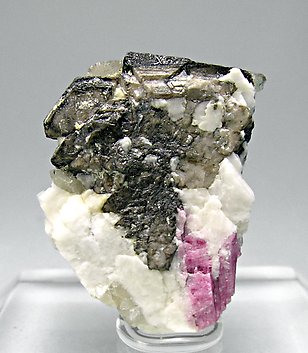
EX92M2: Extraordinary parallel and well defined crystal growth of this extremely rare borate. In the same sample the Schiavinatoite is accompanied by Elbaite (Rubellite), Danburite and smoky Quartz. The specimen is from a recent find (2008) in the same region as the Type Locality.
Ampanodiana, Andrembesoa, Betafo, Antananarivo Madagascar (2008)
Specimen size: 2 × 1.7 × 1.3 cm = 0.79” × 0.67” × 0.51”
Main crystal size: 0.8 × 0.8 cm = 0.31” × 0.31”
Fluorescence on the matrix (short UV)
|
| 
Front | 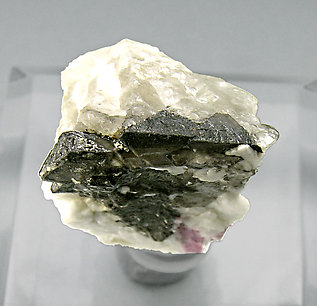
Top |
| |
|
|
| Fluorite |
|
 |
|
|
|
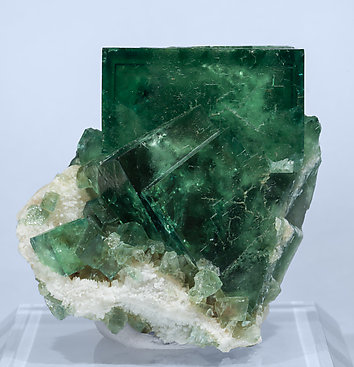
EF66AI1: A novelty at Tucson 2018. A group, on matrix, of cubic Fluorite crystals, between translucent and transparent, with a very deep green color and marine-blue dichroism, not intense but clearly visible in sunlight. The crystals are more individualized and complete than usual with such samples. The locality is very new and even though Madagascar is a well-known mineralogical paradise there were no references to Fluorite occurrences other than the small crystals included in Quartz from Mandronarivo.
Mandronarivo area, Beroroha District, Atsimo Andrefana Region, Toliara Province (Tuléar) Madagascar (06-11/2017)
Specimen size: 4.6 × 4.6 × 3.6 cm = 1.81” × 1.81” × 1.42”
Main crystal size: 3 × 2 cm = 1.18” × 0.79”
Fluorescent long & short UV
|
|
|
|
Fluorite |
|---|
|
|
TQ49AH0: A novelty at Tucson 2018. A group of Fluorite crystal cubes between translucent and transparent, with a very intense and deep green color and marine-blue dichroism, clearly visible in sunlight. On a matrix coated by white Quartz. The locality is totally new and, even though Madagascar is a well-known mineralogical paradise, there were no more references to Fluorite occurrences other than the small crystals included in Quartz from Mandronarivo.
The specimen has been photographed and published in the magazine ‘Paragénesis’, number 02/2018, page 98
Mandronarivo area, Beroroha District, Atsimo Andrefana Region, Toliara Province (Tuléar) Madagascar (08-11/2017)
Specimen size: 7.7 × 3.9 × 3.8 cm = 3.03” × 1.54” × 1.50”
Main crystal size: 1.2 × 1 cm = 0.47” × 0.39”
Fluorescent long & short UV
|
| |
|
| Sapphirine with Quartz and Mica |
|
|
|
|
|
MX6AC8: Sapphirine crystals on matrix, one of them clearly dominant, with very well defined faces and edges and an intense and uniform blue color.
The sample is from the Thomas P. Moore collection whose label we’ll send to the buyer.
Androy Region, Toliara Province (Tuléar) Madagascar
Specimen size: 2.7 × 2.1 × 2.3 cm = 1.06” × 0.83” × 0.91”
Main crystal size: 1.4 × 1.3 cm = 0.55” × 0.51”
|
|
|
|
Laurentthomasite |
|---|
|
|
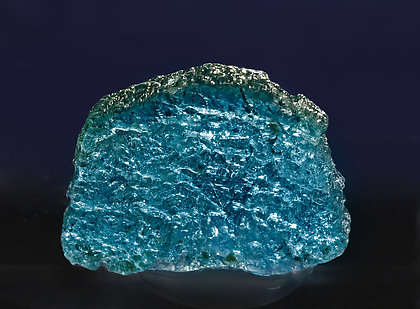
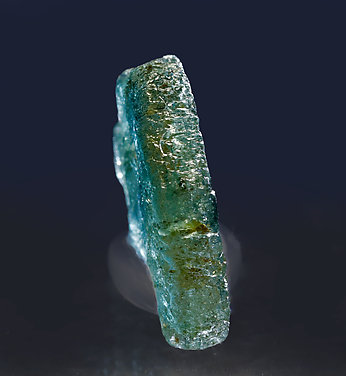
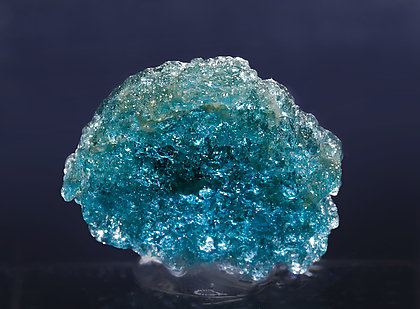
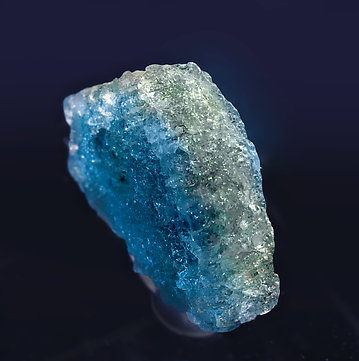
TB92AL0: A new discovery at Tucson 2020. This new mineral species displays, among other notable characteristics, a dichroism: blue "Paraíba" color viewed from the front and yellow with green tints seen from the side (with focused light)
Given its hardness, color and transparency, the mineral falls into the gem category and this, together with the fact that it is a new species as well as its rarity, inevitably makes its price high. Another reason for interest is the high content of Scandium in its composition (around 3.8%)
Laurent Thomas, the person whose name the species carries, presented it at Tucson 2020 and explained to us that although the first news of this new species went out in 2018, the most important find was that of April 2019 and that is the one from which this piece comes.
Together with the specimen we will give the buyer an original label from Laurent Thomas, signed by him.
This specimen has been photographed and published as a novelty at the 2020 Tucson Show in the magazine ‘Lapis‘ number 3/2020, page 31
Beravina, Ambaro, Tsaraitso, Betroka District, Anosy Region Madagascar (04/2019)
Specimen size: 1.1 × 0.9 × 0.2 cm = 0.43” × 0.35” × 0.08”
Type locality
Photos: Joaquim Callén
|
| 
Front with light behind | 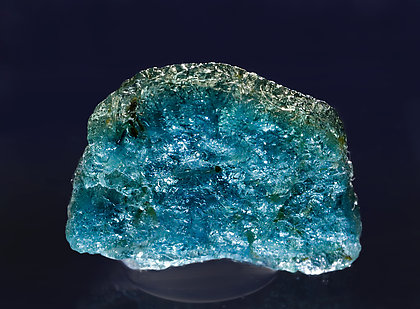
Rear with light behind |
| 
Top with focused light |
|
|
| Laurentthomasite |
|
Front with light behind | 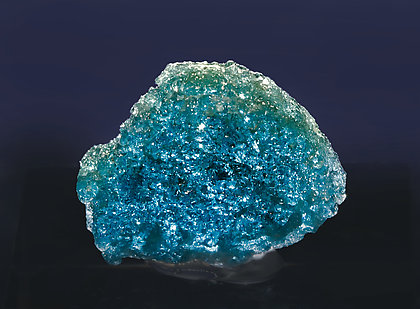
Rear with light behind |
| 
Top with focused light |
|
|
|
|
TA91AL0: A new discovery at Tucson 2020. This new mineral species displays, among other notable characteristics, a dichroism: blue "Paraíba" color viewed from the front and yellow with green tints seen from the side (with focused light)
Given its hardness, color and transparency, the mineral falls into the gem category and this, together with the fact that it is a new species as well as its rarity, inevitably makes its price high. Another reason for interest is the high content of Scandium in its composition (around 3.8%)
Laurent Thomas, the person whose name the species carries, presented it at Tucson 2020 and explained to us that although the first news of this new species went out in 2018, the most important find was that of April 2019 and that is the one from which this piece comes.
Together with the specimen we will give the buyer an original label from Laurent Thomas, signed by him.
Beravina, Ambaro, Tsaraitso, Betroka District, Anosy Region Madagascar (04/2019)
Specimen size: 1.1 × 1.1 × 0.3 cm = 0.43” × 0.43” × 0.12”
Type locality
Photos: Joaquim Callén
|
|
|
|
Laurentthomasite |
|---|
|
|
TD94AL0: A new discovery at Tucson 2020. This new mineral species displays, among other notable characteristics, a dichroism: blue "Paraíba" color viewed from the front and yellow with green tints seen from the side (with focused light)
Given its hardness, color and transparency, the mineral falls into the gem category and this, together with the fact that it is a new species as well as its rarity, inevitably makes its price high. Another reason for interest is the high content of Scandium in its composition (around 3.8%)
Laurent Thomas, the person whose name the species carries, presented it at Tucson 2020 and explained to us that although the first news of this new species went out in 2018, the most important find was that of April 2019 and that is the one from which this piece comes.
Together with the specimen we will give the buyer an original label from Laurent Thomas, signed by him.
Beravina, Ambaro, Tsaraitso, Betroka District, Anosy Region Madagascar (04/2019)
Specimen size: 1.3 × 1.1 × 0.3 cm = 0.51” × 0.43” × 0.12”
Type locality
Photos: Joaquim Callén
|
| 
Front with light behind | 
Rear with light behind |
| 
Side with focused light |
|
|
| Grandidierite with Feldspar |
|
|
|
|
|
TP50AH2: Very sharp flattened and complete crystal (on the base it has small fragments of a feldspar matrix) with very well defined faces and edges and a perfect termination, slightly rough but free of damage. It is translucent and has a very deep and uniform bluish-green color. Among the best for this very rare species, a classic from Madagascar.
Tranomaro Commune, Tranomaro-Maromby area, Amboasary District, Anosy Region (Fort Dauphin Region), Toliara Province (Tuléar) Madagascar (02-06/2017)
Specimen size: 2.9 × 2.3 × 0.8 cm = 1.14” × 0.91” × 0.31”
Main crystal size: 2.9 × 1.6 cm = 1.14” × 0.63”
|
|
|
|
Grandidierite with Quartz, Feldspar and Diopside |
|---|
|
|
TF67AD0: A novelty at Tucson 2016. An isolated crystal on matrix. It is translucent, bright, with a uniform and intense bluish-green color and with very well defined prismatic faces. Of an excellent quality for this rare silicate.
Grandidierite deposit, Tranomaro Commune, Tranomaro-Maromby area, Amboasary District, Anosy Region (Fort Dauphin Region), Toliara Province (Tuléar) Madagascar (05-12/2015)
Specimen size: 2.9 × 2.2 × 1.5 cm = 1.14” × 0.87” × 0.59”
Main crystal size: 2.3 × 1.5 cm = 0.91” × 0.59”
Diopside fluorescent
|
|  |
|
| Grandidierite with Feldspar |
|
Front / Photo: Joaquim Callén | 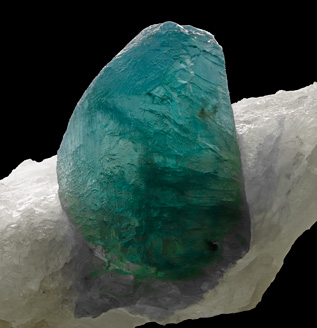
Detail / Photo: Joaquim Callén |
| |
|
Recorded under neon light
|
|
|
|
EAG96CD1: Unusual, both due to the fact that the crystal is isolated and well defined in its Feldspar matrix as well as for being so aerial, so free, so that its morphology is perfectly displayed.
Very few grandidierites have been found in matrix and even fewer so aerial.
Grandidierite deposit, Tranomaro Commune, Tranomaro-Maromby area, Amboasary District, Anosy Region (Fort Dauphin Region), Toliara Province (Tuléar) Madagascar (2017-2018)
Specimen size: 3.2 × 1.8 × 1.7 cm = 1.26” × 0.71” × 0.67”
Main crystal size: 1.4 × 1 cm = 0.55” × 0.39”
|
|
|
|
Grandidierite with Quartz and Feldspar |
|---|
|
|
MX51AD5: A novelty at Tucson 2016. Single crystals on a massive Quartz matrix. The crystals have some very well developed faces and edges on the prism, which is very uncommon for the species. The crystal is translucent and bright and has a uniform greenish blue color. Of an excellent quality for this rare silicate.
Grandidierite deposit, Tranomaro Commune, Tranomaro-Maromby area, Amboasary District, Anosy Region (Fort Dauphin Region), Toliara Province (Tuléar) Madagascar (05-12/2015)
Specimen size: 6.5 × 3.5 × 4 cm = 2.56” × 1.38” × 1.57”
Main crystal size: 4 × 1.4 cm = 1.57” × 0.55”
|
| 
Front | 
Side |
| |
|
|
| Grandidierite with Feldspar and Quartz |
|
|
|
|
|
TD86AH6: Group of Grandidierite crystals on matrix, one of them clearly dominant and very large for the species. The crystals, unusually well defined, are translucent and have a uniform and intense bluish-green color. The main crystal has a rough termination but it is complete, as the detailed image shows. The sample has great quality for this rare silicate.
Tranomaro Commune, Tranomaro-Maromby area, Amboasary District, Anosy Region (Fort Dauphin Region), Toliara Province (Tuléar) Madagascar (02-06/2017)
Specimen size: 7.5 × 4.8 × 3.2 cm = 2.95” × 1.89” × 1.26”
Main crystal size: 5.1 × 2.4 cm = 2.01” × 0.94”
|
|
|
|
Grandidierite with Quartz, Feldspar and Diopside |
|---|
|
|
TE99AD0: A novelty at Tucson 2016. Parallel growth, on matrix, of translucent and bright crystals with a uniform bluish green color and with very well defined prismatic faces. Of an excellent quality for this rare silicate.
Grandidierite deposit, Tranomaro Commune, Tranomaro-Maromby area, Amboasary District, Anosy Region (Fort Dauphin Region), Toliara Province (Tuléar) Madagascar (05-12/2015)
Specimen size: 3.6 × 3 × 2.1 cm = 1.42” × 1.18” × 0.83”
Main crystal size: 3 × 1.3 cm = 1.18” × 0.51”
Diopside fluorescent
|
|  |
|
| Grandidierite with Quartz and Feldspar |
|
 |
|
|
|
TD47AD0: A novelty at Tucson 2016. An isolated crystal on matrix. It is translucent, has a uniform bluish-green color and has very well defined faces and edges (also the terminal). Of an excellent quality for this rare silicate.
Grandidierite deposit, Tranomaro Commune, Tranomaro-Maromby area, Amboasary District, Anosy Region (Fort Dauphin Region), Toliara Province (Tuléar) Madagascar (05-12/2015)
Specimen size: 3.8 × 3.2 × 1.8 cm = 1.50” × 1.26” × 0.71”
Main crystal size: 1.4 × 0.4 cm = 0.55” × 0.16”
|
|
|
|
Grandidierite with Quartz and Mica |
|---|
|
|
TA93AD0: A novelty at Tucson 2016. Single crystal on matrix, with a uniform bluish green color and with faces and edges very much better defined than usual for this species. Of an excellent quality for this rare silicate.
Grandidierite deposit, Tranomaro Commune, Tranomaro-Maromby area, Amboasary District, Anosy Region (Fort Dauphin Region), Toliara Province (Tuléar) Madagascar (05-12/2015)
Specimen size: 5.5 × 4 × 3.9 cm = 2.17” × 1.57” × 1.54”
Main crystal size: 2.7 × 2.3 cm = 1.06” × 0.91”
|
| |
|
If you want to know more about the Andradite (demantoid veriety) from Ambanja please follow this link
| Andradite (variety demantoid) |
|
 |
|
|
|
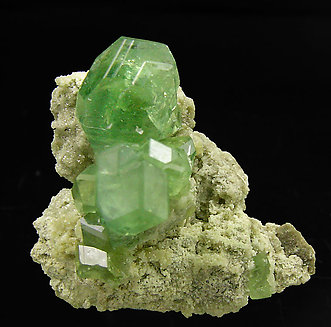
EQ66N8: A novelty in Ste. Marie 2009. Group of crystals with a dominant dodecahedron and the faces of a trapezohedron on the edges. The crystals, on matrix, are very clear and bright, have a good green color and a curious flattened shape. The locality was not well known until recently, and habit of the Demantoid is really unusual.
This specimen was published in the magazine ‘Le Règne Minéral’ number 90, page 42.
Antetezambato outcrop, Antetezambato, Maherivaratra Commune, Ambanja District, Antsiranana Province Madagascar (05-06/2009)
Specimen size: 2.5 × 2.3 × 1.6 cm = 0.98” × 0.91” × 0.63”
Main crystal size: 1 × 0.7 cm = 0.39” × 0.28”
|
|
|
|
Andradite (variety demantoid) |
|---|
|
|
TB31Q0: Two crystals on matrix, one of them clearly dominant. They are very rich in faces, with the dominant forms of the dodecahedron and the trapezohedron. With an intense green color, very bright and transparent.
Antetezambato outcrop, Antetezambato, Maherivaratra Commune, Ambanja District, Antsiranana Province Madagascar (11-12/2009)
Specimen size: 4.2 × 3.2 × 1.4 cm = 1.65” × 1.26” × 0.55”
Main crystal size: 1.2 × 0.8 cm = 0.47” × 0.31”
|
| |
|
| Andradite (variety demantoid) |
|
|
|
|
|
EV57N8: A novelty in Ste. Marie 2009. Group of crystals with a dominant dodecahedron and the faces of a trapezohedron on the edges. The crystals, on matrix, are very clear and bright, have a good green color and a curious flattened shape. The locality was not well known until recently, and habit of the Demantoid is really unusual.
This specimen was published in the magazine ‘Le Règne Minéral’ number 90, page 42.
Antetezambato outcrop, Antetezambato, Maherivaratra Commune, Ambanja District, Antsiranana Province Madagascar (05-06/2009)
Specimen size: 4.4 × 3.6 × 2.8 cm = 1.73” × 1.42” × 1.10”
Main crystal size: 0.6 × 0.6 cm = 0.24” × 0.24”
|
|
|
|
Andradite (variety demantoid) |
|---|
|
|
TK52S9: Transparent complex crystals of intense green color, on matrix. They have dominant forms of the trapezohedron and the dodecahedron, but they also show cube faces, small but perfectly visible. Some of the crystals have curious deformations, to the degree that one of them is almost completely flattened.
Antetezambato outcrop, Antetezambato, Maherivaratra Commune, Ambanja District, Antsiranana Province Madagascar (08/2009)
Specimen size: 7.3 × 6.3 × 4.8 cm = 2.87” × 2.48” × 1.89”
Main crystal size: 1.8 × 1.2 cm = 0.71” × 0.47”
|
| |
|
| Andradite (variety demantoid) with Quartz |
|
|
|
|
|
TA50Q6: Dodecahedral crystals beveled by trapezohedron faces. They are isolated or in groups and are translucent, very bright and with an excellent green color. They are on matrix with Quartz, a very rare association on this locality.
Antetezambato outcrop, Antetezambato, Maherivaratra Commune, Ambanja District, Antsiranana Province Madagascar (08/2009)
Specimen size: 11.2 × 6.8 × 3.6 cm = 4.41” × 2.68” × 1.42”
Main crystal size: 1.2 × 0.7 cm = 0.47” × 0.28”
|
|
|
|
Andradite (variety topazolite) with Stilbite |
|---|
|
|
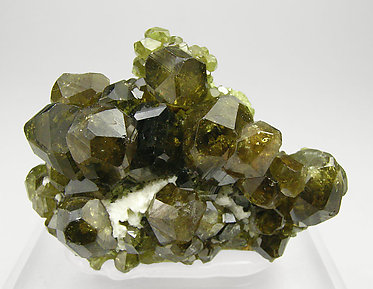
TP49Q0: A novelty at Tucson 2010. A druse on matrix of crystals very rich of faces, with the dominant forms of the dodecahedron and the trapezohedron and greenish brown color. Their luster is extraordinary and they are with small white crystals of Stilbite. The Topazolite variety has been well defined on this kind of sample and this will be reflected in a future article in Mineralogical Record.
Antetezambato outcrop, Antetezambato, Maherivaratra Commune, Ambanja District, Antsiranana Province Madagascar (05-06/2009)
Specimen size: 4.7 × 3.2 × 2.3 cm = 1.85” × 1.26” × 0.91”
Main crystal size: 1.2 × 0.9 cm = 0.47” × 0.35”
|
|  |
|
| Andradite (variety topazolite) |
|
|
|
|
|
TF28AD6: Very aerial aggregate, on matrix, of good sized crystals, very rich in faces, with the dominant forms of the dodecahedron and trapezohedron. The crystals have a greenish brown color and an extraordinary luster.
Antetezambato outcrop, Antetezambato, Maherivaratra Commune, Ambanja District, Antsiranana Province Madagascar (05-06/2009)
Specimen size: 5.8 × 4.8 × 2.5 cm = 2.28” × 1.89” × 0.98”
Main crystal size: 1.3 × 0.9 cm = 0.51” × 0.35”
|
|
|
|
Andradite (variety topazolite) |
|---|
|
|
TL94Q0: A novelty at Tucson 2010. An alignment of good sized crystals, very rich of faces, with the dominant forms of the dodecahedron and the trapezohedron and greenish brown color. Their luster is extraordinary and they are with small white crystals of Stilbite. The Topazolite variety has been well defined on this kind of samples and this will be reflected in a future article in The Mineralogical Record.
Antetezambato outcrop, Antetezambato, Maherivaratra Commune, Ambanja District, Antsiranana Province Madagascar (10-11/2009)
Specimen size: 6.7 × 5.7 × 3.3 cm = 2.64” × 2.24” × 1.30”
Main crystal size: 1.2 × 1.2 cm = 0.47” × 0.47”
|
| |
|
| Andradite (variety topazolite) with Quartz |
|
|
|
|
|
TP97S1: Group of big (for Topazolite) trapezohedral crystals that have grown on a first phase of Demantoid whose color, intense green, abruptly passes to the golden brown of Topazolite. The crystals are bright, transparent and have excellent, very deep color, being on a matrix of Quartz. A very exclusive sample.
Antetezambato outcrop, Antetezambato, Maherivaratra Commune, Ambanja District, Antsiranana Province Madagascar (09/2009)
Specimen size: 8.4 × 7.2 × 4.1 cm = 3.31” × 2.83” × 1.61”
Main crystal size: 2.1 × 1.7 cm = 0.83” × 0.67”
|
|
|
|
Andradite (variety topazolite) |
|---|
|
|
TE51Q0: A novelty at Tucson 2010. A centered group of good-sized crystals, very rich in faces, with the dominant forms of the dodecahedron and the trapezohedron and greenish brown color. Their luster is extraordinary and they are with small white crystals of Stilbite. The Topazolite variety has been well defined on this kind of sample and this will be reflected in a future article in Mineralogical Record.
Antetezambato outcrop, Antetezambato, Maherivaratra Commune, Ambanja District, Antsiranana Province Madagascar (05-06/2009)
Specimen size: 8.7 × 6.2 × 3.7 cm = 3.43” × 2.44” × 1.46”
Main crystal size: 1.7 × 1.6 cm = 0.67” × 0.63”
|
| |
|
One of the most interesting novelties during Tucson 2003 was the new species Pezzottaite from Madagascar (a Cesium rich Beryl whose name has already been officially published in the IMA list). Their color is totally different from other Beryl and their chemical composition (CsLiBe2Al2Si6O18) is also different from that of regular Beryl. As usual, knowing how things happen in the mineral world, we purchased the specimens now offered on line. We selected them for their sharp form, good color or especially in the case of the best one for its 'matrix' appearance.
| Pezzottaite |
|
 |
|
|
|
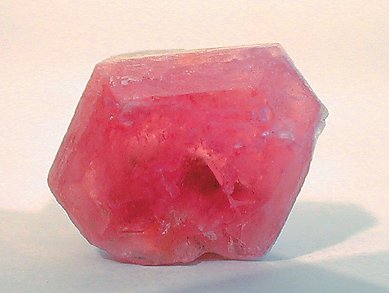
TC9C4: Floater, as were the majority of the specimens of this find, pretty gemmy and sharper and better formed than the majority.
Ambatovita, Mandrosonoro, Antsirabe Madagascar (11/2002)
Specimen size: 1.6 × 1.2 × 0.6 cm = 0.63” × 0.47” × 0.24”
|
|
|
|
Pezzottaite |
|---|
|
|
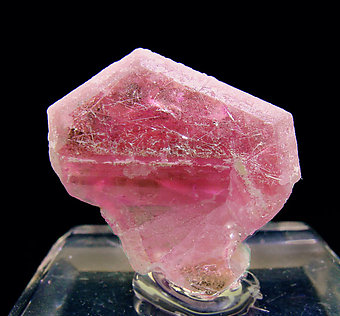
TY89L1: Well defined tabular Pezzottaite crystal of this rare specimen. The crystal is clearly dominated by pinacoidal faces, a very thin prism and a pyramid. Great specimen with good size, excellent color and transparency.
Ambatovita, Mandrosonoro, Antsirabe Madagascar (11/2002)
Specimen size: 2 × 1.9 × 0.7 cm = 0.79” × 0.75” × 0.28”
|
| 
Front | 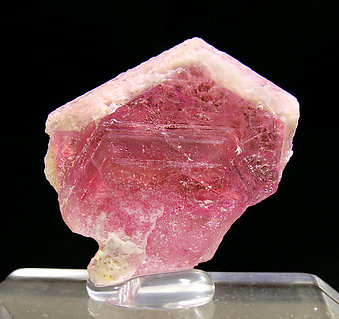
Rear |
| |
|
|
| Pezzottaite |
|
 |
|
|
|
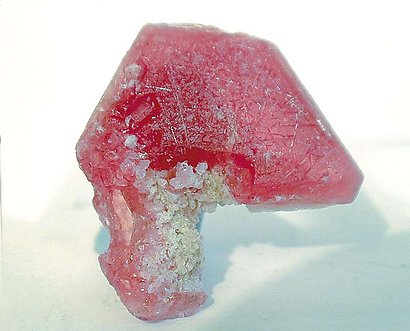
TD37C4: Well, this particular specimen is something special. In this find sadly not many good specimens were found on matrix. Although this specimen is not strictly "on matrix" given its particular form it looks like a matrix specimen. Color quality and geminness are those of the best of the find. The size is good when comparing it with the largest ones. Its price is, in our opinion, reasonable based on the prices for other really good specimens.
Ambatovita, Mandrosonoro, Antsirabe Madagascar (11/2002)
Specimen size: 3 × 2.6 × 0.9 cm = 1.18” × 1.02” × 0.35”
|
|
|
Madagascar is the major source of Rhodizite, a rare Beryllium Oxide, with Caesium, Potassium and Aluminium. From our friends in this country we got choice specimens that have better color (more greenish and intense) than is usual.
|
Rhodizite |
|---|
|
|
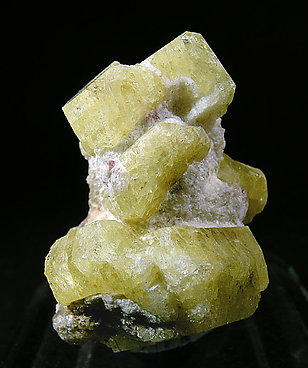
AA76F3: The dodecahedral crystals are yellow and intensely brilliant. They also have a degree of transparency that is not very common. This one has just the right amount of matrix to give it the perfect esthetic balance.
The specimen has been analyzed and we will send a copy of the analysis to the person that buys it.
Antsogombato Mine, Antsentsindrano, Anosiarivo Manapa, Betafo District, Vakinankaratra Region Madagascar (2001)
Specimen size: 3.2 × 2.4 × 2 cm = 1.26” × 0.94” × 0.79”
Main crystal size: 2 × 1 cm = 0.79” × 0.39”
Minor fluorescence long & short UV
|
|  |
|
| Londonite-Rhodizite Series with Elbaite and Schorl |
|
|
|
|
|
TF48AG3: Very sharp dodecahedral crystal with a vivid yellow color, translucent, bright and on matrix, with Elbaite (rubellite variety). The crystals like this have an outer zone that is rich in Caesium, thus are dominant Londonite, and the interior zone is rich in Potassium, thus are dominant Rhodizite.
Antsogombato Mine, Antsentsindrano, Anosiarivo Manapa, Betafo District, Vakinankaratra Region Madagascar
Specimen size: 6.4 × 5.4 × 3.7 cm = 2.52” × 2.13” × 1.46”
Main crystal size: 2.5 × 1.7 cm = 0.98” × 0.67”
Minor fluorescence short UV
Former collection of José Luis Vallecillo
|
|
|
|
Rubidium-rich Rhodizite with Elbaite and Danburite |
|---|
|
|
DA97Z0: Very sharp translucent and bright Rhodizite crystal with a greenish color. It is on a Elbaite- rich matrix (variety rubellite). The rubidian Rhodizite was considered as a possible new species, but analysis indicates it is just a very rare Rhodizite variety.
Tetezantsio-Andoabatokely, Andrembesoa, Betafo, Antananarivo Madagascar
Specimen size: 4.2 × 2.8 × 3 cm = 1.65” × 1.10” × 1.18”
Main crystal size: 1 × 0.8 cm = 0.39” × 0.31”
Fluorescence short UV & minor fluorescence long UV
|
| |
|
| Rb-rich Rhodizite with Elbaite (variety rubellite), Quartz and Feldspar |
|
|
|
|
|
MJ99AJ1: Very sharp dodecahedral Rhodizite crystals, well known by its high content of rubidium, translucent, bright, with a pale greenish yellow color and on matrix with Quartz, Feldspar and red Elbaite (rubellite variety) crystals.
Antsogombato Mine, Antsentsindrano, Anosiarivo Manapa, Betafo District, Vakinankaratra Region Madagascar
Specimen size: 6.6 × 5.4 × 5.2 cm = 2.60” × 2.13” × 2.05”
Main crystal size: 1.3 × 1.2 cm = 0.51” × 0.47”
Feldspar fluorescence short UV & minor fluorescence long UV
|
|
|
|
Prehnite with Epidote |
|---|
|
|
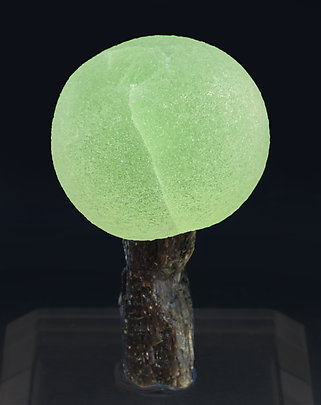
NR26AK0: Prehnite in a spheroidal growth, very aerial and aesthetic, translucent and with an intense and uniform green color and implanted in a very dark green, almost black, Epidote crystal.
The sample comes from the collection of Ignacio Hernández whose label we will send to the buyer.
Bendougou village, Commune Diakon, Arrondissement Diakon, Bafoulabé Circle, Kayes Region Mali
Specimen size: 4.3 × 2.6 × 2.7 cm = 1.69” × 1.02” × 1.06”
Main crystal size: 2.7 × 2.3 cm = 1.06” × 0.91”
Former collection of Ignacio Hernández
|
| 
Front | 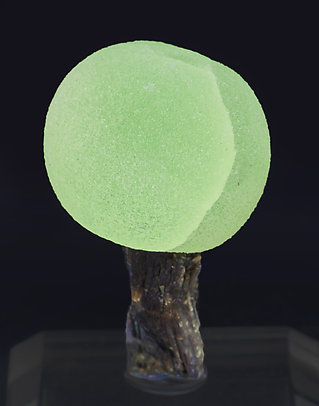
Rear |
| |
|
|
| Grossular |
|
|
|
|
|
ET13M3: A floater, a complete Grossular dodecahedron, beveled by trapezohedron faces. Crystal shows a very curious color zoning, creamy color and opaque on the edges and yellow to greenish and transparent in the center of the faces. A novelty, because this color zoning it was not seen before.
Mendié Kossa, Arrondissement Goundara, Cercle de Bafoulabé, Kayes Region Mali (2008)
Specimen size: 4.8 × 4.4 × 3.8 cm = 1.89” × 1.73” × 1.50”
|
|
|
|
Zircon with Quartz (variety smoky), Orthoclase and Aegirine |
|---|
Fluorescent light (daylight)
|
|
|
ETM89AO8: Group of Quartz crystals, some of them doubly terminated, transparent, with a light smoky tone, with white crystals of Orthoclase, black prismatic Aegirine crystals and dipyramidal crystals of Zircon, many of them doubly terminated, with brilliant luster and an intense orange color. Sometimes misidentified as Xenotime, analysis confirms it to be Zircon.
We will send a copy of the analysis to the buyer.
Mount Malosa, Zomba District Malawi (01/2021)
Specimen size: 6.8 × 6.5 × 4.7 cm = 2.68” × 2.56” × 1.85”
Main crystal size: 0.6 × 0.2 cm = 0.24” × 0.08”
With analysis copy
Fluorescent short UV
|
| |
|
| Zircon with Quartz (variety smoky), Orthoclase and Aegirine |
|
|
Fluorescent light (daylight)
|
|
|
|
ERB98AO8: Group of Quartz crystals, some of them doubly terminated, transparent, with a light smoky tone, with white crystals of Orthoclase, black prismatic Aegirine crystals and dipyramidal crystals of Zircon, many of them doubly terminated, with brilliant luster and an intense orange color. Sometimes misidentified as Xenotime, analysis confirms it to be Zircon.
We will send a copy of the analysis to the buyer.
Mount Malosa, Zomba District Malawi (01/2021)
Specimen size: 7.7 × 5.7 × 5.4 cm = 3.03” × 2.24” × 2.13”
Main crystal size: 0.4 × 0.2 cm = 0.16” × 0.08”
With analysis copy
Fluorescent short UV
|
|
|
|
Zircon with Quartz (variety smoky), Orthoclase and Aegirine |
|---|
Fluorescent light (daylight)
|
|
|
EHJ93AO8: Group of Quartz crystals, some of them doubly terminated, transparent, with a light smoky tone, with white crystals of Orthoclase, black prismatic Aegirine crystals and dipyramidal crystals of Zircon, many of them doubly terminated, with brilliant luster and an intense orange color. Sometimes misidentified as Xenotime, analysis confirms it to be Zircon.
We will send a copy of the analysis to the buyer.
This sample has been referenced and pictured, as a novelty in Ste. Marie 2022, in the magazine 'Le Règne Minéral' number 166, July-August 2022, page 42
Mount Malosa, Zomba District Malawi (01/2021)
Specimen size: 9.3 × 7.5 × 3.9 cm = 3.66” × 2.95” × 1.54”
Main crystal size: 0.7 × 0.4 cm = 0.28” × 0.16”
With analysis copy
Fluorescent short UV
|
| |
|
| Aegirine |
|
 |
|
|
|
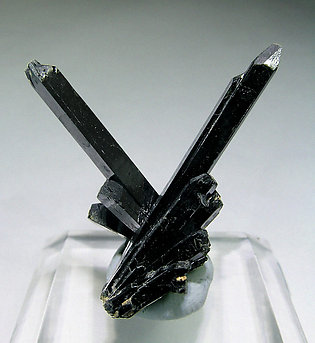
TN63H9: A nice miniature in which there are two main prismatic crystals with excellent terminations of acute pyramids. All crystals are very sharp and bright.
Previously in the Thomas P. Moore collection.
Mount Malosa, Zomba District Malawi
Specimen size: 3 × 2.7 × 1.3 cm = 1.18” × 1.06” × 0.51”
Main crystal size: 3.2 × 0.3 cm = 1.26” × 0.12”
|
|
|
|
Aegirine with smoky Quartz |
|---|
|
|
MM14V0: Doubly terminated crystal of Aegirine with pyramidal faces on one of the terminations and polycrystalline growth on the opposite end. It’s on a doubly terminated crystal of Quartz, colorless and transparent in the prism and neatly deep smoky on the terminations, one of them with a group of small crystals of Aegirine.
Mount Malosa, Zomba District Malawi
Specimen size: 6.5 × 3.9 × 1.1 cm = 2.56” × 1.54” × 0.43”
Main crystal size: 6.5 × 0.5 cm = 2.56” × 0.20”
Former collection of Claus Hedegaard
|
| 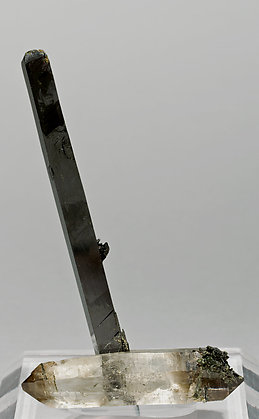 |
|
| Aegirine with Quartz |
|
|
|
|
|
EH6AD8: Aggregate of very elongated Aegirine crystals that are doubly terminated, very bright and with Quartz crystals. The sample has very unusual esthetic quality.
Mount Malosa, Zomba District Malawi (2014)
Specimen size: 6.5 × 4.5 × 1.6 cm = 2.56” × 1.77” × 0.63”
Main crystal size: 5.5 × 0.4 cm = 2.17” × 0.16”
|
|
|
|
Aegirine with Orthoclase and Zircon |
|---|
|
|
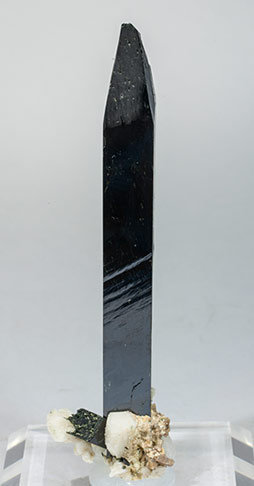
EF76AE4: Very elongated single Aegirine crystal with a very acute pyramidal termination, very bright and on matrix, with Orthoclase and small creamy Zircon crystals.
Mount Malosa, Zomba District Malawi (2016)
Specimen size: 9.4 × 2.4 × 1.5 cm = 3.70” × 0.94” × 0.59”
Main crystal size: 8.3 × 1 cm = 3.27” × 0.39”
|
| 
Front | 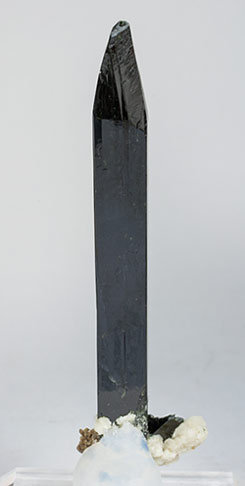
Rear |
| |
|
|
| Twinned Aegirine with Feldspar anz Zircon |
|
|
|
|
|
EC26AD8: A considerably large Aegirine crystal with very well defined faces and edges, with good terminations and a unique characteristic, a very well defined and visible frontal twin, not previously noted at Mount Malosa, as far as we know. The twinned crystal is on a matrix of white feldspar crystals and its back is partially coated by small Zircon crystals, many of them doubly terminated.
Mount Malosa, Zomba District Malawi (2014)
Specimen size: 15 × 11.8 × 11.2 cm = 5.91” × 4.65” × 4.41”
Main crystal size: 13 × 6.8 cm = 5.12” × 2.68”
Zircon fluorescence short UV & minor fluorescence long UV. Feldspar minor fluorescence short UV.
|
|
|
|
Aegirine with Zircon and Feldspar |
|---|
|
|
EM46P4: A fan group of very elongated prismatic crystals with complex terminations, very bright and with a group of white Feldspar crystals (probably Microcline) partially covered by small doubly terminated crystals of Zircon on the base of the sample. For their luster and size of crystals this is an exceptional piece.
Mount Malosa, Zomba District Malawi (04/2009)
Specimen size: 17.5 × 3.9 × 2.9 cm = 6.89” × 1.54” × 1.14”
|
| |
|
| Arfvedsonite with Orthoclase |
|
Front | 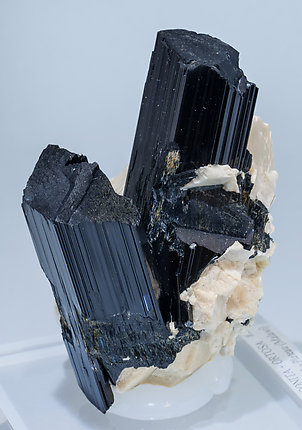
Side |
| |
|
|
|
|
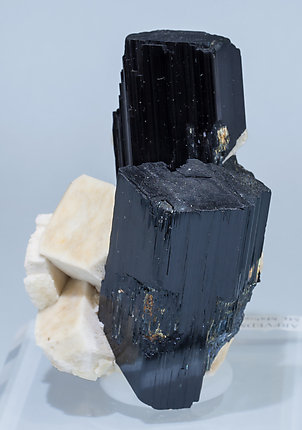
LQ86AL0: Two crystals, one of them partially doubly terminated, with very well defined faces and edges, with good terminations, on a matrix of white Orthoclase crystals. The specimen has been analyzed and we will send a copy of the analysis to the buyer.
Mount Malosa, Zomba District Malawi (07/2007)
Specimen size: 6.1 × 3.6 × 3.8 cm = 2.40” × 1.42” × 1.50”
Main crystal size: 4.4 × 2.6 cm = 1.73” × 1.02”
|
|
|
|
Arfvedsonite with Albite |
|---|
|
|
MB70M8: Crystal has multiple termination and it is partially fibrous. It looks very well defined, very aerial, and has excellent luster. It stands on a matrix of small crystals of Albite.
Mount Malosa, Zomba District Malawi (2008)
Specimen size: 8 × 5 × 3.9 cm = 3.15” × 1.97” × 1.54”
Main crystal size: 7.4 × 2 cm = 2.91” × 0.79”
Albite fluorescent short UV
|
| |
|
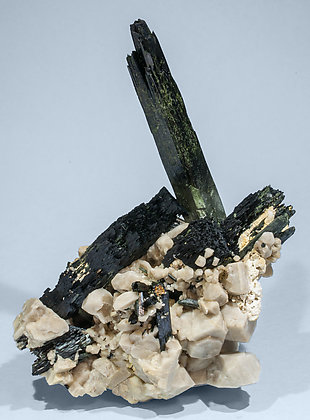
| Arfvedsonite with Aegirine and Orthoclase |
|
Front | 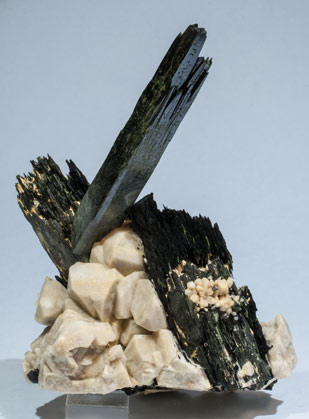
Rear |
| |
|
|
|
|
EC90AH4: Very well defined Arfvedsonite crystals with acute polycrystalline terminations. They are bright with a very deep green color and are on a matrix of Orthoclase crystals that very well defined Baveno twins, and black prismatic Aegirine crystals around the base of the Arfvedsonite crystal.
Mount Malosa, Zomba District Malawi (2014)
Specimen size: 14 × 10.5 × 6.8 cm = 5.51” × 4.13” × 2.68”
Main crystal size: 9 × 1.2 cm = 3.54” × 0.47”
|
|
|
|
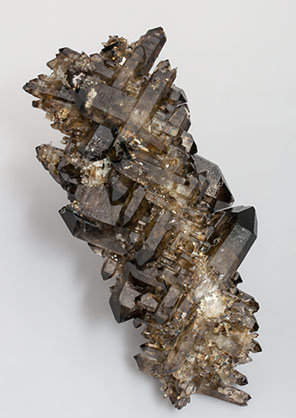
Quartz (variety smoky quartz) |
|---|
|
|
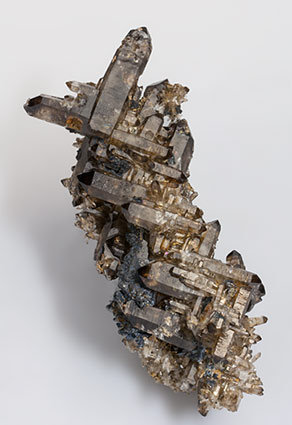
EQ37AC0: A novelty at the Ste. Marie-aux-Mines 2015 Show. Excellent example in which the two directions of the smoky Quartz crystals have been controlled epitactically by the feldspar upon which they grew. They resemble multiple Japan law twins but they are not twins. This phenomenon is seen on similar specimens from the Erongo Mountains, Namibia, as described by John White in an article in Rocks & Minerals, vol. 87, Sept./Oct. 2012, pp. 459-462, but this one has a related combo of small species, classics from Malawi.
Mount Malosa, Zomba District Malawi (11-12/2014)
Specimen size: 8.4 × 4.1 × 2.9 cm = 3.31” × 1.61” × 1.14”
Main crystal size: 2.3 × 1.6 cm = 0.91” × 0.63”
|
|  |
|
| Quartz (variety smoky quartz) |
|
 |
|
|
|
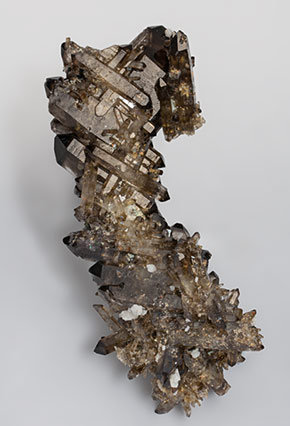
EM27AC0: A novelty at the Ste. Marie-aux-Mines 2015 Show. Excellent example in which the two directions of the smoky Quartz crystals have been controlled epitactically by the feldspar upon which they grew. They resemble multiple Japan law twins but they are not twins. This phenomenon is seen on similar specimens from the Erongo Mountains, Namibia, as described by John White in an article in Rocks & Minerals, vol. 87, Sept./Oct. 2012, pp. 459-462, but this one has a related combo of small species, classics from Malawi.
The specimen's photo has been reviewed and published in the magazine ‘Rocks & Minerals’ on page 11 in the volume 91, number 1, Jan/Feb 2016
Mount Malosa, Zomba District Malawi (11-12/2014)
Specimen size: 8 × 3.5 × 3.6 cm = 3.15” × 1.38” × 1.42”
Main crystal size: 2.7 × 0.7 cm = 1.06” × 0.28”
|
|
|
|
Quartz (variety smoky quartz) |
|---|
|
|
EP37AC0: A novelty at the Ste. Marie-aux-Mines 2015 Show. Excellent example in which the two directions of the smoky Quartz crystals have been controlled epitactically by the feldspar upon which they grew. They resemble multiple Japan law twins but they are not twins. This phenomenon is seen on similar specimens from the Erongo Mountains, Namibia, as described by John White in an article in Rocks & Minerals, vol. 87, Sept./Oct. 2012, pp. 459-462, but this one has a related combo of small species, classics from Malawi.
The specimen's photo has been reviewed and published in the magazine ‘Rocks & Minerals’ on page 11 in the volume 91, number 1, Jan/Feb 2016
Mount Malosa, Zomba District Malawi (11-12/2014)
Specimen size: 9.2 × 4 × 4 cm = 3.62” × 1.57” × 1.57”
Main crystal size: 2.1 × 1.1 cm = 0.83” × 0.43”
|
|  |
|
| Eudidymite with Aegirine and Quartz |
|
Front | 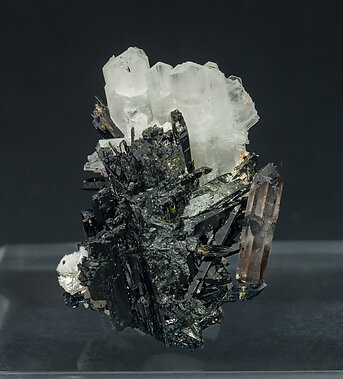
Rear |
| |
|
Fluorescent light (daylight)
|
|
|
|
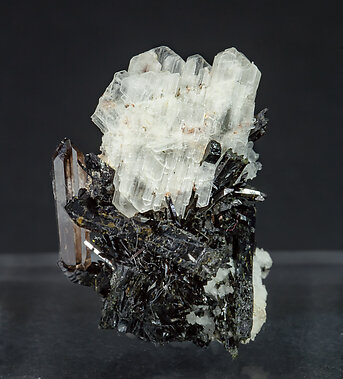
MTX67AO7: Parallel growths of white Eudidymite crystals, sharp, doubly terminated, transparent, lustrous, and implanted in a group of acicular Aegirine crystals. Eudidymite is a species that very rarely occurs in well-defined crystals with good terminations, which is why the specimens from this find fall into the category of exceptional.
The specimen has been analyzed and we will send a copy of the analysis to the buyer.
Mount Malosa (Northwest side), Zomba District Malawi (09/2019)
Specimen size: 2.5 × 1.8 × 1.8 cm = 0.98” × 0.71” × 0.71”
Main crystal size: 1.4 × 1.1 cm = 0.55” × 0.43”
With analysis copy
|
|
|
|
Eudidymite |
|---|
|
|
EB14AC5: Aggregate of laminar very well shaped crystals with acute terminations in parallel growth. Eudidymite is a very uncommon species but characteristic of Mount Malosa. The sample has been analyzed and we’ll send a copy of the analysis to the buyer.
Mount Malosa, Zomba District Malawi (2005)
Specimen size: 4.2 × 1.5 × 0.2 cm = 1.65” × 0.59” × 0.08”
|
| 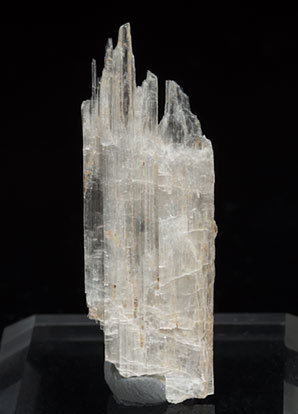
Front | 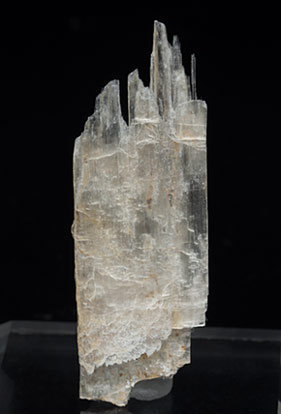
Rear |
| |
|
|
| Eudidymite with Aegirine |
|
|
|
|
|
MG50AK7: New in Munich 2019: Parallel growth of sharp white Eudidymite crystals, doubly terminated and implanted in a group of Aegirine crystals. Eudidymite is a species that very rarely occurs in sharp and well-terminated crystals and that is why the specimens from this find are so exceptional. This specimen has been analyzed and we will send a copy of the analysis to the buyer.
This sample has been referenced and pictured, as a novelty in Munich 2019, in the magazine 'Le Règne Minéral' number 150, page 42 and published on the Mineralogical Record´s web page, in the ‘What's New’ section, report 54, December 13, 2019 edition, page 3 as well as in the magazine ‘Mineral Up’ on page 52 of the 2020/01 edition.
Mount Malosa (Northwest side), Zomba District Malawi (09/2019)
Specimen size: 4.4 × 3 × 2.3 cm = 1.73” × 1.18” × 0.91”
Main crystal size: 2.3 × 1.5 cm = 0.91” × 0.59”
|
|
|
|
Eudidymite |
|---|
|
|
EQ46K3: Fanlike group of laminar very well shaped crystals. Their size is very considerable for the species. A magnificent sample of a very uncommon species. We analyzed the specimen and we’ll send a copy of the analysis to the buyer.
Mount Malosa, Zomba District Malawi (03/2007)
Specimen size: 6.1 × 5.9 × 4.9 cm = 2.40” × 2.32” × 1.93”
Main crystal size: 6 × 4 cm = 2.36” × 1.57”
|
| |
|
| Eudidymite on doubly terminated Aegirine |
|
|
|
|
|
EF16K6: Eudidymite forms a parallel growth of delicate white and doubly terminated crystals implanted on a doubly terminated black crystal of Aegirine.
Mount Malosa, Zomba District Malawi (2006)
Specimen size: 6.3 × 4.1 × 1.7 cm = 2.48” × 1.61” × 0.67”
Main crystal size: 3 × 2.2 cm = 1.18” × 0.87”
|
|
|
|
Eudidymite with Aegirine |
|---|
|
|
EA98Y7: Aggregate of very thin laminar Eudidymite crystals that show very well defined contours, a more than considerable size for the species and with small and acute black Aegirine crystals. An excellent sample of a very uncommon species. The sample has been analyzed and we’ll send a copy of the analysis to the buyer.
Mount Malosa, Zomba District Malawi (2005)
Specimen size: 14.6 × 7.8 × 1.8 cm = 5.75” × 3.07” × 0.71”
|
| |
|
| Epididymite with Aegirine |
|
|
|
|
|
ED78P9: A museum sample, both for its size (enormous for the species) and for its quality. It consists of an aggregate of large white laminar crystals of Epididymite with a satiny luster and with fine black crystals of Aegirine. The sample has been carefully analyzed to differentiate it from Eudidymite, also present at the locality. We’ll send a copy of the analysis to the buyer.
Mount Malosa, Zomba District Malawi (07/2007)
Specimen size: 13.2 × 9.2 × 1.7 cm = 5.20” × 3.62” × 0.67”
|
|
|
|
Barylite and Aegirine |
|---|
|
|
TV87C9: Recently new Barylites were found in the famous Mt. Malosa mining area. They are much better than the others found on the past such as the Langban ones. From this great new find of an uncommon species we selected this specimen for its good combination with the Aegirine as well as for its nice form.
Mount Malosa, Zomba District Malawi (2002)
Specimen size: 2 × 1.6 × 1.3 cm = 0.79” × 0.63” × 0.51”
Main crystal size: 0.8 × 0.2 cm = 0.31” × 0.08”
|
| 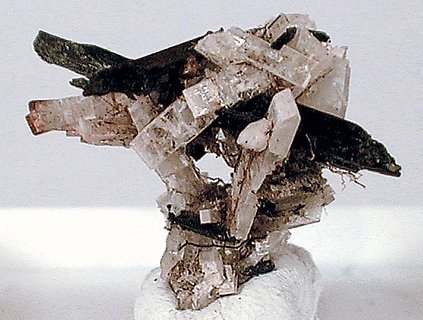 |
|
| Epididymite with Aegirine |
|
|
|
|
|
EB66AF5: A novelty at Sainte Marie-aux-Mines 2017. Very unusual parallel growth, on matrix, of two very well defined elongated crystals (the most common shape is platy and poorly defined), partially doubly terminated, with very well developed faces and edges and with excellent terminal faces that are transparent-translucent and quite bright, with small Aegirine and Quartz crystals.
This specimen was photographed and published as a novelty at the 2017 Ste. Marie Show in the magazine ‘Le Règne Minéral’ number 136, page 47
Machinga, Machinga District Malawi (02/2017)
Specimen size: 3 × 2.9 × 1.9 cm = 1.18” × 1.14” × 0.75”
Main crystal size: 2.4 × 0.7 cm = 0.94” × 0.28”
Fluorescent short UV
|
|
|
|
Niobophyllite with Aegirine and Orthoclase |
|---|
|
|
MT49AE4: A novelty at Munich 2016. Well individualized Niobophyllite crystals with parallel growths, an intense color, and with Aegirine and Orthoclase. The sample is from a recent find in a relatively new open area far from the well-known Mount Malosa.
This sample has been photographed and published as a novelty in Munich 2016 in the magazine Le Règne Minéral number 132, page 49, the magazine ‘Mineral Up’ on page 59 of the 2016/02 edition and the magazine ‘Paragénesis’, number 01/2017, page 68
Machinga, Machinga District Malawi (2016)
Specimen size: 4 × 3.7 × 2.6 cm = 1.57” × 1.46” × 1.02”
Main crystal size: 3.5 × 1 cm = 1.38” × 0.39”
|
| |
|
| Elbaite |
|
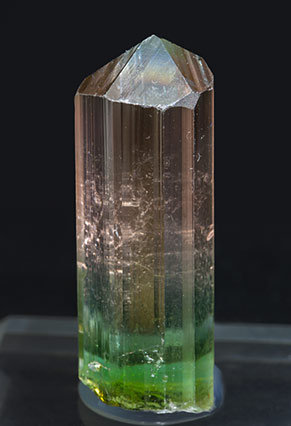
Front | 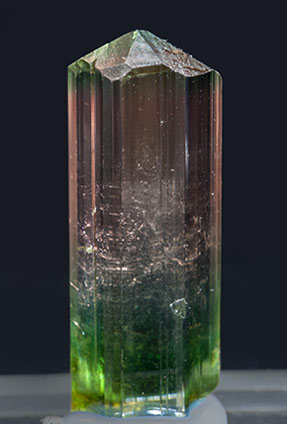
Rear |
| |
|
|
|
|
MK73AE4: Single gemmy crystal, fully transparent and very bright, with very well defined faces and edges on the prism and also on the terminal rhombohedra. A crystal of excellent quality. It is different from what is usually found at this mine.
Naipa Mine, Alto Ligonha pegmatite, Zambezia Province Mozambique (08/2016)
Specimen size: 3.2 × 1.3 × 1.1 cm = 1.26” × 0.51” × 0.43”
Weight: 10 grams
|
|
|
|
Elbaite |
|---|
|
|
EQ73AE4: Single crystal with a very well defined parallel growth and very well defined terminal faces. It is transparent and has colored stripes alternating pink and bluish green color. It’s different to the most usually found at this mine.
This specimen was published on the Mineralogical Record´s web page, in the ‘What's New’ section, report 45, January 2, 2017 edition.
Naipa Mine, Alto Ligonha pegmatite, Zambezia Province Mozambique (08/2016)
Specimen size: 5.1 × 2.2 × 2.2 cm = 2.01” × 0.87” × 0.87”
Weight: 42 grams
|
| 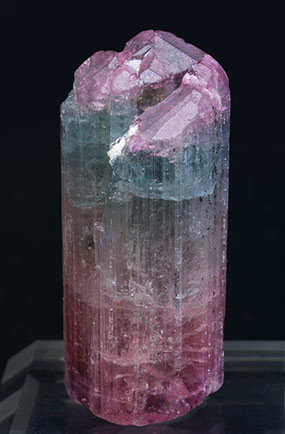
Front | 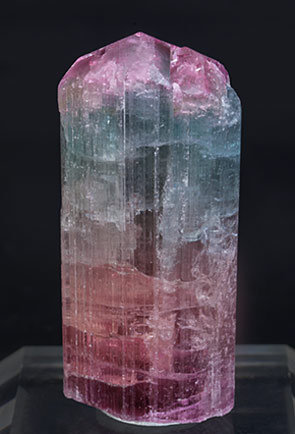
Rear |
| |
|
|
| Elbaite |
|
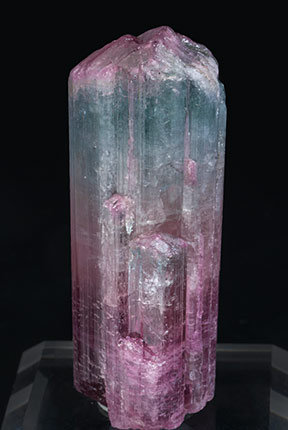
Front | 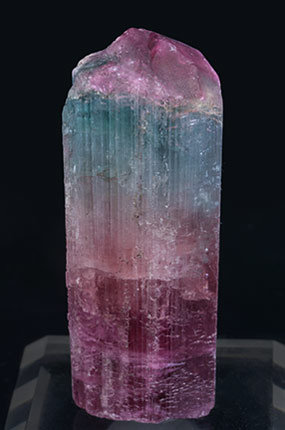
Rear |
| |
|
|
|
|
EV26AE4: Single crystal with a very well defined parallel growth and very well defined terminal faces. It is transparent and has colored stripes alternating pink and bluish green color. It’s different to the most usually found at this mine.
Naipa Mine, Alto Ligonha pegmatite, Zambezia Province Mozambique (08/2016)
Specimen size: 6.4 × 2.4 × 2.4 cm = 2.52” × 0.94” × 0.94”
Weight: 65 grams
|
|
|
|
'lepidolite' after Elbaite with Tantalite-(Mn) |
|---|
|
|
MX70AG3: A novelty at Munich 2017. Parallel growths, with a fibrous aspect, of 'lepidolite' pseudomorphous after an Elbaite crystal, with doubly terminated Tantalite-(Mn) crystals with very well defined faces and edges, transparent and with a very vivid red color.
This specimen was photographed for the ‘Munich 2017’ section of the magazine ‘Mineralien Welt’ and appears on page 70 of number 1/2018
Naipa Mine, Alto Ligonha pegmatite, Zambezia Province Mozambique (07/2017)
Specimen size: 4.9 × 2.8 × 2.4 cm = 1.93” × 1.10” × 0.94”
|
| |
|
| 'lepidolite' after Elbaite |
|
|
|
|
|
NG69AH6: A novelty at Munich 2017. 'lepidolite' pseudomorphous after a single Elbaite (rubellite variety) crystal with visible parallel growths. The Elbaite is visible on the base where it is translucent with an intense pink color and rich in channels and other dissolution forms.
Naipa Mine, Alto Ligonha pegmatite, Zambezia Province Mozambique (07/2017)
Specimen size: 9.8 × 3.3 × 3.1 cm = 3.86” × 1.30” × 1.22”
|
|
|
|
'lepidolite' after Elbaite with Elbaite |
|---|
|
|
MR94AG3: A novelty at Munich 2017. Parallel growths of 'lepidolite' (series) crystals pseudomorphous after Elbaite. They are bright with an intense pink color, with channels and other dissolution forms and with the crystalline remains of Elbaite (verdelite variety) on the upper end.
This specimen was photographed for the ‘Munich 2017’ section of the magazine ‘Mineralien Welt’ and appears on page 70 of number 1/2018
Naipa Mine, Alto Ligonha pegmatite, Zambezia Province Mozambique (07/2017)
Specimen size: 13.2 × 5.2 × 5.2 cm = 5.20” × 2.05” × 2.05”
|
| |
|
| 'lepidolite' after Elbaite with Elbaite |
|
|
|
|
|
MT16AG3: A novelty at Munich 2017. Parallel growths of 'lepidolite' crystals, pseudomorphous after Elbaite, with good terminations. They are bright, with an intense pink color, with channels and other dissolution forms and with transparent Elbaite (verdelite variety) crystals on the upper end that seem to be a later Elbaite generation.
This sample has been photographed and published as a novelty in Munich 2017 in the magazine Le Règne Minéral number 138, page 39, the magazine "Lapis" number 12/2017, page 43 and the magazine ‘Mineralien Welt’ on page 69 of number 1/2018
Naipa Mine, Alto Ligonha pegmatite, Zambezia Province Mozambique (07/2017)
Specimen size: 15.4 × 5 × 4.7 cm = 6.06” × 1.97” × 1.85”
|
|
|
|
Tantalite-(Mn) |
|---|
|
|
TY56H7: An extraordinary specimen. A group of two crystals, one of them twinned, dominant and bigger, showing parallel growth following the twin plane. The definition of the crystal is magnificent. Although its color is not red the analysis determined it is really Tantalite-(Mn). We’ll send a copy of the analysis to the buyer.
Also, this specimen was photographed for the ‘what’s new at St Marie 2006’ section of the magazine ‘Minéraux et Fossiles’ and appears on page 21 of number 353. We will send the purchaser a copy of the magazine.
Murrua Mine, Gile, Quelimane, Alto Ligonha Mozambique (2005)
Specimen size: 10.3 × 6.2 × 4.4 cm = 4.06” × 2.44” × 1.73”
|
| |
|
| Beryl ( variety morganite) |
|
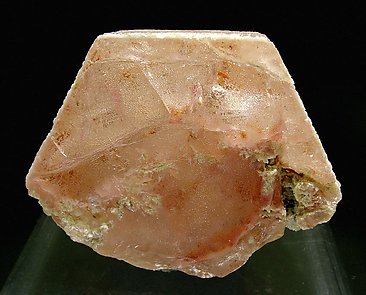
Front | 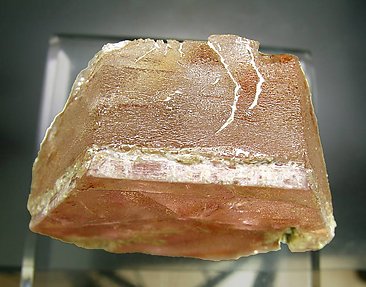
Top | |
|
|
|
|
TC28I1: Very short prismatic crystal with a perfect flat termination and the other showing dissolution shapes. The sharpness of faces and edges is excellent and so is the color, very deep.
Alto Ligonha Mozambique
Specimen size: 5.8 × 4.4 × 2.5 cm = 2.28” × 1.73” × 0.98”
|
|
|
|
Ixiolite with Muscovite |
|---|
|
|
NA63Z6: An aggregate of exceptionally well developed crystals, really large for the species. They are on matrix with very sharp laminar Muscovite crystals. A sample of great quality that has been analyzed. We will send a copy of the analysis to the buyer.
Naipa Mine, Alto Ligonha, Zambezia Mozambique (±1985)
Specimen size: 3.2 × 2.8 × 2.3 cm = 1.26” × 1.10” × 0.91”
Main crystal size: 0.9 × 0.8 cm = 0.35” × 0.31”
|
| |
|
| Descloizite |
|
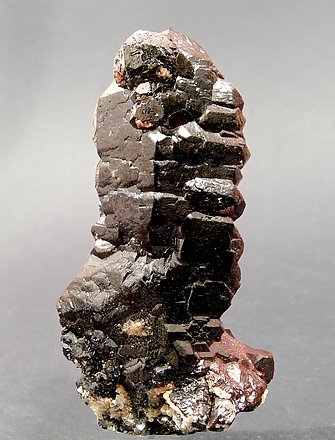 |
|
|
|
EE76D2: Thick, really thick, this crystal does not look anything like the other descloizites I have seen. I really like the bulk of it as well as its strange architecture.
Berg Aukas, Grootfontein District, Otjozondjupa Region Namibia
Specimen size: 5.2 × 2.5 × 1.5 cm = 2.05” × 0.98” × 0.59”
|
|
|
|
Descloizite |
|---|
|
|
EK86V1: Aggregate of very flattened dipyramidal crystals of dark brown, almost black color, with a second generation of smaller reddish crystals.
Berg Aukas, Grootfontein District, Otjozondjupa Region Namibia (1970-1980)
Specimen size: 5.4 × 4.8 × 3.3 cm = 2.13” × 1.89” × 1.30”
Main crystal size: 2.2 × 1.5 cm = 0.87” × 0.59”
Former collection of Uwe Niemeyer
|
| |
|
| Descloizite |
|
|
|
|
|
TR46G3: Such crystallization is very uncommon. Crystals are orthorhombic bipyramids of very well-shaped faces and edges, with a beautiful bright brown color. With a wide "pedigree" as its five labels show. We'll send these labels to the buyer of the specimen.
Olifantsfontein Mine, Olifantsfontein, Grootfontein Namibia
Specimen size: 4 × 3.4 × 2.4 cm = 1.57” × 1.34” × 0.94”
Main crystal size: 0.4 × 0.4 cm = 0.16” × 0.16”
|
|
|
|
Willemite |
|---|
|
|
EZ96X0: Radial groups of very elongated small prismatic, acicular, crystals that have very well defined faces and edges, neatly visible with a lens. The crystals, colorless and very bright, are on a rocky matrix.
Berg Aukas, Grootfontein District, Otjozondjupa Region Namibia
Specimen size: 7.3 × 4 × 1.9 cm = 2.87” × 1.57” × 0.75”
Main crystal size: 0.3 × 0.1 cm = 0.12” × 0.04”
Intense fluorescence short UV & fluorescent long UV
Former collection of Claus Hedegaard. Number 12875
|
| |
|
| Dioptase with Plancheite |
|
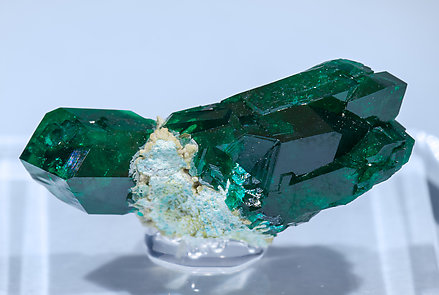
Front | 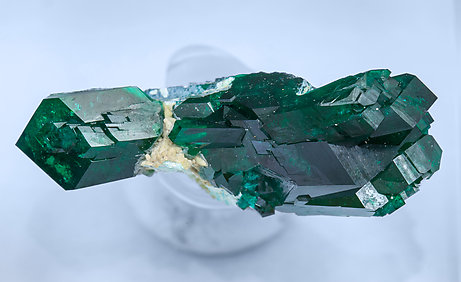
Top |
| |
|
|
|
|
EF86AI7: Divergent crystals of Dioptase on a matrix coated by Planchéite. One of them is a single crystal while the other is polycrystalline, but both have very well defined faces and edges and are very bright, with a very deep color.
Kandesei Mine, Kaokoveld Plateau, Kunene Region Namibia (±2007)
Specimen size: 2.5 × 1.4 × 1 cm = 0.98” × 0.55” × 0.39”
Main crystal size: 1 × 0.6 cm = 0.39” × 0.24”
|
|
|
|
Dioptase with Quartz |
|---|
|
|
TD98V7: Druse of Dioptase crystals, a lot of them doubly terminated, with very acute rhombohedral terminations, translucent, extraordinarily bright and on a matrix of crystalline Quartz.
Kandesei Mine, Kaokoveld Plateau, Kunene Region Namibia (2011)
Specimen size: 5.3 × 2.9 × 3.2 cm = 2.09” × 1.14” × 1.26”
Main crystal size: 0.8 × 0.3 cm = 0.31” × 0.12”
|
| |
|
| Dioptase with Plancheite and Quartz |
|
|
|
|
|
ED90AI5: Isolated Dioptase crystals, one of them clearly dominant, that are partially doubly terminated, bright, with a deep color and on a matrix of crystalline Quartz partially coated by Planchéite.
The sample is from the Raúl Sanabria collection whose label we’ll send to the buyer.
Kandesei Mine, Kaokoveld Plateau, Kunene Region Namibia (±2007)
Specimen size: 5.6 × 4.5 × 4.1 cm = 2.20” × 1.77” × 1.61”
Main crystal size: 1.6 × 0.8 cm = 0.63” × 0.31”
Former collection of Raúl Sanabria
|
|
|
|
Dioptase on Calcite |
|---|
|
|
TA92AD1: Two single and isolated crystals, with a considerable length for the locality, partially doubly terminated, translucent, very bright and implanted on a matrix coated by Calcite.
Kaokoveld Plateau, Kunene Region Namibia (2011)
Specimen size: 6.7 × 4 × 2.7 cm = 2.64” × 1.57” × 1.06”
Main crystal size: 1.5 × 0.9 cm = 0.59” × 0.35”
Calcite minor fluorescence short UV
|
| |
|
| Shattuckite |
|
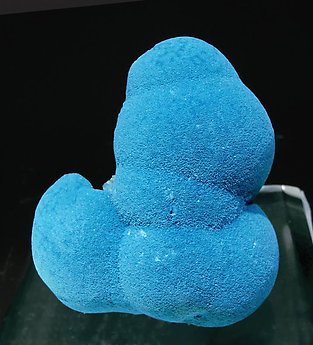 |
|
|
|
TJ89L0: A novelty of Tucson 2008. This Shattuckite specimen comes from the recent works in the Kandesei Mine, on Kaokoveld, that started recently to mine for collection specimens. Very esthetic botryoidal growth, with an intense and very uniform color.
Kandesei Mine, Kaokoveld Plateau, Kunene Region Namibia (2007)
Specimen size: 3.4 × 3 × 1.5 cm = 1.34” × 1.18” × 0.59”
|
|
|
|
Shattuckite with Malachite and Quartz |
|---|
|
|
TE100Z9: Fine botryoidal Shattuckite aggregate, with an intense and deep blue color, that fills a vug on a Quartz matrix with crystalline Malachite.
Kandesei Mine, Kaokoveld Plateau, Kunene Region Namibia (2009)
Specimen size: 5 × 3.5 × 2.8 cm = 1.97” × 1.38” × 1.10”
|
| |
|
| Shattuckite with Quartz |
|
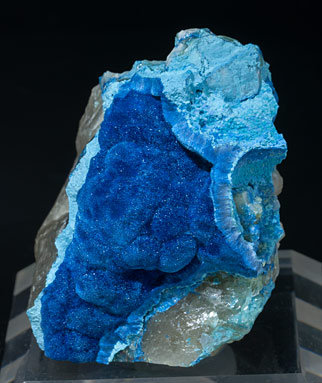 |
|
|
|
TL20AB1: Fine botryoidal Shattuckite aggregate, with a felted surface and a very uniform and intense blue color with, with clearer blue borders with an intense and deep blue color, that upholster a vug on a Quartz matrix.
Kandesei Mine, Kaokoveld Plateau, Kunene Region Namibia (2009)
Specimen size: 5.2 × 3.4 × 4.3 cm = 2.05” × 1.34” × 1.69”
|
|
|
|
Shattuckite with Quartz |
|---|
|
|
TV26Q2: Globular groups of deep sky blue color filling a vug on a Quartz matrix. The mining has been abandoned so probably we must expect an increasing scarcity of this kind of sample in the mineral market.
Kandesei Mine, Kaokoveld Plateau, Kunene Region Namibia (2009)
Specimen size: 5.9 × 4.7 × 2.4 cm = 2.32” × 1.85” × 0.94”
|
| |
|
| Shattuckite with Quartz |
|
|
|
|
|
TN27Z3: Very well defined and isolated globular growths with velvet surfaces and an intense and uniform blue color. They are partially coating a Quartz matrix. Original.
Kandesei Mine, Kaokoveld Plateau, Kunene Region Namibia (2009)
Specimen size: 6 × 4.1 × 1.6 cm = 2.36” × 1.61” × 0.63”
Main crystal size: 0.2 × 0.2 cm = 0.08” × 0.08”
|
|
|
|
Shattuckite with Malachite and Quartz |
|---|
|
|
TT14Q2: Deep blue botryoidal growths filling a vug on a crystallized Quartz matrix and Malachite. The mining has been abandoned so probably we must expect an increasing scarcity of this kind of sample in the mineral market.
Kandesei Mine, Kaokoveld Plateau, Kunene Region Namibia (2009)
Specimen size: 8 × 6.9 × 4.8 cm = 3.15” × 2.72” × 1.89”
|
| |
|
| Shattuckite with Malachite |
|
|
|
|
|
TR16AL2: Botryoidal coating of Shattuckite with a velvety appearance, on Quartz matrix and highlighting a centered aggregate of very good size sharp primary Malachite crystals.
Kandesei Mine, Kaokoveld Plateau, Kunene Region Namibia
Specimen size: 8.2 × 6.2 × 4.8 cm = 3.23” × 2.44” × 1.89”
Main crystal size: 3.4 × 1 cm = 1.34” × 0.39”
|
|
|
|
Shattuckite with Malachite and Quartz |
|---|
|
|
TQ27R9: Globular growths of Shattuckite with a very deep and uniform blue color. They are coated by microcrystals of clear Quartz and are with a bundle of acicular crystals of Malachite on a matrix of Quartz.
Kandesei Mine, Kaokoveld Plateau, Kunene Region Namibia (2009)
Specimen size: 8.6 × 8.2 × 5.3 cm = 3.39” × 3.23” × 2.09”
|
| |
|
| Quartz with Shattuckite inclusions |
|
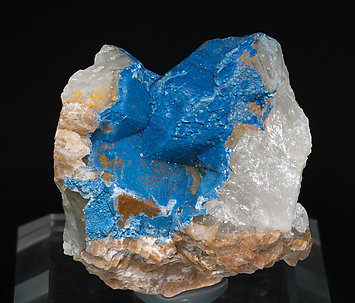 |
|
|
|
TB78Z3: Quartz crystals very rich in Shattuckite inclusions with an unusually intense and uniform color. A sample that is very different than usual.
Kandesei Mine, Kaokoveld Plateau, Kunene Region Namibia (2009)
Specimen size: 3.4 × 3.2 × 2.4 cm = 1.34” × 1.26” × 0.94”
Main crystal size: 2.1 × 1.2 cm = 0.83” × 0.47”
|
|
|
|
Malachite with Cerussite |
|---|
|
|
MY88AK9: Fan-shaped growth, very aerial and aesthetic, of fibrous Malachite crystals, with intense satin luster, implanted on Cerussite crystals with inclusions. The association is rare.
Kaokoveld Plateau, Kunene Region Namibia
Specimen size: 3.2 × 2.2 × 1 cm = 1.26” × 0.87” × 0.39”
|
| 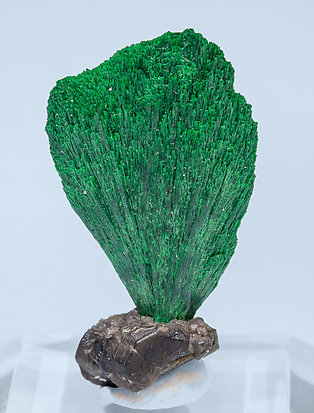
Front | 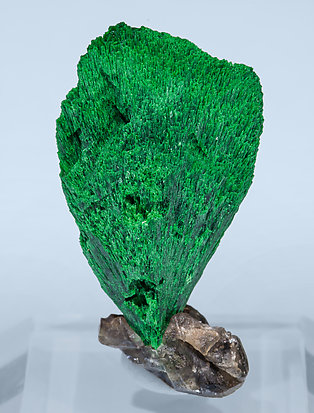
Rear |
| |
|
|
| Malachite with Quartz |
|
|
|
|
|
TG14V1: Radial group of very well developed crystals of primary Malachite. They are very bright and have perfect terminations, a very deep color and are on Quartz matrix.
Kaokoveld Plateau, Kunene Namibia (2009)
Specimen size: 7.8 × 6.5 × 5 cm = 3.07” × 2.56” × 1.97”
Main crystal size: 1.3 × 0.7 cm = 0.51” × 0.28”
|
|
|
|
Fluorite with Calcite |
|---|
|
|
MV63R5: Group of cubic crystals with very well defined faces and edges. They are transparent, very bright and have spectacular changes of color, between the green and the deepest and intense blue-violet shades.
Okorusu Mine, Otjiwarongo District, Otjozondjupa Region Namibia (09-11/2009)
Specimen size: 7.1 × 5.2 × 2.2 cm = 2.80” × 2.05” × 0.87”
Main crystal size: 1.7 × 1.4 cm = 0.67” × 0.55”
Fluorescent long & short UV
|
| |
|
| Fluorite |
|
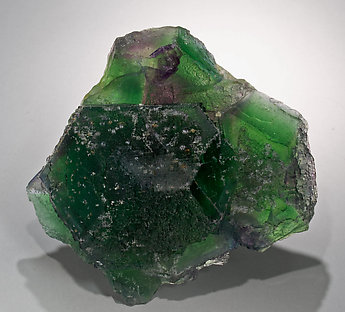 |
|
|
|
ER49X0: Group of cubo-octahedral crystals, one of them clearly dominant and of a considerable size for the locality. They are translucent and have a very deep green color with violet color zoning in some areas.
Okorusu Mine, Otjiwarongo, Otjozondjupa Namibia
Specimen size: 9.4 × 8.6 × 4 cm = 3.70” × 3.39” × 1.57”
Main crystal size: 6.2 × 5.5 cm = 2.44” × 2.17”
Minor fluorescence long & short UV
Former collection of Claus Hedegaard. Number 13034
|
|
|
|
Fluorite |
|---|
|
|
MR96R5: Group of cubic crystals with very well defined faces and edges. They are transparent, bright and have a very fine violet color zoning parallel to the edges of the intense green crystals. Some areas on the sample are partially coated by small white crystals of Calcite.
Okorusu Mine, Otjiwarongo District, Otjozondjupa Region Namibia (09-11/2009)
Specimen size: 15.5 × 7.8 × 4.3 cm = 6.10” × 3.07” × 1.69”
Main crystal size: 1.6 × 1.6 cm = 0.63” × 0.63”
Fluorescent long & short UV
|
| |
|
|
'lepidolite' with Clevelandite |
|---|
|
|
TL96L5: Testaceous group of well defined prismatic 'lepidolite' crystals. Excellent terminations and nice mauve color. Associated with laminar Albite crystals and minor Fluorapatite (very fluorescent) in the matrix.
Otjua Mine, Otjua Farm 37, Karibib District, Erongo Region Namibia
Specimen size: 13.3 × 9.4 × 5.6 cm = 5.24” × 3.70” × 2.20”
Main crystal size: 0.4 × 0.4 cm = 0.16” × 0.16”
Fluorapatite very fluorescent long & short UV
|
| |
|
| Topaz on Quartz |
|
|
|
|
|
TP6AL3: Very sharp Topaz crystal very rich in faces, transparent, with excellent luster and implanted on a Quartz matrix. We will deliver the specimen in its original Perky box from the Robert J. Noble collection, which also contains the label.
Kleine Spitzkoppe, Spitzkopje area, Karibib District, Erongo Region Namibia
Specimen size: 2.5 × 2.5 × 1.7 cm = 0.98” × 0.98” × 0.67”
Main crystal size: 1.5 × 1.1 cm = 0.59” × 0.43”
Former collection of Bob Noble
|
|
|
|
Phlogopite with Calcite |
|---|
|
|
TG12N2: A novelty of Tucson 2009. Flattened crystal of hexagonal profile on a matrix of pinkish Calcite. Very interesting is the fact that the crystals have some terminations. It has been analyzed and shown to be Phlogopite. We’ll send a copy of the analysis to the buyer of the sample.
Arandis, Swakopmund, Erongo Region Namibia (2008)
Specimen size: 3.9 × 3.3 × 3.7 cm = 1.54” × 1.30” × 1.46”
Main crystal size: 3.7 × 2.9 cm = 1.46” × 1.14”
Calcite minor fluorescence long & short UV
|
| 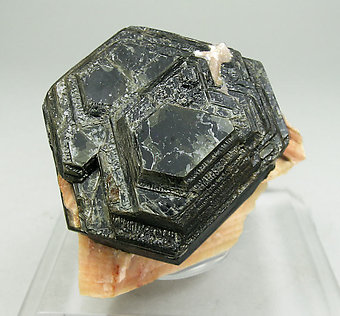 |
|
| Phlogopite with Calcite |
|
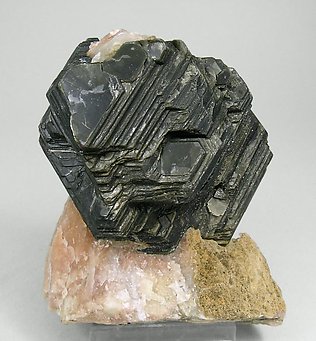
Front | 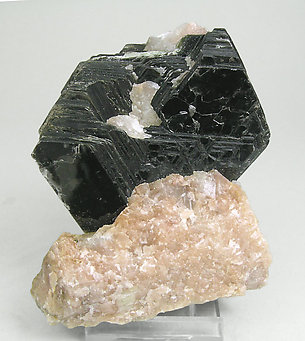
Rear |
| |
|
|
|
|
TA26N2: A novelty of Tucson 2009. Flattened crystal of hexagonal profile on a matrix of pinkish Calcite. Very interesting is the fact that the crystals have some terminations. It has been analyzed and shown to be Phlogopite. We’ll send a copy of the analysis to the buyer of the sample.
Arandis, Swakopmund, Erongo Region Namibia (2008)
Specimen size: 8 × 7.1 × 3.5 cm = 3.15” × 2.80” × 1.38”
Main crystal size: 6.6 × 5.5 cm = 2.60” × 2.17”
Calcite minor fluorescence long & short UV
|
|
|
|
Fluorite |
|---|
|
|
TW27L1: Group of cubic and sharp Fluorite crystals, very transparent, showing deep green cubic internal and centered zonations. The lighter green color is specially pleasant and intense. The main crystal presents an interesting curiosity: is totally hollow, due to natural dissolution processes.
Erongo Mountain, Usakos, Erongo Region Namibia (2007)
Specimen size: 4.6 × 3 × 2.7 cm = 1.81” × 1.18” × 1.06”
Main crystal size: 3 × 2.5 cm = 1.18” × 0.98”
Minor fluorescence long & short UV
|
| 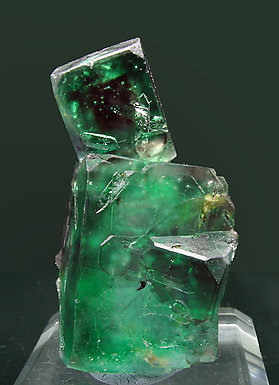 |
|
| Fluorite with Quartz (variety smoky) |
|
|
|
|
|
EG88AE2: An aggregate of crystals showing the cube, octahedron and dodecahedron. They are between transparent and translucent, have a very deep green color with violet zones in some areas of each crystal and with inclusions that resemble eyes, the reason why this Fluorite is called “alien.” On matrix, with Quartz crystals.
Erongo Mountain, Usakos, Erongo Region Namibia
Specimen size: 8 × 5.3 × 3.7 cm = 3.15” × 2.09” × 1.46”
Main crystal size: 2.5 × 2.4 cm = 0.98” × 0.94”
|
|
|
|
Fluorite "scepter" |
|---|
|
|
MM11Y9: Scepter-shaped growth with an octahedral crystal at the top that shows very well defined dissolution shapes and has a green color, more intense and bright at the base. Just different.
Erongo Mountain, Usakos, Erongo Region Namibia
Specimen size: 3.4 × 2.6 × 1.9 cm = 1.34” × 1.02” × 0.75”
Former collection of Piroska Magyar
Fluorescent long & short UV
|
| 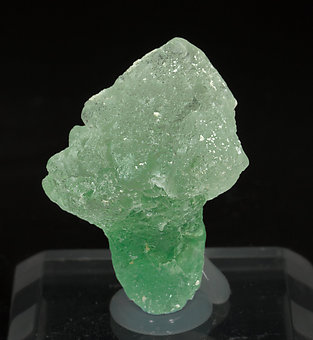
Front | 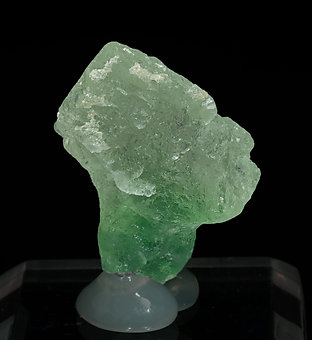
Rear |
| |
|
|
| Jeremejevite |
|
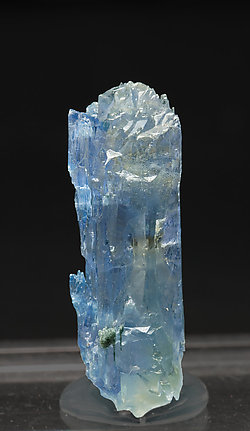
Front | 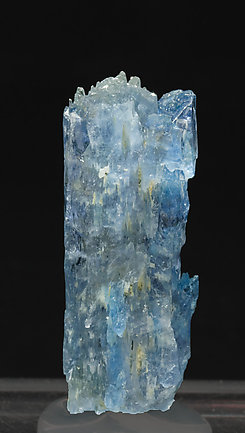
Rear |
| |
|
|
|
|
TK69S0: A novelty at Tucson 2011. Crystal with a very acute pyramidal polycrystalline termination. The crystal is transparent, bright and a deep sky blue color with slight violet shades. They are floaters with irregular surfaces, having had been formed in channels of dissolution in bigger crystals, now missing.
The specimen has been reviewed, photographed and published as a novelty from Tucson 2011 in the Russian magazine ‘Mineral Observer’ on page 70 in the volume 16, number 2
Ameib Farm 60 (Ameib Farm), Usakos, Karibib District, Erongo Region Namibia (02-03/2010)
Specimen size: 2.7 × 0.9 × 0.8 cm = 1.06” × 0.35” × 0.31”
|
|
|
|
Jeremejevite |
|---|
|
|
TB69S0: A novelty at Tucson 2011. Crystal with a very acute pyramidal polycrystalline termination. The crystal is transparent, bright and a deep sky blue color with slight violet shades. They are floaters with irregular surfaces, having had been formed in channels of dissolution in bigger crystals, now missing.
Ameib Farm 60 (Ameib Farm), Usakos, Karibib District, Erongo Region Namibia (02-03/2010)
Specimen size: 3.2 × 0.7 × 0.6 cm = 1.26” × 0.28” × 0.24”
|
| 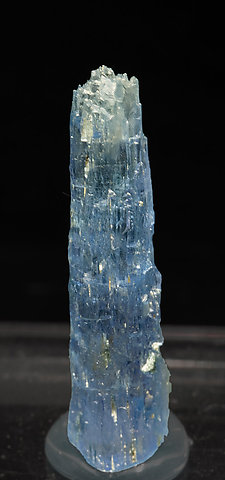
Front | 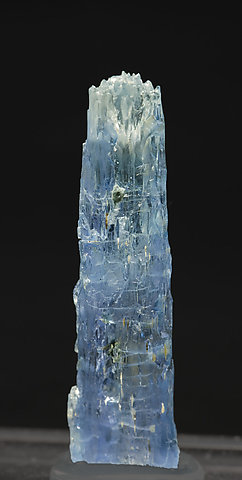
Rear |
| |
|
|
| Beryl (variety aquamarine) with feldspar |
|
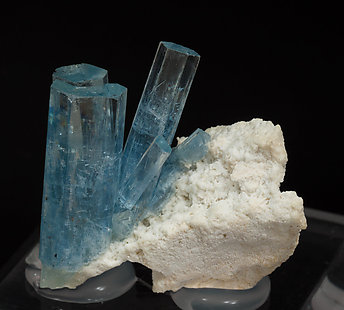
Front | 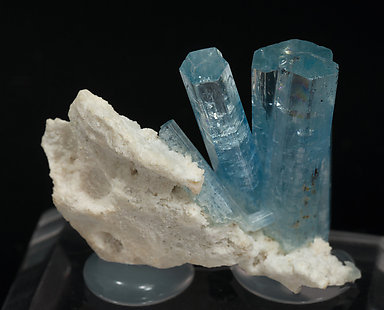
Rear |
| |
|
|
|
|
TL8X6: Very aerial group of bright and transparent crystals. They have a very intense blue color, very well defined faces and edges and perfect pinacoidal terminations and are on feldspar matrix.
Erongo Mountain, Usakos, Erongo Region Namibia (2012)
Specimen size: 4.8 × 4 × 2.1 cm = 1.89” × 1.57” × 0.83”
Main crystal size: 3.5 × 0.8 cm = 1.38” × 0.31”
|
|
|
|
Beryl (variety aquamarine) |
|---|
|
|
TK87X5: Group of Beryl (aquamarine variety) crystals, one of them clearly dominant, doubly terminated, with the prism faces beveled by a pyramid and the pinacoid. They are very transparent and bright, with a very well defined and uniform sky-blue color. They are on a feldspar matrix with small black Schorl crystals.
Erongo Mountain, Usakos, Erongo Region Namibia (2012)
Specimen size: 5.1 × 3 × 1.4 cm = 2.01” × 1.18” × 0.55”
Main crystal size: 3.7 × 0.8 cm = 1.46” × 0.31”
|
| 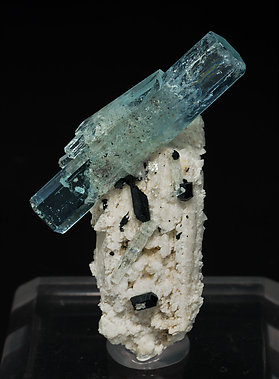
Front | 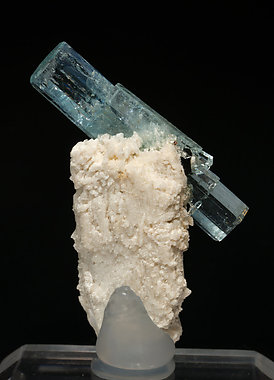
Rear |
| |
|
|
| Beryl (variety aquamarine) with Schorl and feldspar |
|
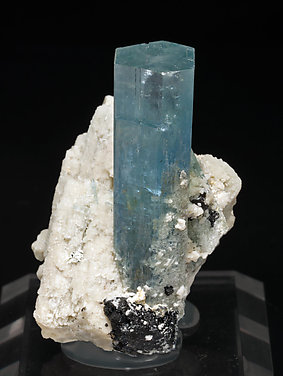
Front | 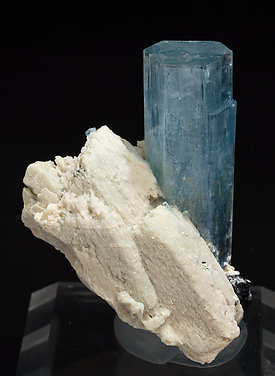
Rear |
| |
|
|
|
|
TA49X6: Bright single Beryl crystal (aquamarine), with very intense color and very well defined faces and edges and a parallel growth. It is on a feldspar crystal matrix with Schorl crystals.
Erongo Mountain, Usakos, Erongo Region Namibia (2012)
Specimen size: 5.2 × 3.9 × 3.4 cm = 2.05” × 1.54” × 1.34”
Main crystal size: 4.5 × 1.5 cm = 1.77” × 0.59”
|
|
|
|
Schorl with Beryl (Aquamarine) |
|---|
|
|
TJ66H9: We especially note, on the same specimen, the coincidence of a prismatic crystal of Schorl with two crystals of Beryl (Aquamarine) on a matrix of Feldspar, probably Orthoclase.
Erongo Mountain, Usakos, Erongo Region Namibia
Specimen size: 5.4 × 4.7 × 3 cm = 2.13” × 1.85” × 1.18”
Main crystal size: 5.1 × 2.2 cm = 2.01” × 0.87”
|
| 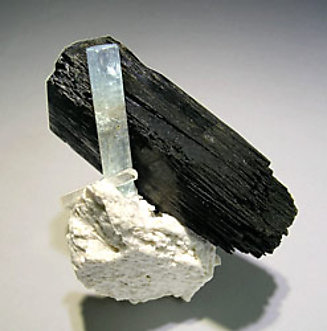 |
|
| Beryl (variety aquamarine) with Feldspar and Schorl |
|
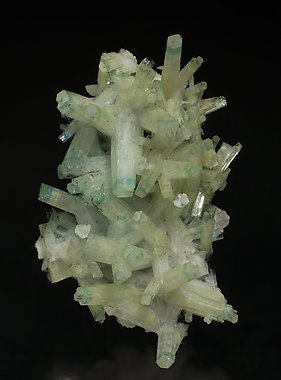
Front | 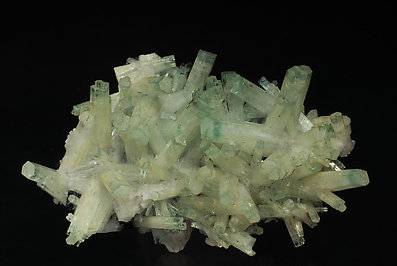
Side |
| |
|
|
|
|
TE8X5: Group of crystals with very well defined faces and edges, with a clear greenish-yellow color and with deep blue geometrical color zoning on terminations. They are on a thin feldspar matrix with small Schorl crystals.
Erongo Mountain, Usakos, Erongo Region Namibia (2012)
Specimen size: 6.5 × 4.4 × 2.3 cm = 2.56” × 1.73” × 0.91”
Main crystal size: 2 × 0.5 cm = 0.79” × 0.20”
|
|
|
|
Beryl (variety aquamarine) with Schorl and Opal |
|---|
|
|
TZ73R1: Group of Beryl aquamarine crystals with a very well defined and uniform blue color. From transparent to translucent in different areas of the prism but completely transparent on terminations. They are on a base of acicular
crystals of Schorl and support a small coating of yellow Opal in part of the piece.
Erongo Mountain, Usakos, Erongo Region Namibia
Specimen size: 10.5 × 7.8 × 4.4 cm = 4.13” × 3.07” × 1.73”
Main crystal size: 1.8 × 0.9 cm = 0.71” × 0.35”
Opal intense fluorescence long and short UV
|
| |
|
| Schorl with Quartz |
|
|
|
|
|
TL37E0: The photo says a lot about the esthetics of this great specimen, so all we need to add is that it is a floater and that the form and brilliance are as good as the photo suggests. It is a really great specimen.
Davib East Farm 61 (Davib Ost Farm), Karibib District, Erongo Region Namibia
Specimen size: 7.5 × 7 × 3.8 cm = 2.95” × 2.76” × 1.50”
Main crystal size: 1.7 × 1.4 cm = 0.67” × 0.55”
|
|
|
|
Schorl |
|---|
|
|
MF96AI4: Very aerial aggregate of Schorl crystals that have very well defined crystalline forms with polycrystalline growths and they are very bright.
Davib East Farm 61 (Davib Ost Farm), Karibib District, Erongo Region Namibia
Specimen size: 8.9 × 7.1 × 5.6 cm = 3.50” × 2.80” × 2.20”
Main crystal size: 4 × 3.8 cm = 1.57” × 1.50”
|
| 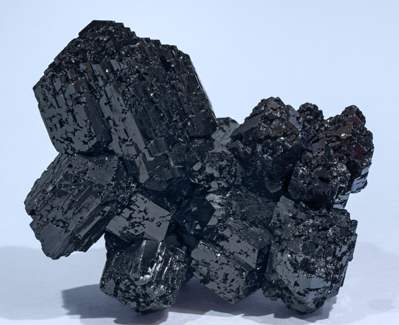
Front | 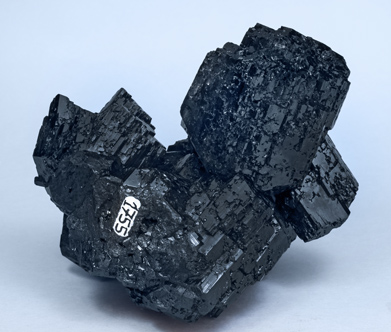
Rear |
| |
|
|
| Andradite (variety demantoid chromium rich) |
|
|
|
|
|
E66FD2: The Italian Demantoids are really good, but this one does not miss the mark by far, transparent, aerial on the matrix of white calcite.
Namgar Mine, Usakos-Omaruru, Erongo Namibia
Specimen size: 4 × 3.5 × 2.5 cm = 1.57” × 1.38” × 0.98”
Main crystal size: 0.6 × 0.5 cm = 0.24” × 0.20”
|
|
|
|
Malachite |
|---|
|
|
TM56AL4: Group of primary Malachite crystals, with sharp faces and edges and fine polycrystalline terminations, lustrous, with a very intense color and implanted in a matrix of Calcite crystals.
We will deliver the specimen in its original Perky box from the Robert J. Noble collection, which also contains the label, stating that it came from the Melanson collection (Denver 2013)
Onganja (Emke) Mine, Helen Farm 235, Onganja mining area, Seeis, Windhoek District, Khomas Region Namibia
Specimen size: 2.7 × 2.4 × 2 cm = 1.06” × 0.94” × 0.79”
Calcite fluorescent long & short UV
Former collection of Bob Noble
|
| |
|
| Malachite after Cuprite |
|
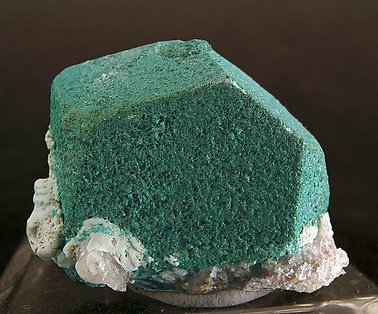 |
|
|
|
TX96D8: From old discoveries comes this Cuprite that has been psuedomorphised by Malachite. The piece is a floater, the crystal is well defined, and it has a form that is different from the typical ones. It also has the virtue of being on matrix, something that is not usual in material from this mine. A special classic specimen.
Onganja (Emke) Mine, Helen Farm 235, Onganja mining area, Seeis, Windhoek District, Khomas Region Namibia
Specimen size: 2.5 × 2.2 × 1.7 cm = 0.98” × 0.87” × 0.67”
|
|
|
|
Cuprite with Quartz |
|---|
|
|
TD99P1: The crystals have the very neat forms of the dodecahedron; very unusual, as isolated forms, for Cuprite. They are bright and have reddish reflections, contrasting with the white matrix of Quartz.
The specimen has been reviewed, photographed and published as a new discovery in the magazine ‘Rivista Mineralogica Italiana’ on page 280 in number 2009/4
Onganja (Emke) Mine, Helen Farm 235, Onganja mining area, Seeis, Windhoek District, Khomas Region Namibia
Specimen size: 8.2 × 6.2 × 2.7 × cm = 3.23” × 2.44” × 1.06”
Main crystal size: 0.8 × 0.8 cm = 0.31” × 0.31”
|
| |
|
| Copper |
|
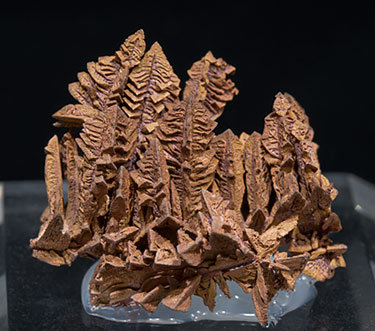
Front | 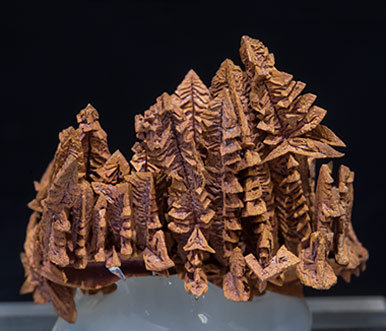
Rear |
| |
|
|
|
|
TD87AD1: Very aerial dendritic growths with parallel formations of extraordinarily sharp and very well defined octahedral crystals.
Onganja (Emke) Mine, Helen Farm 235, Onganja mining area, Seeis, Windhoek District, Khomas Region Namibia
Specimen size: 2.6 × 2.2 × 1.7 cm = 1.02” × 0.87” × 0.67”
Main crystal size: 1.4 × 0.4 cm = 0.55” × 0.16”
|
|
|
|
Copper |
|---|
|
|
TE48AD1: Dendritic growth of crystals that have very well defined faces and edges, with the dominant forms of the octahedron and the dodecahedron.
Onganja (Emke) Mine, Helen Farm 235, Onganja mining area, Seeis, Windhoek District, Khomas Region Namibia
Specimen size: 2.8 × 2.4 × 1.5 cm = 1.10” × 0.94” × 0.59”
Main crystal size: 1.4 × 0.7 cm = 0.55” × 0.28”
|
| 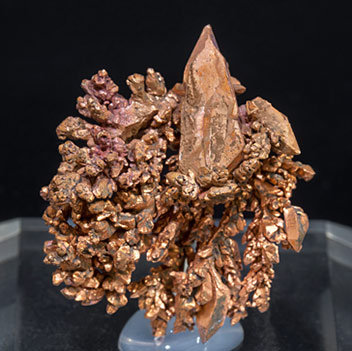
Front | 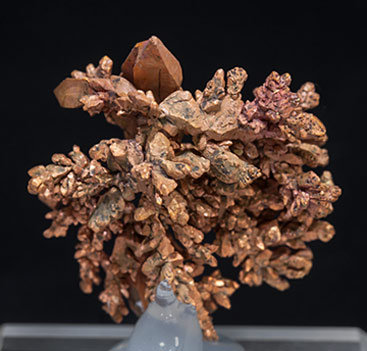
Rear |
| |
|
|
| Copper |
|
|
|
|
|
TX30AD1: Very aerial arborescent growth of very well defined crystals, slightly elongated, with the octahedron and the dodecahedron as dominant forms.
Onganja (Emke) Mine, Helen Farm 235, Onganja mining area, Seeis, Windhoek District, Khomas Region Namibia
Specimen size: 7 × 3.7 × 2.4 cm = 2.76” × 1.46” × 0.94”
Main crystal size: 1 × 0.5 cm = 0.39” × 0.20”
|
|
|
|
Prehnite |
|---|
|
|
EB66X0: Very aerial spherical growths. They are translucent and with a green color that changes its intensity, it passes to whitish on the smaller spherules at the base.
Koedoekop, Keetmanshoop, Karas Namibia
Specimen size: 9.3 × 3.7 × 6.4 cm = 3.66” × 1.46” × 2.52”
Main crystal size: 1.6 × 1.5 cm = 0.63” × 0.59”
Former collection of Claus Hedegaard. Number 13038
|
| |
|
| Smithsonite with Hemimorphite |
|
|
|
|
|
MV71AC6: Botryoidal aggregates of small greenish blue Smithsonite crystals on a matrix coated by small and very bright Hemimorphite crystals. Very esthetic as the image shows.
This sample has been photographed and published in the magazine "Le Règne Minéral" number 126, page 47
Skorpion Mine, Rosh Pinah, Lüderitz District, ǁKaras Region Namibia (2007-2010)
Specimen size: 12.7 × 7.1 × 3.8 cm = 5.00” × 2.80” × 1.50”
Main crystal size: 1.2 × 1.2 cm = 0.47” × 0.47”
|
|
|
|
Tarbuttite with Hydroxylapatite and Hemimorphite |
|---|
|
|
MK49AA7: Swirling platy growths of very sharp Tarbuttite crystals, transparent, bright and with a uniform pale green color, they are partially coated by white Hydroxylapatite and Hemimorphite micro-crystals. The three co-existing species on the sample have been analyzed and we will send a copy of the analyses to the buyer.
Skorpion Mine, Rosh Pinah, Lüderitz District, ǁKaras Region Namibia (2006-2007)
Specimen size: 7.2 × 3.4 × 2.5 cm = 2.83” × 1.34” × 0.98”
Main crystal size: 0.7 × 0.4 cm = 0.28” × 0.16”
Fluorescent long UV & minor fluorescence short UV
|
| |
|
| Tarbuttite with Hydroxylapatite and Hemimorphite |
|
|
|
|
|
MF38AA7: Fanlike growths of Hydroxylapatite and Hemimorphite micro-crystals on Tarbuttite partially dissolved but distinguishable on the back side of the sample due to its green color. The three co-existing species on the sample have been analyzed and we will send a copy of the analyses to the buyer.
Skorpion Mine, Rosh Pinah, Lüderitz District, ǁKaras Region Namibia (2006-2007)
Specimen size: 4.9 × 3.6 × 2.6 cm = 1.93” × 1.42” × 1.02”
Main crystal size: 2 × 1.4 cm = 0.79” × 0.55”
Fluorescence short UV & minor fluorescence long UV
|
|
|
|
Tarbuttite with Hydroxylapatite and Hemimorphite |
|---|
|
|
MN68AA7: Divergent growths, on matrix, of acicular Tarbuttite crystals with a pale green color and partially coated by white Hydroxylapatite and Hemimorphite micro-crystals. The three co-existing species on the sample have been analyzed and we will send a copy of the analyses to the buyer.
Skorpion Mine, Rosh Pinah, Lüderitz District, ǁKaras Region Namibia (2006-2007)
Specimen size: 5.8 × 4 × 3.2 cm = 2.28” × 1.57” × 1.26”
Main crystal size: 0.6 × 0.1 cm = 0.24” × 0.04”
Fluorescence short UV & minor fluorescence long UV
|
| |
|
| Actinolite |
|
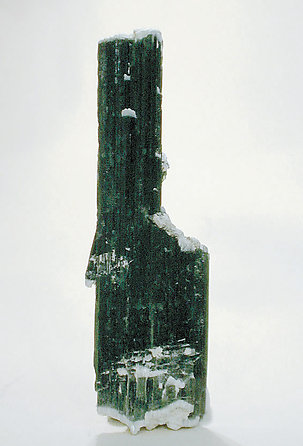 |
|
|
|
TB88: A Namibian novelty: in one area of the Namibian dessert, more or less due West of Uis, people found new Actinolites, very sharp and with a slight green tint, making the specimens more agreeable than others that are blacker. We got this specimen, which is a floater and complete on all its sides, for its luster and perfection.
West Uis Namibia (12/02)
Specimen size: 8.5 × 2.5 × 2 cm = 3.35” × 0.98” × 0.79”
|
|
|
|
Quartz (variety amethyst) with Prehnite, Quartz and Calcite |
|---|
|
|
TX71AF0: Very bright Quartz crystal with a very sharply defined amethyst colored phantom and an aesthetic color gradation, clearer near the base and the termination and very intense in the central zone. It is with Prehnite and Calcite and is on matrix, which is very rare with samples from this region. Badly popularized as Brandberg, the true locality is Gobobos, another nearby volcano. The sample was from Charles Key.
Goboboseb Mountains, Brandberg area, Erongo Region Namibia
Specimen size: 7 × 6.3 × 5.3 cm = 2.76” × 2.48” × 2.09”
Main crystal size: 6.4 × 2.3 cm = 2.52” × 0.91”
Calcite fluorescent short UV
From Charles Key
|
| |
|
| Quartz (variety amethyst) "phantom" |
|
|
|
|
|
TP27L1: Very sharp and brilliant Amethyst crystal. Specimen shows nice and well defined color zonations that are inside the known “phantom” growths. The terminal rhombohedra faces present the beginning of “window” growths.
Gobobos Volcano, Gobobosebberge Namibia
Specimen size: 7.6 × 2.3 × 1.8 cm = 2.99” × 0.91” × 0.71”
|
|
|
|
Quartz (variety amethyst) and Epidote |
|---|
|
|
TD13J5: Magnificent crystal, very well defined and bright with an esthetic graded change of color clearer at the base and deeper on the termination with zoning. An important aspect is that it is on matrix, which is very rare with samples from this region. Even it had (badly) been popularized as Brandberg, the true locality is Gobobos, another nearest volcano.
The specimen is from the Charlie Key collection.
Gobobos Volcano, Gobobosebberge Namibia
Specimen size: 10.3 × 7 × 3.8 cm = 4.06” × 2.76” × 1.50”
Main crystal size: 7.4 × 1.9 cm = 2.91” × 0.75”
|
| |
|
| Prehnite with Quartz |
|
|
|
|
|
TX6AL4: Group of Prehnite crystals that partially cover a water-clear Quartz crystal. The Prehnite crystals, more individualized than usual for the species, with defined faces and edges, are translucent, shiny, and have a uniform pale green color.
We will send the specimen in its original Perky box from the Robert J. Noble collection, which also contains the label.
Goboboseb Mountains, Brandberg area, Erongo Region Namibia
Specimen size: 3.6 × 1.5 × 1.1 cm = 1.42” × 0.59” × 0.43”
Former collection of Bob Noble
|
|
|
|
Prehnite |
|---|
|
|
MB99AL5: Druze on matrix of Prehnite crystals with polycrystalline growths, translucent, bright and with a vivid and uniform green color. The specimen comes from the Claus Hedegaard collection, whose label we will send to the buyer.
Goboboseb Mountains, Brandberg area, Erongo Region Namibia
Specimen size: 11.8 × 10.9 × 2.4 cm = 4.65” × 4.29” × 0.94”
Former collection of Claus Hedegaard
|
| |
|
| Prehnite |
|
|
|
|
|
EA67Y0: Aggregate of crystals with polycrystalline growths and very well defined forms. They are translucent, bright and have a very intense and uniform color. The sample has the usual high quality of the good Brandberg Prehnite, but its size is bigger than usual.
Goboboseb Mountain, Brandberg, Erongo Namibia
Specimen size: 12.5 × 11.5 × 3.5 cm = 4.92” × 4.53” × 1.38”
Former collection of Claus Hedegaard
|
|
|
|
Quartz (variety amethyst) |
|---|
Fluorescent light (daylight)
|
|
|
EJK46AO9: Obtained at Ste. Marie 2022
Group of Quartz crystals with scepter-shaped growths and very sharp crystal forms, with a relatively short prism, translucent and with a violet color with different shades depending on the area of the crystal, with inclusions. On matrix, edged by small crystals of white Quartz. The specimen comes from a find made in a locality virtually unknown to date.
Berjé, Aïr Massif, Agadez Region Niger (08/2021)
Specimen size: 5.7 × 5.2 × 3.5 cm = 2.24” × 2.05” × 1.38”
Main crystal size: 4.6 × 2.8 cm = 1.81” × 1.10”
|
| |
|
| Beryl (variety emerald) |
|
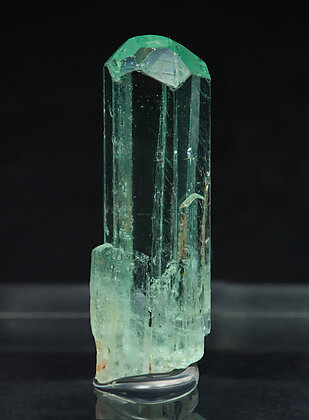
Front | 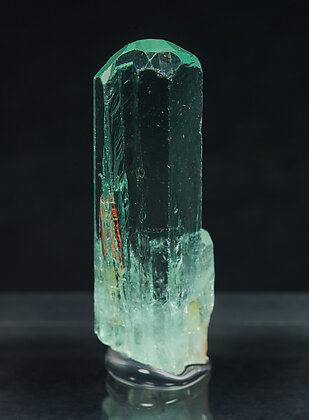
Rear |
| |
|
Fluorescent light (daylight)
|
|
|
|
ELB51AO7: New discovery at Ste. Marie 2022, new locality for Beryl (variety emerald)
As explained in emeralds of Niger, although their color is not intense, the presence of Cr and V accredits them as emeralds. In its favor its transparency and good crystallographic forms and being a previously unknown locality.
This sample has been referenced and pictured, as a novelty in Ste. Marie 2022, in the magazine 'Le Règne Minéral' number 166, July-August 2022, page 47
Taraouadji Mountains, Aïr Massif, Agadez Region Niger (04/2022)
Specimen size: 2.4 × 0.7 × 0.5 cm = 0.94” × 0.28” × 0.20”
Weight: 1.6 grams
|
|
|
|
Fluorite (dichroic) with Quartz |
|---|
Recorded under neon light
|
|
|
MXF99CD1: Much deserves to be said about this piece, but the Mineralogical Record magazine's website has already done so, in its section "What’s New on the Internet Reports”, vol. 68, December 2023, page 9, and also, and very extensively, the magazines Lapis on page 37 of its 12/2023 edition, and Le Règne Minéral, no. 174/2023, page 26.
These dichroic fluorites from Nigeria have been seen at different shows throughout the year, but until now no specimens of significant quality had appeared. Are we going to see many more specimens of this quality? Is this piece, so perfect, going to be an exception? Impossible to know that now, but surely the year 2024 will show us whether this piece is a unique case or not. The only thing that is certain is that it is a very pretty Fluorite, whatever happens later with specimens from this locality.
Mina Jalingo, higher level, Mambilla Plateau, Taraba State Nigeria (2023)
Specimen size: 10.9 × 7.4 × 3.9 cm = 4.29” × 2.91” × 1.54”
Main crystal size: 3.3 × 3 cm = 1.30” × 1.18”
|
| 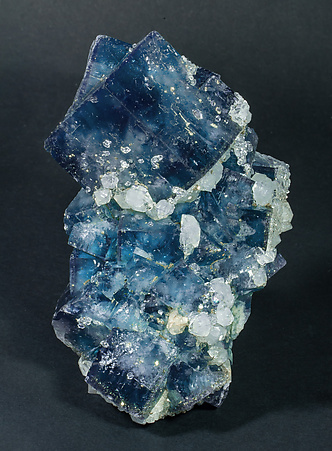
natural light | 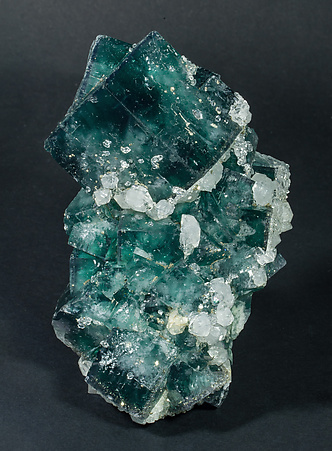
incandescent light |
| |
|
|
| Pyromorphite |
|
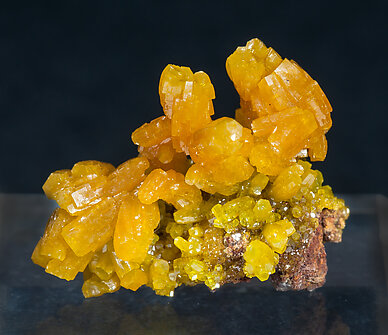
Front | 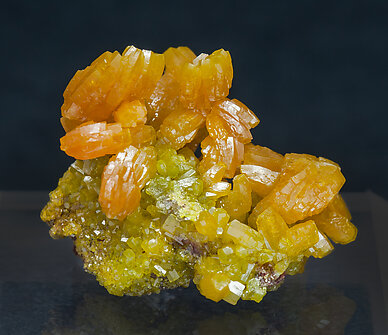
Rear |
| |
|
|
|
|
TY14AN1: Group of Pyromorphite crystals with sharp crystal forms, many of them doubly terminated, lustrous and bi-colored, with areas of orange crystals and others with an intense and uniform greenish yellow color. From a very classic locality, but from which few quality Pyromorphite specimens are found.
This specimen is from the Pierre Vincent collection.
M'Fouati, M'Fouati District, Bouenza Department Republic of the Congo (±1970)
Specimen size: 1.8 × 1.6 × 1.4 cm = 0.71” × 0.63” × 0.55”
Main crystal size: 0.6 × 0.3 cm = 0.24” × 0.12”
Fluorescence short UV & minor fluorescence long UV
Former collection of Pierre Vincent
|
|
|
|
Pyromorphite |
|---|
|
|
TE26AN1: Floater group of Pyromorphite crystals with sharp crystal forms, many of them doubly terminated, very lustrous and bi-colored, with areas of orange crystals and others with an intense and uniform greenish yellow color. From a very classic locality, but from which few quality Pyromorphite specimens are found.
The specimen is from the Pierre Vincent collection.
M'Fouati, M'Fouati District, Bouenza Department Republic of the Congo (±1970)
Specimen size: 2.4 × 2.3 × 1.8 cm = 0.94” × 0.91” × 0.71”
Main crystal size: 0.4 × 0.2 cm = 0.16” × 0.08”
Fluorescence short UV & minor fluorescence long UV
Former collection of Pierre Vincent
|
| |
|
| Pyromorphite |
|
|
|
|
|
TD16AN1: Floater group of Pyromorphite crystals with sharp crystal forms, many of them doubly terminated, very lustrous and bi-colored, with areas of orange crystals and others with an intense and uniform greenish yellow color. From a very classic locality, but from which few quality Pyromorphite specimens are found.
The specimen is from the Pierre Vincent collection.
M'Fouati, M'Fouati District, Bouenza Department Republic of the Congo (±1970)
Specimen size: 3.6 × 2.7 × 2.4 cm = 1.42” × 1.06” × 0.94”
Main crystal size: 0.4 × 0.2 cm = 0.16” × 0.08”
Fluorescence short UV & minor fluorescence long UV
Former collection of Pierre Vincent
|
|
|
|
Pyromorphite |
|---|
|
|
TF14AN1: Floater group of Pyromorphite crystals with sharp crystal forms, many of them doubly terminated, very lustrous and bi-colored, with areas of orange crystals and others with an intense and uniform greenish yellow color. From a very classic locality, but from which few quality Pyromorphite specimens are found.
The specimen is from the Pierre Vincent collection.
M'Fouati, M'Fouati District, Bouenza Department Republic of the Congo (±1970)
Specimen size: 3.7 × 2.4 × 1.3 cm = 1.46” × 0.94” × 0.51”
Main crystal size: 0.7 × 0.4 cm = 0.28” × 0.16”
Fluorescence short UV & minor fluorescence long UV
Former collection of Pierre Vincent
|
| |
|
| Pyromorphite |
|
|
|
|
|
TJ13AN1: Group, on matrix, of Pyromorphite crystals with sharp crystal forms, many of them doubly terminated, with very bright luster and an intense and uniform green color. From a very classic locality, but from which few quality Pyromorphite specimens have been found.
The specimen is from the Pierre Vincent collection.
M'Fouati, M'Fouati District, Bouenza Department Republic of the Congo (±1970)
Specimen size: 3.7 × 2.4 × 1.7 cm = 1.46” × 0.94” × 0.67”
Main crystal size: 0.3 × 0.2 cm = 0.12” × 0.08”
Fluorescence short UV & minor fluorescence long UV
Former collection of Pierre Vincent
|
|
|
|
Wulfenite |
|---|
|
|
MK66AJ1: Floater group with two complete and very sharp Wulfenite crystals that are translucent, with inclusions, and with a very intense orange color. An excellent miniature from a locality considered as a classic for the species.
M'Fouati, M'Fouati District, Bouenza Department Republic of the Congo
Specimen size: 2 × 2 × 0.5 cm = 0.79” × 0.79” × 0.20”
Main crystal size: 1.5 × 1.4 cm = 0.59” × 0.55”
|
| 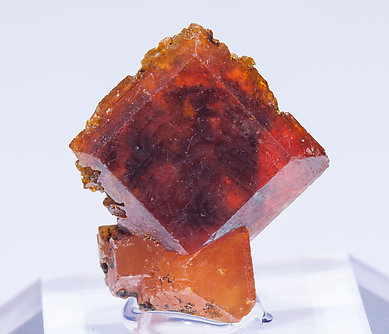 |
|
| Wulfenite |
|
|
|
|
|
MJ66AJ3: Group of very sharp crystals, one of them clearly dominant, with polycrystalline growths and dominant pyramidal faces. They are translucent, bright and with a very deep orange color. The sample is from a locality that is a classic for Wulfenite but where good samples are very scarce.
From the Thomas P. Moore collection whose label we will send to the buyer.
M'Fouati, M'Fouati District, Bouenza Department Republic of the Congo
Specimen size: 2.3 × 1.9 × 1 cm = 0.91” × 0.75” × 0.39”
Former collection of Thomas P. Moore
|
|
|
|
Wulfenite |
|---|
|
|
MF48AA9: Aggregate of crystals of a considerable size for the locality and with very well defined faces and edges. They are translucent and have a yellow color with orange shades. It is from a very well known locality but which very few Wulfenite samples of good quality are preserved.
M'Fouati, M'Fouati District, Bouenza Department Republic of the Congo
Specimen size: 3.9 × 3.2 × 2.4 cm = 1.54” × 1.26” × 0.94”
Former collection Caroline Martaud (Wulfenites)
|
| 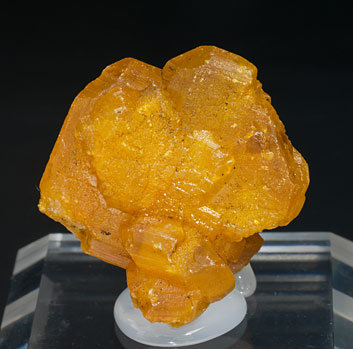
Front | 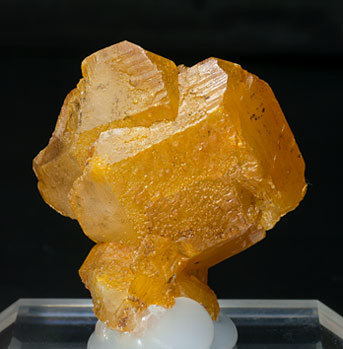
Rear |
| |
|
|
| Dioptase |
|
|
|
|
|
MK36AM8: Group on matrix of elongated Dioptase crystals, between translucent and transparent and very lustrous.
We will send the buyer the specimen in its original Perky box from the Robert J. Noble collection, which also contains the label.
'Mbumba, Pimbi Hill, Mindouli, Mindouli District, Pool Department Republic of the Congo
Specimen size: 2.3 × 1.7 × 0.8 cm = 0.91” × 0.67” × 0.31”
Main crystal size: 0.5 × 0.2 cm = 0.20” × 0.08”
Former collection of Bob Noble
|
|
|
|
Dioptase |
|---|
|
|
ML6AM8: Group of translucent and lustrous Dioptase crystals, one of them clearly dominant and of a considerable size.
We will send the buyer the specimen in its original Perky box from the Robert J. Noble collection, which also contains the label.
Indus Mine; Renéville Mine, Renéville, Kindanba District, Pool Department Republic of the Congo
Specimen size: 2.4 × 1.8 × 1.3 cm = 0.94” × 0.71” × 0.51”
Former collection of Bob Noble
|
| 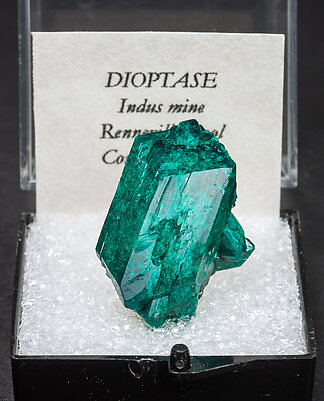
Front | 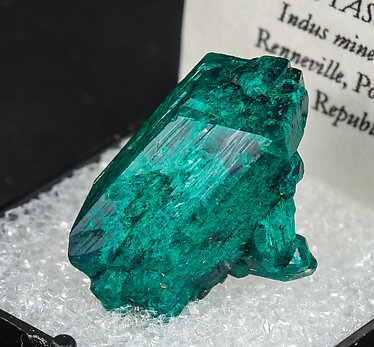
Side |
| |
|
|
| Dioptase |
|
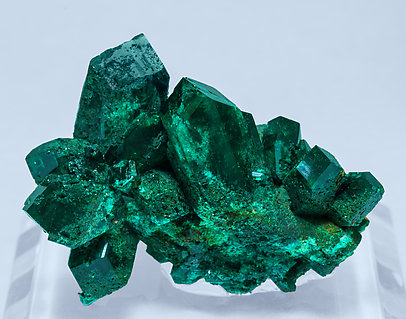 |
|
|
|
LR88AK2: Group of very sharp crystals, some of them partially doubly terminated, of good size, brilliant, with very deep color and partially covered by a second generation of small crystals of the same mineral Dioptase. The sample is from the Philippe Morelon collection (No. 805), whose catalogue entry we will send to the buyer.
'Mbumba, Pimbi Hill, Mindouli, Mindouli District, Pool Department Republic of the Congo (2011)
Specimen size: 4.5 × 3.6 × 2.9 cm = 1.77” × 1.42” × 1.14”
Main crystal size: 2.5 × 1.2 cm = 0.98” × 0.47”
Former collection of Philippe Morelon
|
|
|
|
Dioptase with Duftite |
|---|
Fluorescent light (daylight)
|
|
|
TFB92AN5: Coatings of equant Dioptase crystals in circular holes in a curious matrix. The crystals are very lustrous, with a very deep green color, associated with small, very sharp isolated crystals of Duftite.
Mindouli, Mindouli District, Pool Department Republic of the Congo
Specimen size: 5.8 × 5.3 × 2.8 cm = 2.28” × 2.09” × 1.10”
Main crystal size: 0.2 × 0.2 cm = 0.08” × 0.08”
|
| |
|
| Dioptase with Plancheite |
|
|
|
|
|
MC87AN0: Growth of very sharp and lustrous crystals of Dioptase partially covered by globular growths of sky-blue Plancheite.
Mindouli, Mindouli District, Pool Department Republic of the Congo
Specimen size: 7.4 × 4.8 × 4.4 cm = 2.91” × 1.89” × 1.73”
Main crystal size: 1 × 0.9 cm = 0.39” × 0.35”
|
|
|
|
Dioptase with Chrysocolla |
|---|
Fluorescent light (daylight)
|
|
|
MB36AL4: Group of highly profiled, translucent and brilliant Dioptase crystals, on matrix and with pale blue-green Chrysocolla. Excellent specimen, classic and very aesthetic.
Mindouli, Mindouli District, Pool Department Republic of the Congo
Specimen size: 10.5 × 5.4 × 6.9 cm = 4.13” × 2.13” × 2.72”
Main crystal size: 1.4 × 0.4 cm = 0.55” × 0.16”
|
| |
|
| Dioptase on Plancheite |
|
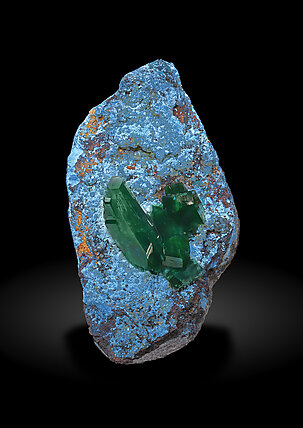
Front / Photo: Joaquim Callén | 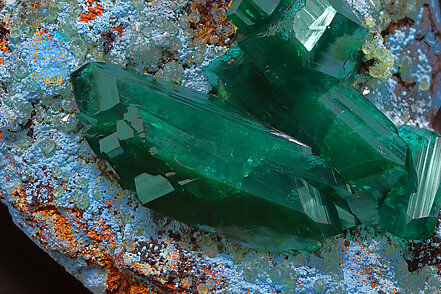
Detail / Photo: Joaquim Callén |
| |
|
Fluorescent light (daylight)
|
|
|
|
MLT47AP3: Group of Dioptase crystals, most of them doubly terminated, more elongated than usual in the species, and extraordinarily lustrous, on matrix, with deep blue Plancheite. The specimen comes from a very little known locality.
The Plancheite has been analyzed and we will send a copy of the analysis to the buyer.
Ngouedi mission village, Loutete, Mouyondzi District, Bouenza Department Republic of the Congo (2022)
Specimen size: 5.8 × 3.2 × 2.4 cm = 2.28” × 1.26” × 0.94”
Main crystal size: 1.8 × 1 cm = 0.71” × 0.39”
With analysis copy
|
|
|
|
Senegalite with Turquoise |
|---|
|
|
EB36J8: A very recent rediscovery of this rare species, which seems to have disappeared many years ago. On fissures and vugs of a Limonite matrix grown small yellowish crystals of this rare phosphate on a base of blue Turquoise.
This specimen was published on the Mineralogical Record´s web page, in the ‘What's New’ section of the March 13, 2008 edition.
Kourou Diakouma Mount, Saraya, Tambacounda Region Senegal (01-03/2007)
Specimen size: 4.2 × 2.3 × 3.1 cm = 1.65” × 0.91” × 1.22”
Main crystal size: 0.1 × 0.1 cm = 0.04” × 0.04”
Type locality
|
| |
|
| Senegalite with Turquoise |
|
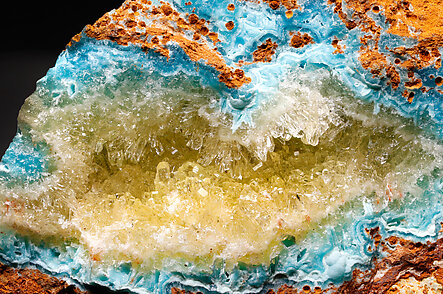
Front / Photo: Joaquim Callén | 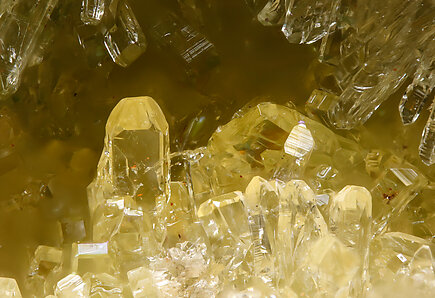
Detail / Photo: Joaquim Callén |
| |
|
Recorded under neon light
|
|
|
|
EQR64CD2: Lenticular geode of well-profiled and sharp crystals of Senegalite, transparent, shiny, and yellow in color. On matrix, with bands of very intense blue Turquoise crystals.
It comes from the type locality for the species, from which little or nothing has arrived for a long time, and we only know about it through old pieces like this one.
Kourou Diakouma Mount, Saraya, Tambacounda Region Senegal
Specimen size: 4.3 × 2.7 × 1,7 cm = 1.69” × 1.06” × 0.39”
Main crystal size: 0.1 × 0.1 cm = 0.04” × 0.04”
Type locality
|
|
|
|
Senegalite with Turquoise and Crandallite |
|---|
|
|
EM97M2: Very rich Senegalite vug coated by very sharp and lustrous crystals, with an intense yellow color and transparency. Between the matrix and the Senegalite crystal base, one can see a thin blue layer of Turquoise that is coating other small vugs in the matrix, accompanied by Crandallite. It is from a recent find (March 2008) at the Type Locality for the species.
The specimen has been reviewed, photographed and published as a new discovery in the magazines ‘Mineralogical Record’ on page 68 in the volume 40 number 1, and in ‘Rivista Mineralogica Italiana’ page 190, number 2008/3. Also in the magazine "Lapis" number 04/2014, page 11
Kourou Diakouma Mount, Saraya, Tambacounda Region Senegal (03/2008)
Specimen size: 7.7 × 6.6 × 5.9 cm = 3.03” × 2.60” × 2.32”
Main crystal size: 0.3 × 0.1 cm = 0.12” × 0.04”
Type locality
|
| |
|
| Senegalite with Turquoise and Crandallite |
|
|
|
|
|
EF47AC2: Very rich Senegalite vug with spheroidal growths of very sharp and lustrous crystals with an intense yellowish green color and high transparency. Between the matrix and the Senegalite, one can see a thin blue layer of Turquoise that is coating other small vugs in the matrix, accompanied by white Crandallite. The sample, from the type locality for the species, is from a very well known and single find in 2008.
Kourou Diakouma Mount, Saraya, Tambacounda Region Senegal (2007-2008)
Specimen size: 8.4 × 6 × 4.3 cm = 3.31” × 2.36” × 1.69”
Main crystal size: 0.2 × 0.1 cm = 0.08” × 0.04”
Type locality
|
|
|
|
Senegalite with Turquoise |
|---|
|
|
EP48M2: Really esthetic specimen formed by vugs coated by very sharp and lustrous Senegalite crystals, with an intense yellowish color and transparency. Between the matrix and the Senegalite crystal base, one can see a thin blue layer of Turquoise that is coating other small vugs in the matrix. The specimen is from a recent find (March 2008) at the Type Locality for the species.
Kourou Diakouma Mount, Saraya, Tambacounda Region Senegal (03/2008)
Specimen size: 10.1 × 9 × 5.2 cm = 3.98” × 3.54” × 2.05”
Main crystal size: 0.3 × 0.1 cm = 0.12” × 0.04”
Type locality
|
| |
|
| Shigaite on Rhodochrosite |
|
|
|
|
|
ML68AC5: Laminar crystals of this rare species. They have a sharp hexagonal shape, deep red-brown color and they are translucent, very bright, and are implanted on a matrix of Rhodochrosite crystals with a very intense luster and color and mainly formed by the prism and the scalenohedron.
N'Chwaning I Mine, N'Chwaning mining area, Kuruman, Kalahari manganese field (KMF), Northern Cape Province South Africa (2006)
Specimen size: 5 × 3.3 × 1.3 cm = 1.97” × 1.30” × 0.51”
Main crystal size: 0.3 × 0.3 cm = 0.12” × 0.12”
Rhodochrosite fluorescent short UV
|
|
|
|
Celestine |
|---|
|
|
MH27R8: Esthetic growth of two groups of elongated radiating prismatic crystals with very acute terminations. The crystals, bright and of uniform clear sky blue color, are on a small matrix.
N'Chwaning II Mine, N'Chwaning mining area, Kuruman, Kalahari manganese field (KMF), Northern Cape Province South Africa (2009)
Specimen size: 8.5 × 8 × 4.5 cm = 3.35” × 3.15” × 1.77”
Main crystal size: 4.5 × 0.9 cm = 1.77” × 0.35”
|
| 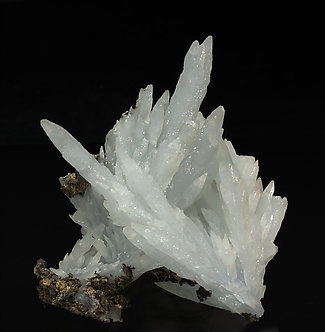
Front | 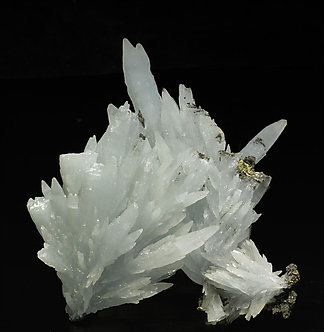
Rear |
| |
|
|
| Bultfonteinite with Hydroxyapophyllite-(K) and Calcite |
|
|
|
|
|
EZ56R1: Fanlike groups of snowy white acicular crystals of Bultfonteinite replacing the faces of short elongated crystals of Hydroxyapophyllite-(K) which has a pseudocubic habit. In some cases the replacement is deeper and forms a more or less complete pseudomorph of the preexisting Hydroxyapophyllite-(K). All are on a matrix of clear, complex, crystals of Calcite. We’ll send a copy of the analysis to the buyer of the piece.
N'Chwaning II Mine, N'Chwaning mining area, Kuruman, Kalahari manganese field (KMF), Northern Cape Province South Africa (2006)
Specimen size: 8 × 8 × 6 × cm = 3.15” × 3.15” × 2.36”
Main crystal size: 1.5 × 1.2 cm = 0.59” × 0.47”
|
|
|
|
Hydroxyapophyllite-(K) |
|---|
|
|
MZ14D5: The N'Chwaning Mine is famous for its fine Rhodos but it also produces curious Hydroxyapophyllite-(K) specimens which are totally different from the Indian ones or any others for that matter. This esthetic group perched on its matrix displays very well due the extremely aerial position of the crystals.
N'Chwaning II Mine, N'Chwaning mining area, Kuruman, Kalahari manganese field (KMF), Northern Cape Province South Africa (2001)
Specimen size: 7 × 3.5 × 3 cm = 2.76” × 1.38” × 1.18”
Main crystal size: 1 × 1 cm = 0.39” × 0.39”
|
| 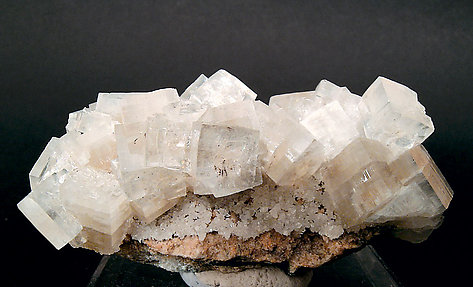 |
|
| Gaudefroyite with Baryte |
|
|
|
|
|
MF86Y9: Irregular aggregate of very sharp Gaudefroyite crystals that are very aerial, bright and are with small white Baryte crystals.
This specimen's photo has been reviewed and published in the magazine ‘Mineralogical Record’ on page 39 in the volume 48, number 1 (January-February 2017)
N'Chwaning II Mine, N'Chwaning mining area, Kuruman, Kalahari manganese field (KMF), Northern Cape Province South Africa
Specimen size: 4.2 × 2.6 × 1.8 cm = 1.65” × 1.02” × 0.71”
Main crystal size: 1.8 × 0.3 cm = 0.71” × 0.12”
Former collection of Piroska Magyar
|
|
|
|
Hausmannite with Bementite |
|---|
|
|
ML14AM6: Octahedral Hausmannite crystal with very sharp and shiny polycrystalline growths, on a matrix of Bementite crystals. We will send the buyer the specimen in its original perky box from the Robert J. Noble collection, which also contains the label.
N'Chwaning II Mine, N'Chwaning mining area, Kuruman, Kalahari manganese field (KMF), Northern Cape Province South Africa
Specimen size: 2.1 × 1.3 × 1.7 cm = 0.83” × 0.51” × 0.67”
Main crystal size: 1.7 × 1.3 cm = 0.67” × 0.51”
Former collection of Bob Noble
|
| |
|
| Hausmannite |
|
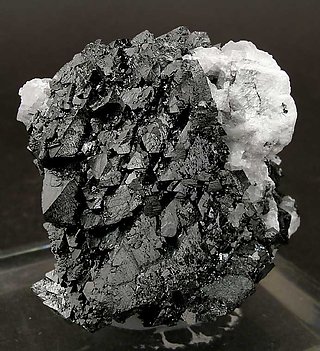 |
|
|
|
LR36F4: This specimen shows parallel growths on a single axis, so typical of the finds from N'Chwanning. The tetrahedral crystals are brilliant with very well defined faces and edges, and a brilliant surface.
From the David Lucas collection, number 587 so we will give the buyer his label.
N'Chwaning II Mine, N'Chwaning mining area, Kuruman, Kalahari manganese field (KMF), Northern Cape Province South Africa
Specimen size: 3.5 × 3.2 × 3.3 cm = 1.38” × 1.26” × 1.30”
Calcite extremely fluorescent long & short UV
|
|
|
|
Hausmannite with Celestine |
|---|
|
|
ET29Y5: Irregular aggregate of very sharp octahedral crystals, extraordinarily bright, on matrix and with small groups of white Celestine crystals.
N'Chwaning II Mine, N'Chwaning mining area, Kuruman, Kalahari manganese field (KMF), Northern Cape Province South Africa
Specimen size: 6.7 × 5.3 × 2.9 cm = 2.64” × 2.09” × 1.14”
Main crystal size: 0.3 × 0.3 cm = 0.12” × 0.12”
|
| |
|
| Bultfonteinite with Hydroxyapophyllite-(K) and Calcite |
|
|
|
|
|
EC56R1: Fanlike groups of snowy white acicular crystals of Bultfonteinite replacing the faces of short elongated crystals of Hydroxyapophyllite-(K) which has a pseudocubic habit. In some cases the replacement is deeper and forms a more or less complete pseudomorph of the preexisting Hydroxyapophyllite-(K). All are on a matrix of clear, complex, crystals of Calcite. We’ll send a copy of the analysis to the buyer of the piece.
N'Chwaning II Mine, N'Chwaning mining area, Kuruman, Kalahari manganese field (KMF), Northern Cape Province South Africa (2006)
Specimen size: 8.5 × 3.4 × 2.5 cm = 3.35” × 1.34” × 0.98”
Main crystal size: 1.2 × 1 cm = 0.47” × 0.39”
|
|
|
|
Pectolite |
|---|
|
|
NM66AL0: Double fan-like growth of white acicular crystals, with good terminations visible with a loupe, and with a satin luster.
N'Chwaning II Mine, N'Chwaning mining area, Kuruman, Kalahari manganese field (KMF), Northern Cape Province South Africa
Specimen size: 6.3 × 5.8 × 1.8 cm = 2.48” × 2.28” × 0.71”
|
| |
|
| Braunite with Calcite |
|
|
|
|
|
TQ97N0: A novelty for Tucson 2009. Very well defined crystals of the best quality for the species. With an excellent luster, they are on a matrix of white crystals of Calcite. From a recent find (2008) at the new N’Chwanning III mine.
N'Chwaning III Mine, N'Chwaning mining area, Kuruman, Kalahari manganese field (KMF), Northern Cape Province South Africa (2008)
Specimen size: 6.6 × 6 × 3.9 cm = 2.60” × 2.36” × 1.54”
Main crystal size: 0.3 × 0.3 cm = 0.12” × 0.12”
|
|
|
|
Bixbyite with Sturmanite and Calcite |
|---|
|
|
MD64AK3: Group of very sharp Bixbyite crystals, of cubic habit, very bright, on matrix, with Calcite and small Sturmanite crystals.
The specimen is from the Carles Manresa collection, whose label we will send to the buyer.
N'Chwaning III Mine, N'Chwaning mining area, Kuruman, Kalahari manganese field (KMF), Northern Cape Province South Africa
Specimen size: 4.4 × 3.8 × 2.7 cm = 1.73” × 1.50” × 1.06”
Main crystal size: 0.4 × 0.2 cm = 0.16” × 0.08”
Former collection of Carles Manresa
|
| |
|
| Bixbyite with Hausmannite and Celestine |
|
|
|
|
|
TG96W4: Group of extraordinarily large cubic crystals of Bixbyite. They are very bright and form polycrystalline growths, with small crystals of Hausmannite and small white coatings of Celestine.
N'Chwaning III Mine, N'Chwaning mining area, Kuruman, Kalahari manganese field (KMF), Northern Cape Province South Africa (2011)
Specimen size: 10 × 7.4 × 4.6 cm = 3.94” × 2.91” × 1.81”
Main crystal size: 2.3 × 2.2 cm = 0.91” × 0.87”
|
|
|
|
Jacobsite with Calcite and Andradite |
|---|
|
|
TF12X3: A novelty at Tucson 2013. Sharp, brilliant, octahedral crystals. The contrast between the black Jacobsite crystals and the white Calcite makes this specimen nicer than usual.
We'll send a copy of the analysis to the buyer of the piece.
N'Chwaning III Mine, N'Chwaning mining area, Kuruman, Kalahari manganese field (KMF), Northern Cape Province South Africa (±08/2012)
Specimen size: 1.6 × 1.3 × 1.3 cm = 0.63” × 0.51” × 0.51”
Main crystal size: 0.2 × 0.2 cm = 0.08” × 0.08”
Calcite minor fluorescence long & short UV
|
| 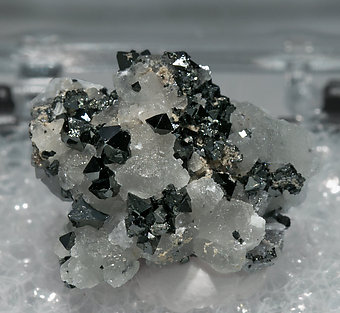 |
|
| Jacobsite with Calcite and Andradite |
|
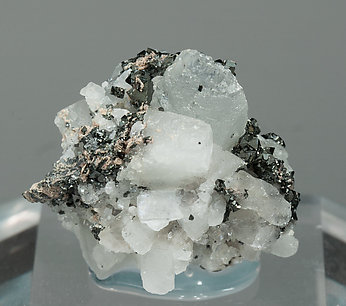 |
|
|
|
TR11Z1: A novelty at Tucson 2013. Groups of sharp, brilliant, well defined octahedral crystals on a matrix of Calcite crystals with small Andradite crystals. The Jacobsite crystals strongly contrast with the white Calcite and make this specimen nicer than usual.
N'Chwaning III Mine, N'Chwaning mining area, Kuruman, Kalahari manganese field (KMF), Northern Cape Province South Africa (±08/2012)
Specimen size: 2.8 × 2.6 × 1.8 cm = 1.10” × 1.02” × 0.71”
Main crystal size: 0.2 × 0.1 cm = 0.08” × 0.04”
Calcite minor fluorescence long & short UV
|
|
|
|
Jouravskite with Xonotlite |
|---|
|
|
EX91AG3: A novelty at Denver 2017. Botryoidal aggregates of Jouravskite micro-crystals, a very rare calcium and manganese sulfate-carbonate. They are very sharp, very bright, have and an extraordinary lemon-yellow color and are on a Xonotlite matrix.
This specimen was photographed for the ‘Munich 2017’ section of the magazine ‘Mineralien Welt’ and appears on page 71 of number 1/2018 and the magazine ‘Paragénesis’, number 01/2018, page 103
N'Chwaning III Mine, N'Chwaning mining area, Kuruman, Kalahari manganese field (KMF), Northern Cape Province South Africa (2017)
Specimen size: 5.8 × 3.6 × 1.7 cm = 2.28” × 1.42” × 0.67”
Main crystal size: 0.7 × 0.3 cm = 0.28” × 0.12”
|
| |
|
| Jouravskite |
|
|
|
|
|
TK16AH1: A novelty at Denver 2017. Aggregate of very sharp Jouravskite crystals, a very rare calcium and manganese sulfate-carbonate. The crystals, on a rocky matrix with Quartz, apart their excellent luster, have and an extraordinary lemon-yellow color.
N'Chwaning III Mine, N'Chwaning mining area, Kuruman, Kalahari manganese field (KMF), Northern Cape Province South Africa (2017)
Specimen size: 5.8 × 5.6 × 4 cm = 2.28” × 2.20” × 1.57”
Main crystal size: 0.6 × 0.4 cm = 0.24” × 0.16”
|
|
|
|
Jouravskite with Xonotlite and Hydroxyapophyllite-(K) |
|---|
|
|
EZ99AG4: A novelty at Denver 2017. Very well defined lenticular Jouravskite crystals, a very rare calcium and manganese sulfate-carbonate. They are translucent, very bright, with an extraordinary lemon-yellow color and on matrix, with white Xonotlite aggregates and translucent botryoidal Hydroxyapophyllite-(K) aggregates with a lavender color.
The specimen has been reviewed, photographed and published as a new discovery in the magazine ‘Mineral Up’ on page 64 in number 2017/2
N'Chwaning III Mine, N'Chwaning mining area, Kuruman, Kalahari manganese field (KMF), Northern Cape Province South Africa (2017)
Specimen size: 8.8 × 4.4 × 1.2 cm = 3.46” × 1.73” × 0.47”
Main crystal size: 0.7 × 0.3 cm = 0.28” × 0.12”
Xonotlite fluorescence short UV & minor fluorescence long UV
|
| |
|
| Inesite with Orlymanite and Calcite |
|
|
|
|
|
ER27X0: Radial growths of acicular crystals of Inesite with a very deep color, with white scalenohedral crystals of Calcite and on a botryoidal growth of Orlymanite, a rare silicate of calcium and manganese. From the type locality for Orlymanite.
Wessels Mine, Hotazel, Kalahari manganese field (KMF), Northern Cape Province South Africa
Specimen size: 6.7 × 3.6 × 2 cm = 2.64” × 1.42” × 0.79”
Main crystal size: 1 × 0.1 cm = 0.39” × 0.04”
Calcite fluorescent long & short UV
Former collection of Claus Hedegaard. Number 10830
|
|
|
|
Kutnohorite |
|---|
|
|
EH37D2: Really nice form for this reasonably uncommon mineral and just how I like them: very aerial crystals well separated from the matrix.
Wessels Mine, Hotazel, Kalahari manganese field (KMF), Northern Cape Province South Africa (1980)
Specimen size: 5 × 4.7 × 3 cm = 1.97” × 1.85” × 1.18”
Fluorescent long & short UV
|
| 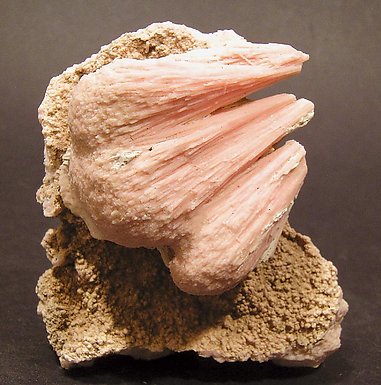 |
|
| Rhodochrosite with Gageite |
|
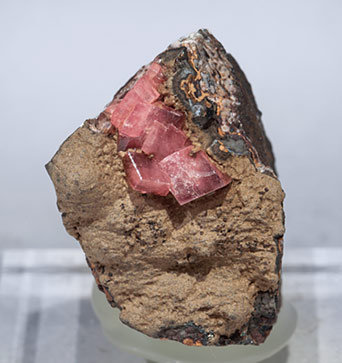 |
|
|
|
MD12AE7: Botryoidal aggregate of Gageite, a rare manganese and zinc silicate. It has a greenish-brown color and is coating a matrix of manganese oxides crowned by a group of rhombohedral Rhodochrosite crystals that are translucent, bright and have a uniform pink color. The sample has been analyzed and we’ll send a copy of the analysis to the buyer.
Wessels Mine, Hotazel, Kalahari manganese field (KMF), Northern Cape Province South Africa
Specimen size: 2.8 × 2.2 × 2.4 cm = 1.10” × 0.87” × 0.94”
Main crystal size: 0.4 × 0.4 cm = 0.16” × 0.16”
|
|
|
|
Sugilite with Pectolite |
|---|
|
|
EF89AA5: Parallel growths of small Sugilite crystals with good terminations. They are on matrix, with radial sprays of small Pectolite crystals. Very recently we posted this same specimen, but its vivid and uniform bluish color gave us some doubts about its identity, so we removed it until it could be analyzed. We will send the buyer a copy of the analysis confirming that it is sugilite.
Wessels Mine, Hotazel, Kalahari manganese field (KMF), Northern Cape Province South Africa
Specimen size: 4.1 × 4 × 2 cm = 1.61” × 1.57” × 0.79”
Pectolite intense fluorescence short UV & fluorescent long UV
|
| |
|
| Ephesite |
|
|
|
|
|
TQ49AF2: A group of very well defined crystals on matrix. They are bright and have a very intense color. Ephesite, a phyllosilicate of the mica group, is a very rare species, and more rare in crystals of this length and quality.
The sample is from Charles Key.
Kuruman, Kalahari manganese field (KMF), Northern Cape Province South Africa
Specimen size: 3.7 × 4.1 × 2.5 cm = 1.46” × 1.61” × 0.98”
Main crystal size: 0.4 × 0.3 cm = 0.16” × 0.12”
|
|
|
|
Octahedral Fluorite |
|---|
|
|
TP86N0: Group of very sharp octahedral crystals. They are transparent, bright and have an excellent, very intense green color. From a recent find in Riemvasmaak in 2008.
Riemvasmaak, Orange river area, Kakamas, ZF Mgcawu District, Northern Cape Province South Africa (2008)
Specimen size: 5.4 × 4.7 × 2.1 cm = 2.13” × 1.85” × 0.83”
Main crystal size: 1.8 × 1.3 cm = 0.71” × 0.51”
Fluorescent long & short UV
|
| 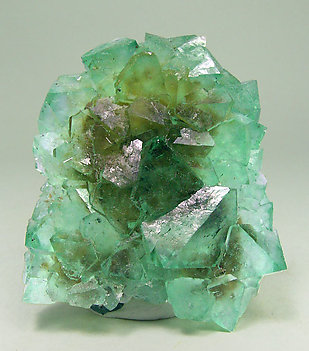 |
|
| Octahedral Fluorite |
|
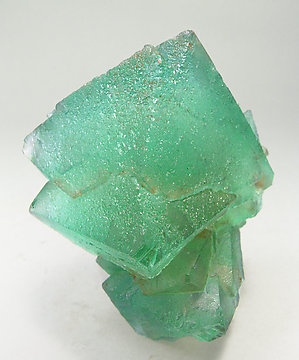 |
|
|
|
TH97N0: Very aerial group of very sharp octahedral crystals of a considerable size. They are transparent, bright and have and excellent, very intense green color. From a recent find in Riemvasmaak in 2008.
Riemvasmaak, Orange river area, Kakamas, ZF Mgcawu District, Northern Cape Province South Africa (2008)
Specimen size: 6 × 5 × 3.6 cm = 2.36” × 1.97” × 1.42”
Main crystal size: 3.3 × 3 cm = 1.30” × 1.18”
Fluorescent long & short UV
|
|
|
|
Octahedral Fluorite with Quartz |
|---|
|
|
TG50N0: Group of very sharp octahedral crystals. They are transparent, bright, with inclusions, and have an excellent, very intense green color. Partially coated by white Quartz. From a recent find in Riemvasmaak in 2008.
Riemvasmaak, Orange river area, Kakamas, ZF Mgcawu District, Northern Cape Province South Africa (2008)
Specimen size: 7 × 5.9 × 4.5 cm = 2.76” × 2.32” × 1.77”
Main crystal size: 2.2 × 1.6 cm = 0.87” × 0.63”
Fluorescent long & short UV
|
| |
|
| Octahedral Fluorite |
|
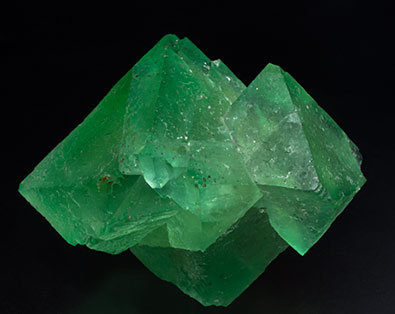
Front | 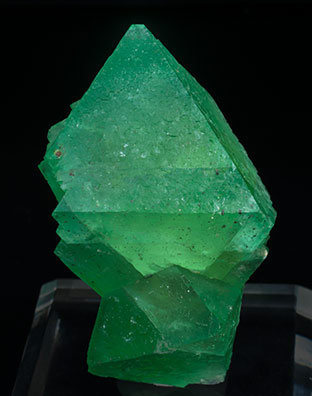
Side |
| |
|
|
|
|
MF37AC3: Aggregate of very sharp octahedral Fluorite crystals. They are between transparent and translucent and have an intense and very uniform green color.
Riemvasmaak, Orange river area, Kakamas, ZF Mgcawu District, Northern Cape Province South Africa (±2005)
Specimen size: 7.3 × 4.2 × 5.5 cm = 2.87” × 1.65” × 2.17”
Main crystal size: 4.8 × 4.8 cm = 1.89” × 1.89”
Fluorescent long & short UV
|
|
|
|
Octahedral Fluorite with Quartz |
|---|
|
|
EC28Q7: Isolated and grouped octahedral crystals, transparent and with a very intense and uniform green color and partially coated by white Quartz.
Riemvasmaak, Orange river area, Kakamas, ZF Mgcawu District, Northern Cape Province South Africa (01/2010)
Specimen size: 8.2 × 5.7 × 3.2 cm = 3.23” × 2.24” × 1.26”
Main crystal size: 1.7 × 1.5 cm = 0.67” × 0.59”
Fluorescent long & short UV
|
| |
|
| Fluorite (octahedral) with Quartz |
|
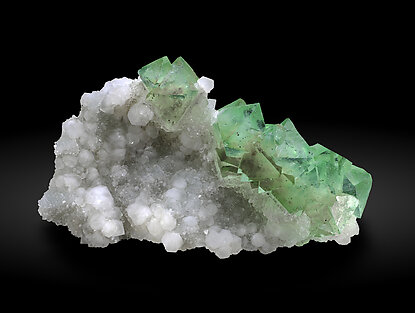
Front / Photo: Joaquim Callén | 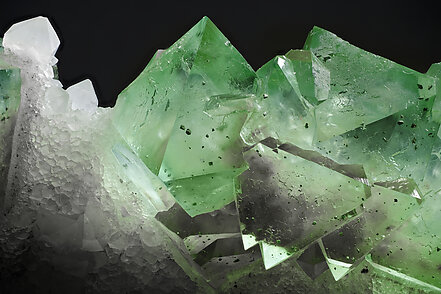
Detail / Photo: Joaquim Callén |
| |
|
Fluorescent light (daylight)
|
|
|
|
TRB27AO5: Very sharp octahedral Fluorite crystals, between translucent and transparent, with good luster and a uniform green color adn with inclusions. On a matrix of white Quartz crystals that do not seem to have been acid-etched, showing a very "fresh" appearance.
Riemvasmaak, Orange river area, Kakamas, ZF Mgcawu District, Northern Cape Province South Africa
Specimen size: 8.4 × 5 × 3.1 cm = 3.31” × 1.97” × 1.22”
Main crystal size: 1.4 × 0.9 cm = 0.55” × 0.35”
Fluorescent long & short UV
|
|
|
|
Octahedral Fluorite |
|---|
|
|
EB68Q7: Group of transparent octahedral crystals with a very intense and uniform green color, some of them with centered inclusions.
Riemvasmaak, Orange river area, Kakamas, ZF Mgcawu District, Northern Cape Province South Africa (01/2010)
Specimen size: 9.3 × 8.3 × 4.8 cm = 3.66” × 3.27” × 1.89”
Main crystal size: 2.6 × 2.2 cm = 1.02” × 0.87”
Fluorescent long & short UV
|
| |
|
| Fluorite |
|
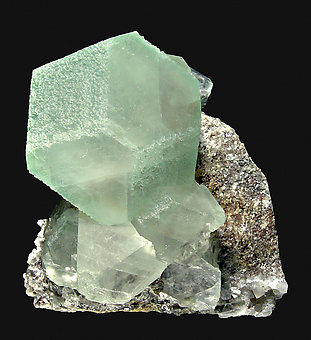
Front | 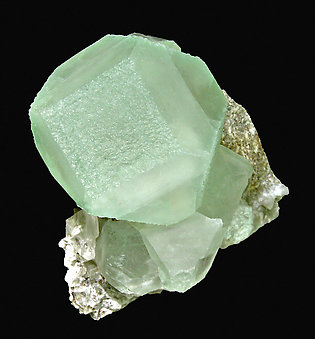
Side |
| |
|
|
|
|
TB89J1: Very aerial and esthetic specimen with an excellent crystallization in which appear, without predominance of one or another, the faces of the cube, slightly rough, and those of the octahedron, completely smooth. The green color is another feature of this original sample.
Pella, Orange River, Northern Cape Province South Africa (2006)
Specimen size: 6.3 × 6 × 4.2 cm = 2.48” × 2.36” × 1.65”
Main crystal size: 3.5 × 3.5 cm = 1.38” × 1.38”
Fluorescent long & short UV
|
|
|
|
Sceptered smoky Quartz |
|---|
|
|
TR17S0: A novelty at Tucson 2011. Parallel and sceptered growth with some doubly terminated crystals that are transparent, very bright in deep smoky shades and on a parallel group of very elongate crystals of white Quartz.
Steinkopf, Namakwa District (Namaqualand), Northern Cape Province South Africa (08/2010)
Specimen size: 6.3 × 1.6 × 1.5 cm = 2.48” × 0.63” × 0.59”
Main crystal size: 1.7 × 1.1 cm = 0.67” × 0.43”
|
| 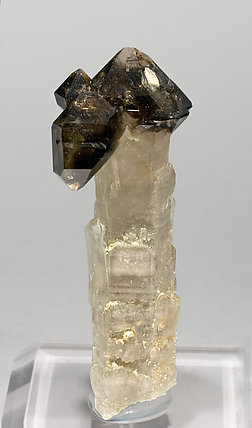
Front | 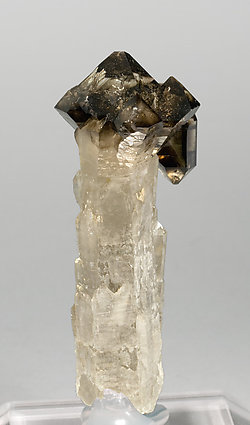
Rear |
| |
|
|
| Sceptered smoky Quartz |
|
|
|
|
|
TE28S0: A novelty at Tucson 2011. Parallel and sceptered growth with a centered “window” formation. Crystals are very bright with deep smoky shades and are on a parallel group of very elongate crystals of white Quartz.
Steinkopf, Namakwa District (Namaqualand), Northern Cape Province South Africa (08/2010)
Specimen size: 8.2 × 3.5 × 2.5 cm = 3.23” × 1.38” × 0.98”
|
|
|
|
Gold with Quartz |
|---|
|
|
ML27T8: Very well defined laminar growths and very thin hooked crystals on Quartz matrix. The sample is from a locality that is rarely referenced in mineral collections.
From the Claus Hedegaard collection (num. 13579), whose label we’ll send to the buyer.
Witwatersrand field, Gauteng South Africa
Specimen size: 3.4 × 2.8 × 2.2 cm = 1.34” × 1.10” × 0.87”
Opal Fluorescent long & short UV
|
| |
|
| Rhodochrosite with Shigaite |
|
|
|
|
|
MH66AA7: Aggregate of two small very sharp Shigaite crystals. They are laminar, bright, with a very intense and deep color and on a rocky matrix coated by a botryoidal Rhodochrosite growth, very bright and with a very intense, vivid and uniform pink color. The whole sample is extremely esthetic.
N'Chwaning I Mine, N'Chwaning mining area, Kuruman, Kalahari manganese field (KMF), Northern Cape Province South Africa (2006)
Specimen size: 8.7 × 6.2 × 4.9 cm = 3.43” × 2.44” × 1.93”
Main crystal size: 0.3 × 0.1 cm = 0.12” × 0.04”
Fluorescence short UV & minor fluorescence long UV
|
|
|
Bultfonteinite is a rare phyllosilicate (calcium fluorsilicate) that exists in the N'Chwaning mine along with another rare phyllosilicate (also calcium), Oyelite. In fact, while awaiting the analysis of these specimens we had indicated on the web site that they were Oyelite, as previous finds from the same mine with the same appearance and white color had always been considered Oyelite. So when we got the results of the analysis, much to our surprise, the fluor present in the sample as well as the atomic ratio of Ca/Si=1:2 indicates that the specimens are Bultfonteinite and not Oyelite.
|
Bultfonteinite with Hydroxyapophyllite-(K) and Calcite |
|---|
|
|
EZ63R1: Fanlike groups of snowy white acicular crystals of Bultfonteinite replacing the faces of short elongated crystals of Hydroxyapophyllite-(K) which has a pseudocubic habit. In some cases the replacement is deeper and forms a more or less complete pseudomorph of the preexisting Hydroxyapophyllite-(K). All are on a matrix of clear, complex, crystals of Calcite. We’ll send a copy of the analysis to the buyer of the piece.
This specimen has been photographed and published as a reference for the Bultfonteinite species in the magazine ‘Lapis‘ number 02/2021, page 9
N'Chwaning II Mine, N'Chwaning mining area, Kuruman, Kalahari manganese field (KMF), Northern Cape Province South Africa (2006)
Specimen size: 3.6 × 3.1 × 2.8 cm = 1.42” × 1.22” × 1.10”
Main crystal size: 0.7 × 0.6 cm = 0.28” × 0.24”
|
| 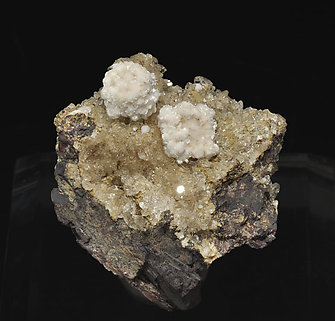 |
|
| Bultfonteinite with Hydroxyapophyllite-(K) and Calcite |
|
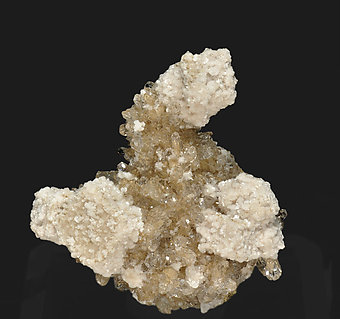 |
|
|
|
ET64R1: Fanlike groups of snowy white acicular crystals of Bultfonteinite replacing the faces of short elongated crystals of Hydroxyapophyllite-(K) which has a pseudocubic habit. In some cases the replacement is deeper and forms a more or less complete pseudomorph of the preexisting Hydroxyapophyllite-(K). All are on a matrix of clear, complex, crystals of Calcite. We’ll send a copy of the analysis to the buyer of the piece.
N'Chwaning II Mine, N'Chwaning mining area, Kuruman, Kalahari manganese field (KMF), Northern Cape Province South Africa (2006)
Specimen size: 4.2 × 3.7 × 2.1 cm = 1.65” × 1.46” × 0.83”
Main crystal size: 0.9 × 0.9 cm = 0.35” × 0.35”
|
|
|
From the great Olmiite finds made in N'Chwaning Mine we offer this further material. The quality is, as you can see, much better than the Poldervaartites found in the Wessels Mine. Notably the color is much more intense and redder. On the subject of the color it is necessary to warn you that some of these new Olmiites show an intense color change depending of the kind of light used: in day light they become yellowish but in artificial light they are a spectacular strawberry red color.
|
Olmiite |
|---|
|
|
AX49AD6: Doubly terminated crystal on matrix. It is very individualized, translucent, bright and with a good color, with fine polycrystalline growths on the surface of its faces.
The sample is from the Sylvane collection, which label we’ll send to the buyer.
N'Chwaning II Mine, N'Chwaning mining area, Kuruman, Kalahari manganese field (KMF), Northern Cape Province South Africa (01/2002)
Specimen size: 2.3 × 2.2 × 2.2 cm = 0.91” × 0.87” × 0.87”
Main crystal size: 2 × 1.5 cm = 0.79” × 0.59”
Fluorescent long & short UV
Former collection of Josep Amigó (Silvane)
|
| 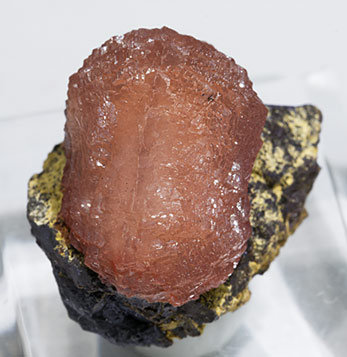
Bulb light | 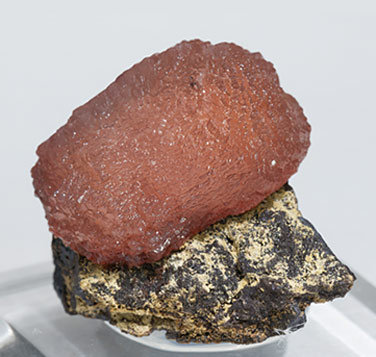
Bulb light |
| |
|
|
| Olmiite |
|
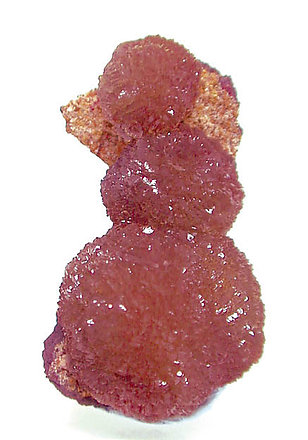 |
|
|
|
EQ99: Excellent color, perfection, and esthetic: the form is really nice, it looks like a snowman. A exclusive and funny thing.
N'Chwaning II Mine, section 5 south, stope 46-47 roof, N'Chwaning mining area, Kuruman, Kalahari manganese field (KMF), Northern Cape Province South Africa (01/2002)
Specimen size: 2.5 × 1.7 × 1.7 cm = 0.98” × 0.67” × 0.67”
Main crystal size: 2.4 × 1.9 cm = 0.94” × 0.75”
Fluorescent long & short UV
Type locality
|
|
|
|
Olmiite with Calcite |
|---|
|
|
TM96N2: A novelty of Tucson 2009. Unusual groups of crystals of irregular contour, more or less oval-shaped. They are pink, and more intense on the terminations. They are on very acute scalenohedrons of Calcite and on matrix. They have come from a single geode. At first we believed they could be Poldervaartite due to the presence of the accompanying Calcite and the pinkish color of the crystals, but the analysis confirms that they are Olmiite (the manganoan end of the series) and not Poldervaartite (the calcian end). We’ll send a copy of the analysis to the buyer of the sample.
The specimen has been reviewed, photographed and published as a new discovery in the magazine ‘Mineral Up’ on page 29 in number 2009/2.
N'Chwaning II Mine, upper levels, N'Chwaning mining area, Kuruman, Kalahari manganese field (KMF), Northern Cape Province South Africa (12/2008)
Specimen size: 3.4 × 2.3 × 3.8 cm = 1.34” × 0.91” × 1.50”
Fluorescent long & short UV
Type locality
|
| 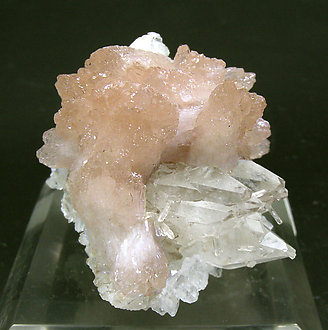
Front | 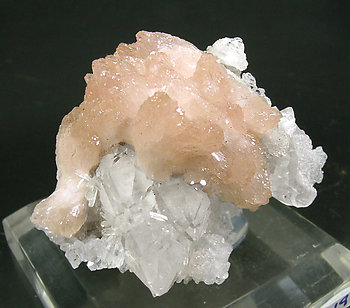
Side |
| |
|
|
| Olmiite with Calcite |
|
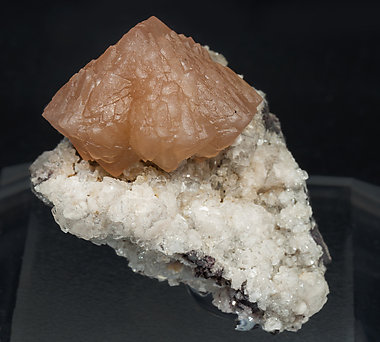
neon light (day light) | 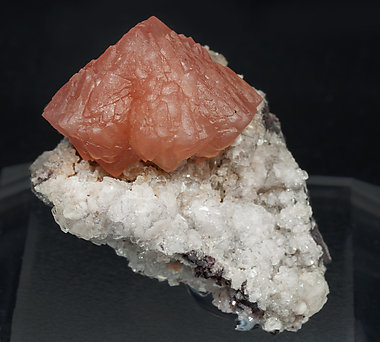
bulb light |
| 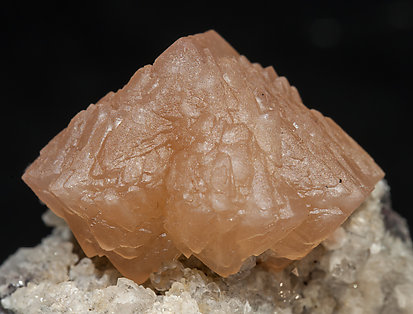 |
|
|
|
|
MA27AH0: Complex and very aerial Olmiite crystal with parallel and polycrystalline growths, with very well defined faces and edges, translucent with a pink color changing to reddish in incandescent light. It is on matrix, with white Calcite crystals.
The sample, a South African classic, is from the Desmond Sacco collection, whose label we’ll send to the buyer.
N'Chwaning II Mine, N'Chwaning mining area, Kuruman, Kalahari manganese field (KMF), Northern Cape Province South Africa (2017)
Specimen size: 3.5 × 3.4 × 3.2 cm = 1.38” × 1.34” × 1.26”
Main crystal size: 2.4 × 1.8 cm = 0.94” × 0.71”
With handwritten label from the Desmond Sacco Collection
|
|
|
|
Olmiite |
|---|
|
|
EB54E8: This one stands out for the crystalline terminations, pyramidal and in complex groups that give it a spherical look, and the sharpness of the forms of the prismatic faces. Both the color and brilliance are magnificent. The position of the group on the matrix makes it very esthetic and adds the definitive touch.
N'Chwaning II Mine, section 5 south, stope 46-47 roof, N'Chwaning mining area, Kuruman, Kalahari manganese field (KMF), Northern Cape Province South Africa (01/2002)
Specimen size: 4.8 × 2 × 3.4 cm = 1.89” × 0.79” × 1.34”
Fluorescent long & short UV
Type locality
|
| 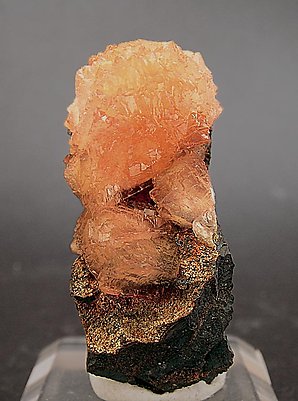
neon light (day light) | 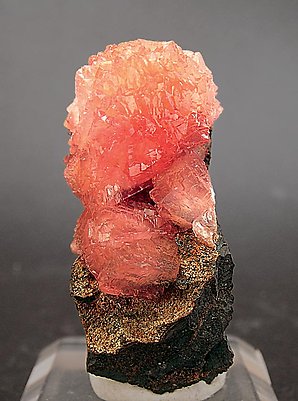
bulb light |
| 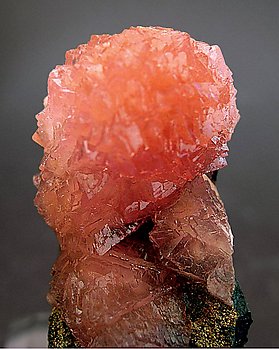
bulb light |
|
|
| Olmiite with Calcite |
|
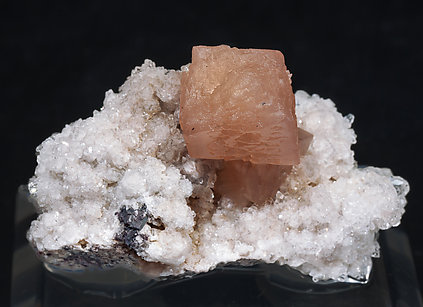
neon light (day light) | 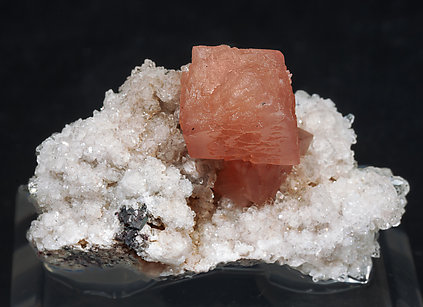
bulb light |
| 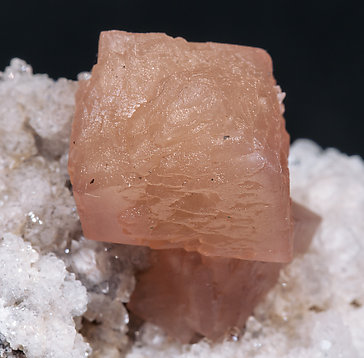 |
|
|
|
|
MB27AH0: A very aerial Olmiite crystal with polycrystalline growths, with very well defined faces and edges, translucent with a pink color that changes to reddish under an incandescent light. It is on matrix, with white Calcite crystals.
The sample, a South African classic, is from the Desmond Sacco collection, whose label we’ll send to the buyer.
N'Chwaning II Mine, N'Chwaning mining area, Kuruman, Kalahari manganese field (KMF), Northern Cape Province South Africa (2017)
Specimen size: 4.9 × 3.4 × 2.7 cm = 1.93” × 1.34” × 1.06”
Main crystal size: 1.4 × 1.4 cm = 0.55” × 0.55”
With handwritten label from the Desmond Sacco Collection
|
|
|
|
Olmiite |
|---|
|
|
EB2B9: Two photos showing its spectacular color change. Just minor matrix on its rear, almost a floater specimen complete in all sides with perfect form and excellent luster-color perfection. The crystals have a spherical form, they are gemmy and are formed by hundreds of small parallel grow crystals. A beauty!.
This specimen was photographed for the magazine ‘Mineralien Welt’ and appears on page 18 of number 1/2009.
N'Chwaning II Mine, section 5 south, stope 46-47 roof, N'Chwaning mining area, Kuruman, Kalahari manganese field (KMF), Northern Cape Province South Africa (01/2002)
Specimen size: 5.5 × 3.7 × 3.2 cm = 2.17” × 1.46” × 1.26”
Fluorescent long & short UV
Type locality
|
| 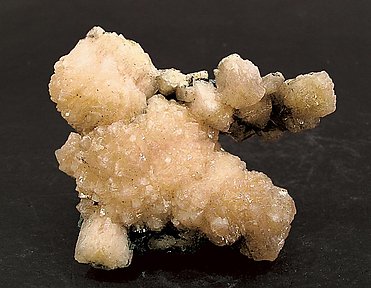
neon light (day light) | 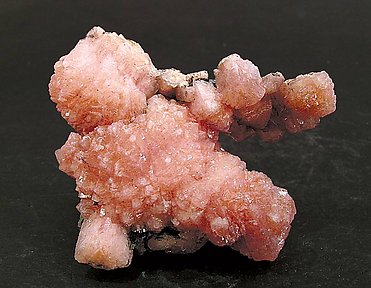
bulb light | |
|
|
| Olmiite with Calcite |
|
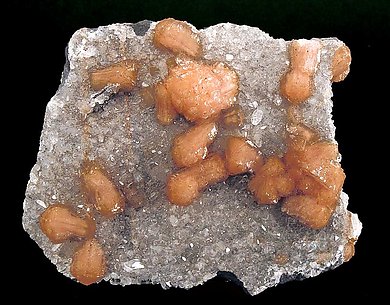 |
|
|
|
TM98D8: Recently new Olmiites were found in N'chwaning. The color is a little more orange than the first ones, and the crystals are a little bit smaller. But these ones are on a matrix of small crystals of gemmy Calcite, making the whole specimen esthetically pleasing. The prices are also lower than they were for the first ones, so we think they are a good deal. In this case the crystals of Poldervaarite are well positioned on the matrix, nicely separated, aerial, and have good contrast with the matrix.
N'Chwaning II Mine, N'Chwaning mining area, Kuruman, Kalahari manganese field (KMF), Northern Cape Province South Africa (11/2003)
Specimen size: 8.2 × 6.3 × 2.2 cm = 3.23” × 2.48” × 0.87”
Main crystal size: 1.7 × 1.2 cm = 0.67” × 0.47”
Extremely fluorescent long & short UV
Type locality
|
|
|
|
Olmiite with Quartz |
|---|
|
|
MA88N6: Globular growths of small crystals of Olmiite whose faces are very well defined and very bright, with two degrees of color, clear cream in some areas and slightly orange in others. On matrix, with small crystals of white Quartz.
N'Chwaning II Mine, 45 level, Kuruman, Kalahari manganese fields, Northern Cape South Africa (10/2008)
Specimen size: 4.8 × 4.7 × 3.3 cm = 1.89” × 1.85” × 1.30”
Main crystal size: 1.2 × 1 cm = 0.47” × 0.39”
Fluorescence short UV & minor fluorescence long UV
Type locality
|
| |
|
| Olmiite |
|
|
|
|
|
MH31M5: A novelty of Munich 2008. The sample forms globular growths of well defined terminations of crystals. The deeper color is similar to the older pieces, classified then as Poldervaartite.
This specimen was photographed for the ‘what’s new at Munich 2008’ section of the magazine ‘Mineralien Welt’ and appears on page 18 of number 1/2009.
N'Chwaning II Mine, 45 level, Kuruman, Kalahari manganese fields, Northern Cape South Africa (10/2008)
Specimen size: 9.2 × 5.8 × 3 cm = 3.62” × 2.28” × 1.18”
Main crystal size: 2.8 × 2.1 cm = 1.10” × 0.83”
Fluorescence short UV & minor fluorescence long UV
Type locality
|
|
|
|
Spessartine with Mica |
|---|
|
|
ER86P2: Very aerial on its small Muscovite matrix, the trapezohedral crystal is almost complete and has an excellent definition of its faces and edges. Color, luster and transparency are magnificent.
Sangulungulu Hill, Naan, Loliondo, Ngorongoro, Arusha region Tanzania (2008)
Specimen size: 2.5 × 1.9 × 1.9 cm = 0.98” × 0.75” × 0.75”
Main crystal size: 1.9 × 1.9 cm = 0.75” × 0.75”
|
| 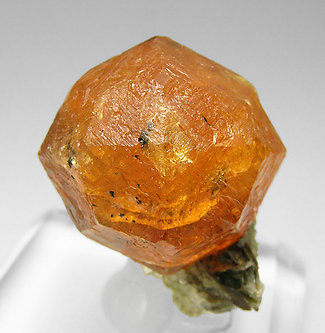
Front | 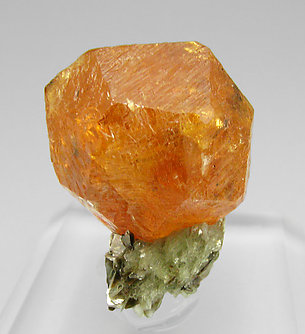
Side |
| |
|
|
| Spessartine with Kyanite and Mica |
|
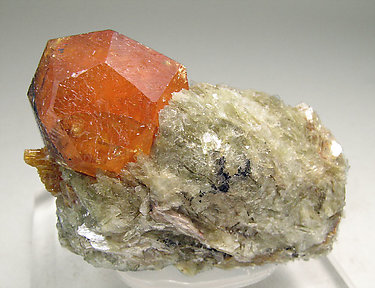
Front | 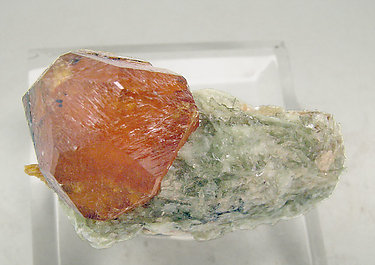
Top |
| |
|
|
|
|
MG27N6: Trapezohedral crystal of Spessartine with very well defined faces and edges, translucent and having an excellent color and standing on a matrix of Mica with brownish Kyanite.
Sangulungulu Hill, Naan, Loliondo, Ngorongoro, Arusha region Tanzania (2008)
Specimen size: 4 × 2.7 × 2 cm = 1.57” × 1.06” × 0.79”
Main crystal size: 2 × 1.6 cm = 0.79” × 0.63”
|
|
|
|
Alabandite with Zoisite (variety tanzanite) and Quartz |
|---|
|
|
MF89AK6: Very sharp Alabandite crystal, octahedral with cube faces, with a transparent Quartz crystal with inclusions, and two Zoisite crystals (tanzanite variety) with very well defined faces and edges, bright, transparent and with blue-violet to yellow colors.
Merelani Hills, Lelatema Mountains, Simanjiro District, Manyara Region Tanzania (2019)
Specimen size: 3 × 3 × 2.7 cm = 1.18” × 1.18” × 1.06”
|
| |
|
| Prehnite with Calcite |
|
|
|
|
|
MF68AK7: Spheroidal growth of Prehnite crystals with very well defined terminal faces, translucent, very bright and very intense yellow. On rock matrix, with Calcite.
Merelani Hills, Lelatema Mountains, Simanjiro District, Manyara Region Tanzania (2019)
Specimen size: 4.7 × 4.7 × 4.2 cm = 1.85” × 1.85” × 1.65”
Main crystal size: 1.3 × 0.5 cm = 0.51” × 0.20”
|
|
|
|
Zoisite (variety tanzanite) |
|---|
|
|
MA27AM6: Crystal of Zoisite (tanzanite variety) very sharp, with sharp crystal forms, perfect terminations (with a contact in one of them), transparent, with good luster and different shades of color between intense lavender blue and violet. We will send the buyer the specimen in its original perky box from the Robert J. Noble collection, which also contains the label.
Merelani Hills, Lelatema Mountains, Simanjiro District, Manyara Region Tanzania
Specimen size: 2 × 1.4 × 0.6 cm = 0.79” × 0.55” × 0.24”
Former collection of Bob Noble
Weight: 3.3 grams
|
| |
|
| Zoisite (variety tanzanite) |
|
|
|
|
|
EB26AK7: Parallel growth of Zoisite crystals (Tanzanite variety), of gem quality, transparent, very bright, and exhibiting dichroic color, deep and uniform navy blue that turns reddish according to the orientation of the light.
D-Block Mine, Merelani Hills, Lelatema Mountains, Simanjiro District, Manyara Region Tanzania (2016)
Specimen size: 3.4 × 1.9 × 0.9 cm = 1.34” × 0.75” × 0.35”
|
|
|
|
Zoisite (variety tanzanite) |
|---|
|
|
NG61AI3: Single crystal with very well defined faces and edges, with very transparent and bright (gem quality) terminal faces and an excellent color, intense blue with violet shades. The transition between the different colored areas on the crystal indicates it has not suffered any heat treatment.
The sample is from the Ignacio Hernández collection (num. 84) whose original label we’ll send to the buyer.
Merelani mines, Merelani Hills, Lelatema Mountains, Simanjiro District, Manyara Region Tanzania
Specimen size: 3.5 × 1.4 × 1.3 cm = 1.38” × 0.55” × 0.51”
Former collection of Ignacio Hernández
|
| |
|
| Zoisite (variety tanzanite) with Prehnite |
|
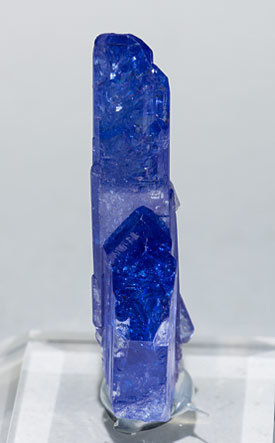
Front | 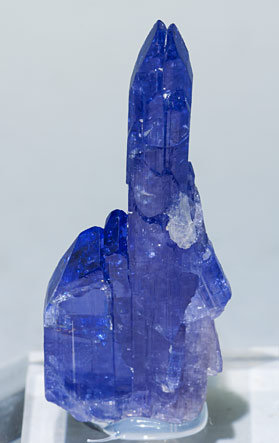
Side |
| |
|
|
|
|
MX89AA8: Parallel growth of two Zoisite (tanzanite variety) crystals, one of them very elongated. They are transparent, with a very intense and uniform color and small white Prehnite crystals, whose existence testifies that the sample has not been heated to increase its color intensity.
Merelani Hills, Lelatema Mountains, Simanjiro District, Manyara Region Tanzania (±2011)
Specimen size: 3.5 × 1.6 × 0.8 cm = 1.38” × 0.63” × 0.31”
Main crystal size: 3.5 × 0.7 cm = 1.38” × 0.28”
|
|
|
|
Zoisite (variety tanzanite) with Prehnite |
|---|
|
|
EM63T0: A crystal with very well defined faces and edges, transparent, very bright and with a doubly terminated crystal. The color is especially intense and, due to some details, we believe it is natural, not induced by heating. The "fresh" appearance of related Prehnite crystal, with some white areas that must change color when heated, and the grayish shades at the bottom of the piece, that must also turned to blue-violet, are reasons why we offer this sample as natural, not heated.
Merelani Hills, Lelatema Mountains, Simanjiro District, Manyara Region Tanzania (2010)
Specimen size: 3.6 × 1 × 1.2 cm = 1.42” × 0.39” × 0.47”
Main crystal size: 3.6 × 1.2 cm = 1.42” × 0.47”
|
| 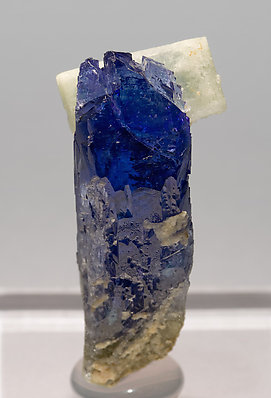
Front | 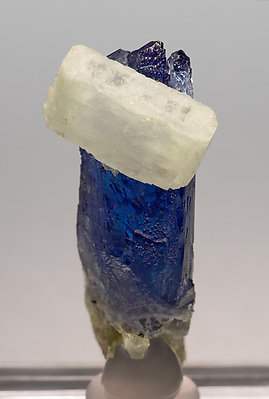
Rear |
| |
|
|
| Zoisite (variety tanzanite) with Prehnite and Chabazite |
|
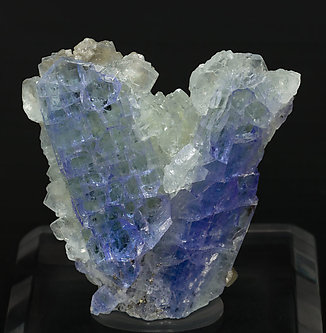
Front | 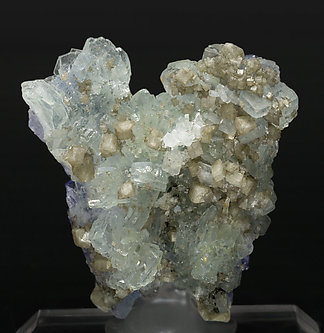
Rear |
| |
|
|
|
|
EG14T0: Group of two crystals. One of them, the left one, is doubly terminated, blue with slightly greenish areas. They are transparent, very bright and with crystals of Chabazite and well formed Prehnite crystals completely coating the back side and the top of the Zoisite crystals.
This specimen was photographed and published as a novelty at the 2011 Ste. Marie Show in the magazine ‘Le Règne Minéral’, special edition, number 100, page 132, and has been referenced and figured in the book "Minéraux - Le Guide des Passionnés" (page 430)
Merelani Hills, Lelatema Mountains, Simanjiro District, Manyara Region Tanzania (2010)
Specimen size: 4.2 × 4.1 × 1.5 cm = 1.65” × 1.61” × 0.59”
Main crystal size: 3.5 × 1.4 cm = 1.38” × 0.55”
|
|
|
|
Zoisite |
|---|
|
|
EF59T0: A novelty at Sainte Marie-aux-Mines 2011. Very transparent and bright parallel growth with a pink! color that appears with special intensity in some areas of the crystal.
This specimen was photographed and published as a novelty at the 2011 Ste. Marie Show in the magazine ‘Le Règne Minéral’, special edition, number 100, page 132, the magazine ‘Rivista Mineralogica Italiana’ on page 191 in number 2011/3, and in the book "Minéraux - Le Guide des Passionnés" (page 431)
Merelani Hills, Lelatema Mountains, Simanjiro District, Manyara Region Tanzania (2011)
Specimen size: 2.2 × 1.2 × 0.5 cm = 0.87” × 0.47” × 0.20”
|
| 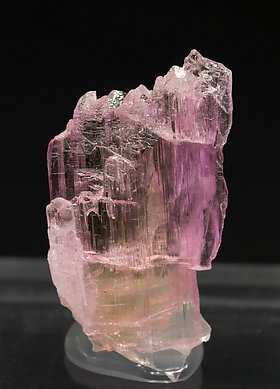
Front | 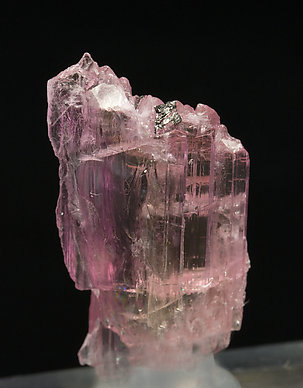
Rear |
| |
|
|
| Diopside |
|
|
|
|
|
TM81AH6: A very sharp Diopside crystal with very well defined faces and edges and a perfect termination, very rich in faces. It is bright, completely transparent, with a very intense and uniform color and has small Graphite inclusions.
We’ll send the sample in its original Perkin’s box from the R.J. Noble collection, also containing the collection label.
Samax Mine, Merelani Hills, Lelatema Mountains, Simanjiro District, Manyara Region Tanzania
Specimen size: 2 × 0.7 × 0.4 cm = 0.79” × 0.28” × 0.16”
Former collection of Bob Noble
|
|
|
|
Diopside with Titanite and Graphite |
|---|
|
|
TH26S3: A novelty at Tucson 2010. With the exceptional Tanzanite with Prehnite also appeared from Merelani some crystals of Diopside of notable size. This one has an excellent development of the upper terminal faces. It is transparent with an intense color and has an associated curious dark Titanite crystal that we analyzed. It also has small crystals of graphite on the back side.
Merelani Hills, Lelatema Mountains, Simanjiro District, Manyara Region Tanzania (2010)
Specimen size: 4.4 × 2.5 × 1.7 cm = 1.73” × 0.98” × 0.67”
Main crystal size: 3.2 × 1.6 cm = 1.26” × 0.63”
Fluorescence short UV & minor fluorescence long UV
|
| |
|
| Tremolite |
|
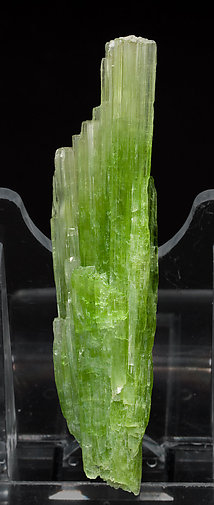
Front | 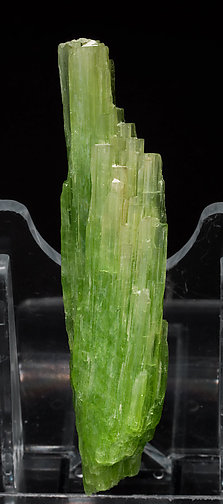
Rear |
| |
|
|
|
|
EA27W1: Aggregate of very elongated and flattened prismatic crystals with good terminations. They are translucent, bright and have an unusual and really intense green color, very rare for the species. Another representative species from Merelani.
Merelani Hills, Lelatema Mountains, Simanjiro District, Manyara Region Tanzania (2011)
Specimen size: 7 × 1.6 × 1 cm = 2.76” × 0.63” × 0.39”
Fluorescent short UV
|
|
|
|
Dravite |
|---|
|
|
TD47AI8: Floater parallel aggregate of doubly terminated Dravite crystals that are between transparent and translucent, very bright, with inclusions and that have a uniform dark brown color.
The sample is from the mineral reserve of John S. White whose label we will send to the buyer.
The specimen has been photographed and published in the magazine ‘Paragénesis’, number 01/2020, page 60
Merelani Hills, Lelatema Mountains, Simanjiro District, Manyara Region Tanzania
Specimen size: 4.7 × 1.6 × 1.5 cm = 1.85” × 0.63” × 0.59”
John S. White mineral reserve
|
| 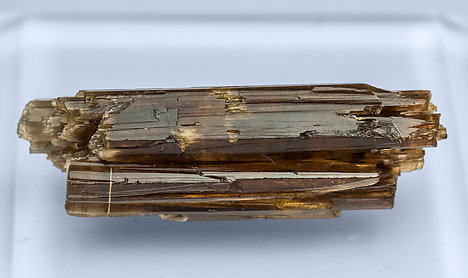
Front | 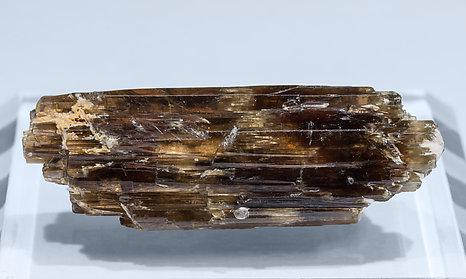
Rear |
| |
|
|
| Anglesite with Galena |
|
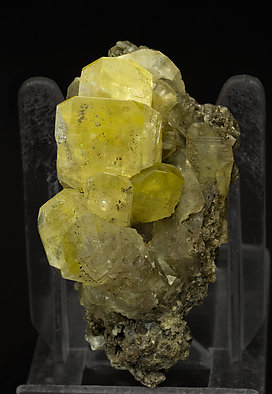
Front | 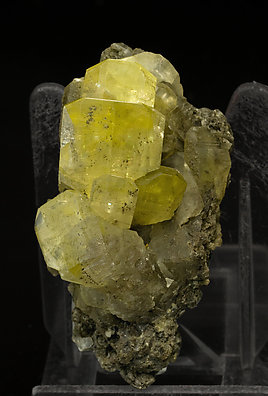
Side |
| |
|
|
|
|
ED68V0: Group of short prismatic crystals, rich in faces, between transparent and translucent, with a lemon yellow color and on Galena matrix. The sample is from a very classic locality for the species. Only very rarely is it possible to obtain old samples of this quality, and still more infrequently with a yellow color. It’s from a well known European collection whose label we’ll send to the buyer.
Sidi Amor ben Salem Mine, Slata, Tajerouine Tunisia
Specimen size: 5.8 × 3.1 × 2.9 cm = 2.28” × 1.22” × 1.14”
Main crystal size: 2.1 × 1.6 cm = 0.83” × 0.63”
|
|
|
|
Twinned Rutile |
|---|
|
|
MA63L8: Group of Rutile crystals that show perfect cyclic twins on a matrix of Limonite and Quartz. Very bright, striated faces and deep red color transparency and reflections visible under an intense light. Although the first locality given in the market was D.R. of Congo, we can give the correct locality as Zambia, close to the D.R. of Congo border.
Kinyanfumbe Zambia (2007)
Specimen size: 3.1 × 2.3 × 2.6 cm = 1.22” × 0.91” × 1.02”
Main crystal size: 1.1 × 1 cm = 0.43” × 0.39”
|
| 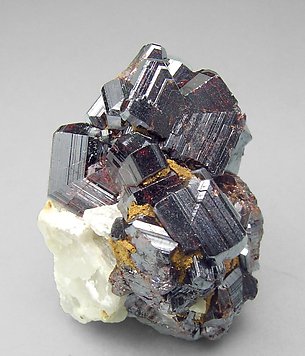 |
|
| Twinned Rutile |
|
|
|
|
|
MB60L8: Group of Rutile crystals, one of them with a good size. On a Limonite matrix that resembles a conglomerate. Rutile crystals display a perfect example of the classic cyclic twin. Very bright, striated faces and deep red color transparency and reflections visible under an intense light. Although the first locality given in the market was D.R. of Congo, we can give the correct locality as Zambia, close to the D.R. of Congo border.
Kinyanfumbe Zambia (2007)
Specimen size: 3.2 × 4.1 × 3.2 cm = 1.26” × 1.61” × 1.26”
Main crystal size: 0.9 × 0.9 cm = 0.35” × 0.35”
|
|
|
|
Twinned Rutile |
|---|
|
|
MA61L8: Group of Rutile crystals that show perfect cyclic twins on a matrix formed by Rutile, Limonite and a bit of Quartz. Very bright, striated faces and deep red color transparency and reflections visible under an intense light. Although the first locality given in the market was D.R. of Congo, we can give the correct locality as Zambia, close to the D.R. of Congo border.
Kinyanfumbe Zambia (2007)
Specimen size: 5 × 4 × 2.9 cm = 1.97” × 1.57” × 1.14”
Main crystal size: 1 × 1 cm = 0.39” × 0.39”
|
| |
|
| Malachite with Chrysocolla |
|
|
|
|
|
MX66S3: Centered and fanlike growths of acicular crystals of Malachite with very deep, intense and uniform color, and with scoriaceous growths of very clear green Chrysocolla.
Nkana Mine, Kitwe Zambia
Specimen size: 11.2 × 9 × 2.6 cm = 4.41” × 3.54” × 1.02”
Main crystal size: 0.2 × 0.2 cm = 0.08” × 0.08”
|
|
|
|
Libethenite |
|---|
|
|
TV96AL8: Group of very sharp dipyramidal Libethenite crystals with well defined faces and edges, bright and with a deep and uniform green color. On matrix with Chrysocolla.
We will ship the specimen in its original Perky box from the Robert J. Noble collection, which also contains the label.
Nkana Mine (Rokana Mine), Mindola pit, Kitwe, Kitwe District, Copperbelt Province Zambia
Specimen size: 1.9 × 1.9 × 1.4 cm = 0.75” × 0.75” × 0.55”
Main crystal size: 1.1 × 1 cm = 0.43” × 0.39”
Former collection of Bob Noble
|
| |
|
| Libethenite |
|
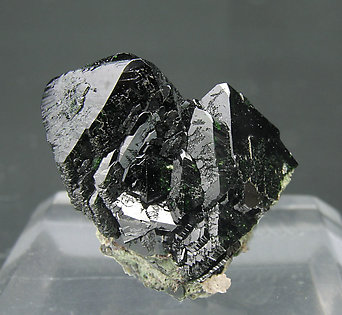
Front | 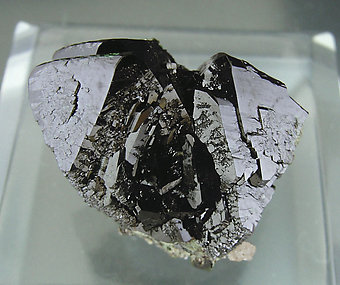
Top |
| |
|
|
|
|
TG89L3: The definitive thumbnail. Extremely well defined Libethenite crystals, with marked pseudo-octahedral habit. Very deep green color, excellent luster and on matrix.
This sample was collected by K. J. Reid in November, 1976, and there is a good paper about this deposit on The Mineralogical Record (Vol. 9 n. 6, Nov.-Dec. 1978)
The specimen has been reviewed, photographed and published in the magazine ‘Mineral Up’ on page 26 in number 2008/2
Nkana Mine (Rokana Mine), Mindola pit, Kitwe, Kitwe District, Copperbelt Province Zambia (11/1976)
Specimen size: 2.1 × 1.6 × 1.4 cm = 0.83” × 0.63” × 0.55”
Main crystal size: 1.1 × 1 cm = 0.43” × 0.39”
|
|
|
|
Libethenite |
|---|
|
|
EB36AL8: Elongated crystal of Libethenite on matrix, doubly terminated, and very rich in polycrystalline growths. With good luster and a very deep and uniform green color.
The specimen is accompanied by the collector's card, Dr. K.J. Reid, in which the date of the find is handwritten and signed.
Nkana Mine (Rokana Mine), Mindola pit, Kitwe, Kitwe District, Copperbelt Province Zambia (06/11/1976)
Specimen size: 3 × 2.4 × 1.1 cm = 1.18” × 0.94” × 0.43”
Main crystal size: 1.1 × 0.5 cm = 0.43” × 0.20”
Former collection of K.J. Reid
|
| |
|
| Libethenite |
|
|
|
|
|
TV6AK7: Group of tetrahedral crystals with very well defined faces and edges, lustrous, very deep and uniform green color, on matrix. A Zambian classic that we will send in its original Perky box from the Robert J. Noble collection, which also includes a label indicating that the piece was previously in the Sullivan collection.
Nkana Mine (Rokana Mine), Kitwe, Kitwe Dstrict, Copperbelt Province Zambia
Specimen size: 3.2 × 1.9 × 1.4 cm = 1.26” × 0.75” × 0.55”
Main crystal size: 1.2 × 1 cm = 0.47” × 0.39”
Former collection of Bob Noble
|
|
|
|
Libethenite with Malachite |
|---|
|
|
EA14AL8: Group of very sharp dipyramidal Libethenite crystals with well defined faces and edges, bright and with an intense and vivid green color. On matrix and with Malachite.
The specimen is accompanied by the collector's card, Dr. K.J. Reid, in which the date of the find is handwritten and signed.
Nkana Mine (Rokana Mine), Mindola pit, Kitwe, Kitwe District, Copperbelt Province Zambia (06/11/1976)
Specimen size: 3.4 × 2.4 × 1.9 cm = 1.34” × 0.94” × 0.75”
Main crystal size: 0.2 × 0.2 cm = 0.08” × 0.08”
Former collection of K.J. Reid
|
| |
|
| Libethenite |
|
|
|
|
|
EC67AL8: Elongated crystal of Libethenite on matrix, doubly terminated, very rich in polycrystalline growths, good luster and a very deep and uniform green color.
The specimen is accompanied by the collector's card, Dr. K.J. Reid, in which the date of the find is handwritten and signed.
This specimen has been published on the Mineralogical Record´s web page, in the ‘What's New’ section, report 57, August 30, 2020 edition, page 5
Nkana Mine (Rokana Mine), Mindola pit, Kitwe, Kitwe District, Copperbelt Province Zambia (06/11/1976)
Specimen size: 3.6 × 2.8 × 2.1 cm = 1.42” × 1.10” × 0.83”
Main crystal size: 1.5 × 0.9 cm = 0.59” × 0.35”
Former collection of K.J. Reid
|
|
|
|
Libethenite |
|---|
|
|
ED67AL8: Polycrystalline growth of Libethenite crystals with very sharp faces and edges, good luster and a very deep and uniform green color. On matrix.
The specimen is accompanied by the collector's card, Dr. K.J. Reid, in which the date of the find is handwritten and signed.
Nkana Mine (Rokana Mine), Mindola pit, Kitwe, Kitwe District, Copperbelt Province Zambia (06/11/1976)
Specimen size: 4.1 × 3 × 2.3 cm = 1.61” × 1.18” × 0.91”
Main crystal size: 1 × 1 cm = 0.39” × 0.39”
Former collection of K.J. Reid
|
| |
|
| Libethenite |
|
|
|
|
|
TE99L1: Very sharp, complex and excellent luster Libethenite crystals on matrix. The specimen comes from a one of the most classical Libethenite localities, where nowadays it is quite difficult to find fresh and high quality specimens.
This sample was collected by K. J. Reid in November, 1976, and there is a good paper about this deposit on The Mineralogical Record (Vol. 9 n. 6, Nov.-Dec. 1978)
Nkana Mine (Rokana Mine), Mindola pit, Kitwe, Kitwe District, Copperbelt Province Zambia (11/1976)
Specimen size: 4.5 × 3.6 × 3 cm = 1.77” × 1.42” × 1.18”
Main crystal size: 1.5 × 1.4 cm = 0.59” × 0.55”
|
|
|
|
Libethenite |
|---|
|
|
MC57S3: Druse of dipyramidal crystals, with very well defined faces and edges and deep and uniform green color, on matrix.
Nchanga Mine, Chingola Zambia
Specimen size: 10.2 × 7.5 × 3.6 cm = 4.02” × 2.95” × 1.42”
Main crystal size: 0.15 × 0.15 cm = 0.06” × 0.06”
|
| |
|
| Tarbuttite |
|
|
|
|
|
TA37AL5: Very aerial group of highly profiled Tarbuttite crystals, unusually transparent and sharp and on matrix. We will send the specimen, from the type locality for the species, in its original Perky box from the Robert J. Noble collection, which also contains the label, on which it appears that it was previously in the Jim & Dawn Minette collection.
Kabwe Mine (Broken Hill Mine), Kabwe (Kabwe-Ka Mukuba), Kabwe District, Central Province Zambia
Specimen size: 3.1 × 2 × 2.7 cm = 1.22” × 0.79” × 1.06”
Main crystal size: 0.4 × 0.2 cm = 0.16” × 0.08”
Type locality
Former collection of Bob Noble
Fluorescent long UV & minor fluorescence short UV
|
|
|
|
Tarbuttite |
|---|
|
|
EB46AL9: Elongated crystals of Tarbuttite with sharp faces and edges, on a limonite matrix. Translucent, white and covered with small crystals of a second generation of lenticular crystals of the same Tarbuttite, with a color between reddish and creamy due to inclusions.
The specimen, from the type locality for the species, is accompanied by a card from the prospector and collector, Dr. K.J. Reid, in which the date of the find is handwritten and signed.
Kabwe Mine (Broken Hill Mine), Kabwe (Kabwe-Ka Mukuba), Kabwe District, Central Province Zambia (07/1976)
Specimen size: 4 × 3.5 × 1.8 cm = 1.57” × 1.38” × 0.71”
Main crystal size: 1 × 0.3 cm = 0.39” × 0.12”
Type locality
Minor fluorescence short UV
Former collection of K.J. Reid
|
| 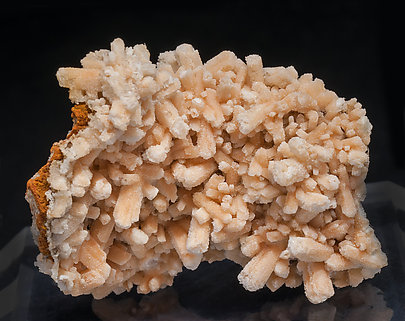
Front | 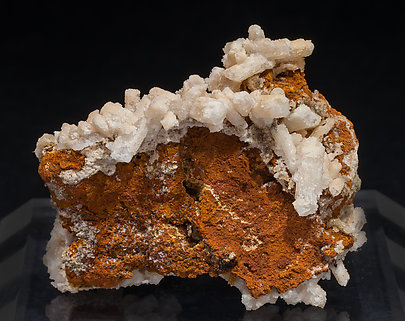
Rear |
| |
|
|
| Tarbuttite |
|
|
|
|
|
EB97AL9: Elongated crystals of Tarbuttite with sharp faces and edges, on a limonite matrix. Translucent, white and covered with small crystals of a second generation of lenticular crystals of the same Tarbuttite, with a color between reddish and creamy due to inclusions. The specimen, from the type locality for the species, is accompanied by a card from the prospector and collector, Dr. K.J. Reid, in which the date of the find is handwritten and signed.
Kabwe Mine (Broken Hill Mine), Kabwe (Kabwe-Ka Mukuba), Kabwe District, Central Province Zambia (07/1976)
Specimen size: 5 × 3.8 × 2 cm = 1.97” × 1.50” × 0.79”
Main crystal size: 1.1 × 0.4 cm = 0.43” × 0.16”
Type locality
Minor fluorescence short UV
Former collection of K.J. Reid
|
|
|
|
Pyromorphite |
|---|
|
|
TY26T3: Aggregate of very acute crystals with slightly curved faces and edges, with clear green color and white areas and on limonite matrix. We note the locality, where the Pyromorphite is a not so common.
The sample is from John Marshall’s collection, whose label and card we’ll send to the buyer.
Broken Hill Mine, Kabwe (Broken Hill), Central Province Zambia
Specimen size: 6.7 × 5.2 × 4.7 cm = 2.64” × 2.05” × 1.85”
Main crystal size: 1 × 0.3 cm = 0.39” × 0.12”
Minor fluorescence long & short UV
|
| |
|
| Quartz scepter (variety smoky and amethyst) |
|
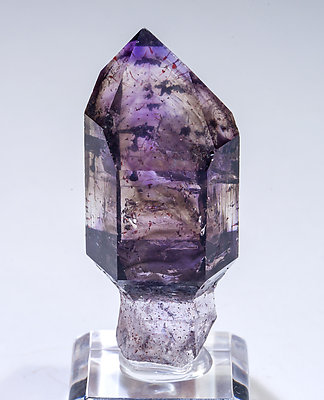
Front | 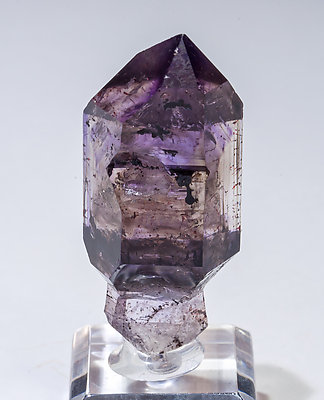
Rear |
| |
|
|
|
|
EA6AL8: Scepter growth of a transparent Quartz crystal very lustrous, with phantom growths, abundant inclusions and a very vivid amethyst color with smoky colored areas distributed irregularly in the crystal. Of the best possible quality for the locality, which is not very well known.
Chibuku Mine, Zambezi Valley, Mashonaland West Zimbabwe (2018)
Specimen size: 4 × 1.6 × 1.3 cm = 1.57” × 0.63” × 0.51”
Main crystal size: 3 × 1.6 cm = 1.18” × 0.63”
|
|
|
|
Quartz scepter (variety amethyst) |
|---|
|
|
EB16AL8: Scepter growth of a transparent Quartz crystal very lustrous, with phantom growths, abundant inclusions and a very vivid amethyst color with smoky colored areas distributed irregularly in the crystal. Of the best possible quality for the locality, which is not very well known.
Chibuku Mine, Zambezi Valley, Mashonaland West Zimbabwe (2018)
Specimen size: 4.2 × 1.4 × 1.2 cm = 1.65” × 0.55” × 0.47”
Main crystal size: 2.6 × 1.4 cm = 1.02” × 0.55”
|
| 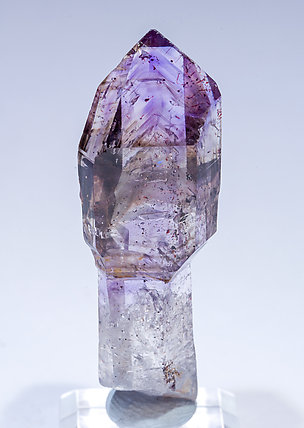
Front | 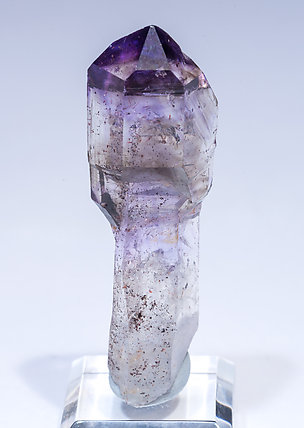
Rear |
| |
|
|
| Quartz scepter (variety amethyst) |
|
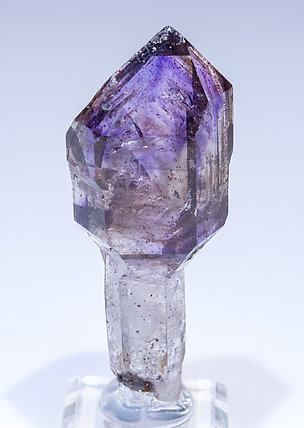
Front | 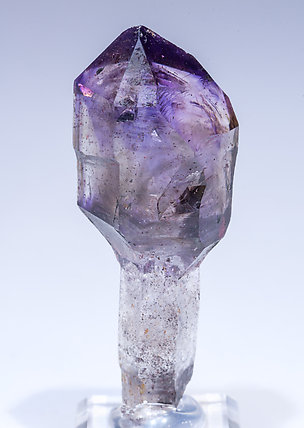
Rear |
| |
|
|
|
|
ED66AL8: Scepter growth of a transparent Quartz crystal very shiny, with phantom growths, abundant inclusions and a very vivid amethyst color with smoky colored areas distributed irregularly in the crystal. Of the best possible quality for the locality, which is not very well known.
This specimen has been published on the Mineralogical Record´s web page, in the ‘What's New’ section, report 57, August 30, 2020 edition, page 4
Chibuku Mine, Zambezi Valley, Mashonaland West Zimbabwe (2018)
Specimen size: 4.7 × 1.7 × 1.6 cm = 1.85” × 0.67” × 0.63”
Main crystal size: 2.9 × 1.7 cm = 1.14” × 0.67”
|
|
|
|
Quartz scepter (variety smoky and amethyst) |
|---|
|
|
EH97AL8: Scepter growth of a transparent Quartz crysta very lustrous, with phantom growths, abundant inclusions and a very vivid and deep amethyst colo with smoky areas distributed irregularly in the crystal. Of the best possible quality for the locality, which is not very well known.
Chibuku Mine, Zambezi Valley, Mashonaland West Zimbabwe (2018)
Specimen size: 8.3 × 2.8 × 2.6 cm = 3.27” × 1.10” × 1.02”
Main crystal size: 6 × 2.8 cm = 2.36” × 1.10”
|
| 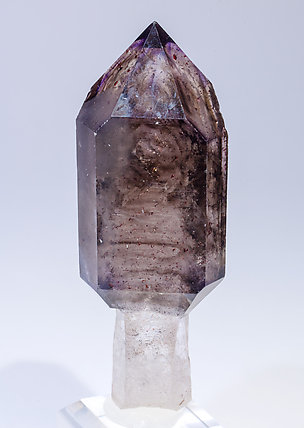
Front | 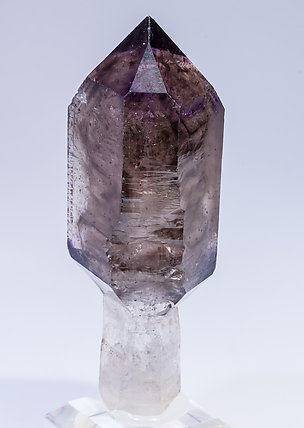
Rear |
| |
|
|
Very interesting novelty of 2007 Munich Show: trigonal crystals of Ilmenite transformed into an intimate intergrowth of Rutile and Hematite. Microscopic examination shows that Rutile (reddish) occurs as a delicate network of needles which are oriented parallel to the basal sections of the former Ilmenite, while Hematite (black) forms the interstices.
If you want to know more about Rutile and Hematite pseudomorph after Ilmenite please follow this link
| Rutile and Hematite pseudomorph after Ilmenite |
|
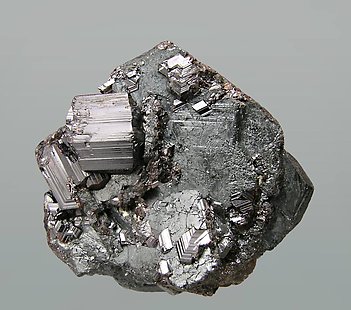
Front | 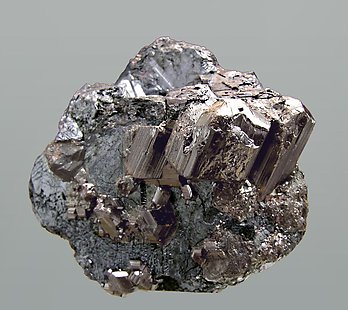
Rear |
| |
|
|
|
|
MC9K7: Epitaxial growth of red brilliant twinned Rutile on a doubly tabular former Ilmenite crystal pseudomorphed by Rutile and Hematite.
This specimen was published on the Mineralogical Record´s web page, in the ‘What's New’ section of the January 18, 2008 edition.
Mwinilunga District, North-Western Province Zambia (05/2007)
Specimen size: 3.8 × 3.3 × 2 cm = 1.50” × 1.30” × 0.79”
With analysis copy
|
|
|
|
Rutile and Hematite pseudomorph after Ilmenite |
|---|
|
|
MG62K7: Epitaxial growth of red brilliant twinned Rutile on a tabular former Ilmenite crystal pseudomorphed by Rutile and Hematite. The former Ilmenite is showing well-marked geometrical forms.
The specimen's photo has been reviewed and published in the magazine ‘Rocks & Minerals’ on page 174 in the volume 85, number 2 , in the magazine ‘Le Règne Minéral’ number 97, page 42, and in the magazine ‘extraLAPIS’ on page 49, number 43, "Pseudomorphosen".
Mwinilunga District, North-Western Province Zambia (05/2007)
Specimen size: 5.6 × 2.9 × 1.5 cm = 2.20” × 1.14” × 0.59”
With analysis copy
|
| 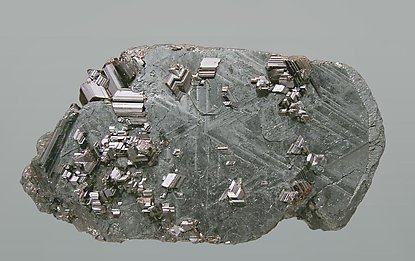
Front | 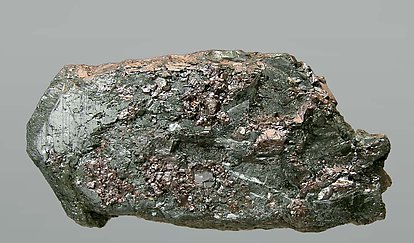
Rear | |
|
|
| Hematite after Ilmenite with Rutile |
|
|
|
|
|
MG56R5: Epitaxial growths of twinned deep red and bright Rutile crystals on a thick tabular crystal of Ilmenite pseudomorphed by Rutile and Hematite.
Mwinilunga District, North-Western Province Zambia (2005)
Specimen size: 11.4 × 5.6 × 1.7 cm = 4.49” × 2.20” × 0.67”
|
|
|





 Next Page


